
Vlad the Impaler and Dracula: history, legend and the castle
Who Vlad III, a 15th-century prince of Wallachia, really was, and how his name became Bram Stoker's vampire. On strigoi, his unknown grave and Bran Castle.
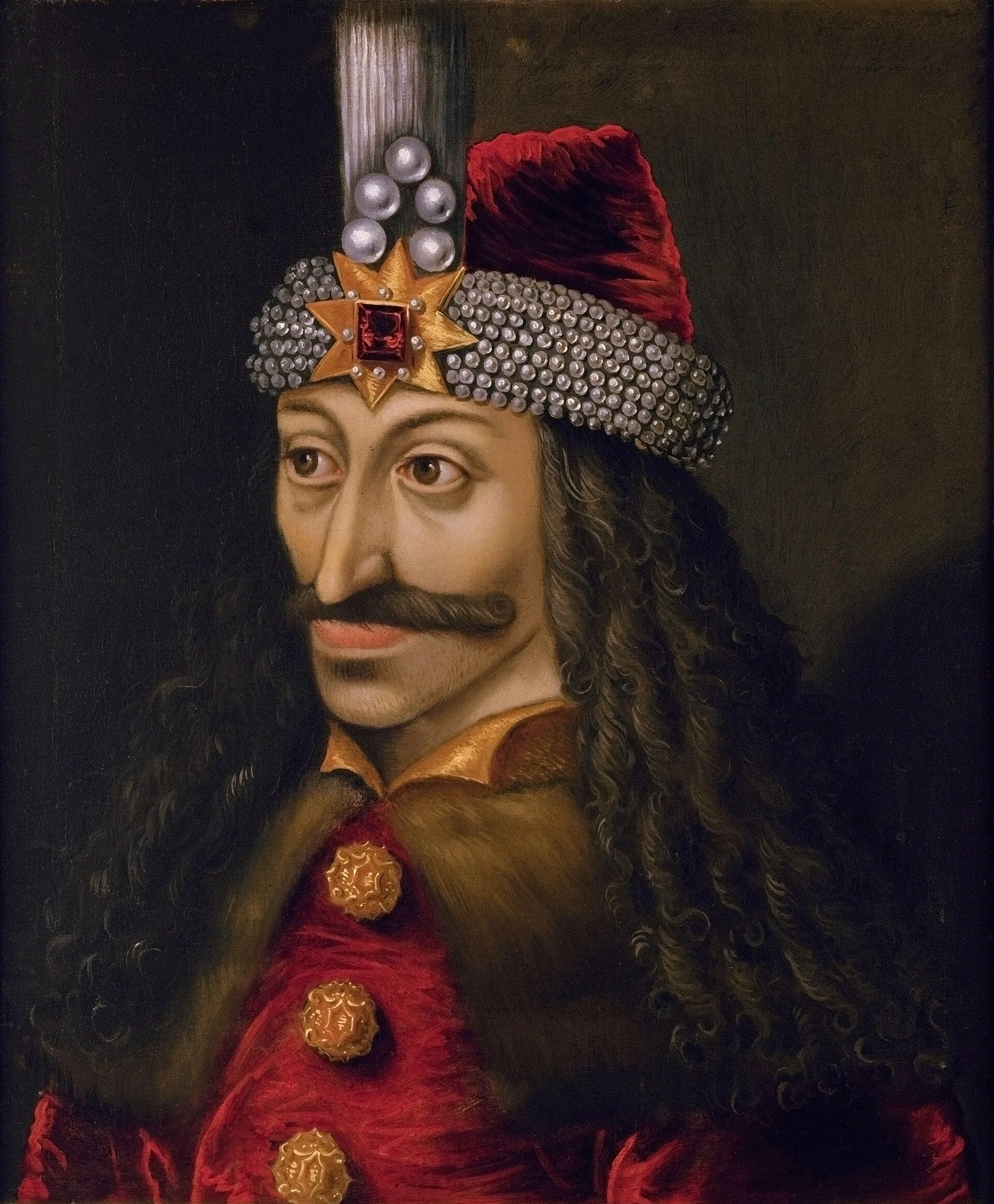
What history says
Vlad III ruled Wallachia three times: in 1448, from 1456 to 1462, and in 1476. His birth is not documented: historians place it between 1428 and 1431, and Radu Florescu writes that he was born in Sighișoara, where his father lived between 1431 and 1435. The name comes from his father, Vlad Dracul. The Order of the Dragon, created by King Sigismund of Luxembourg in 1408, admitted Vlad Dracul in 1431, in Nuremberg; hence the nickname "Dracul", meaning "of the Dragon". "Drăculea" means "son of Dracul". The nickname "Țepeș" (the Impaler) comes from impalement, a punishment he used often.
The princely residence was at Târgoviște, where, on the night of 16 to 17 June 1462, he attacked the camp of Sultan Mehmed II, but failed to capture him. Poienari Fortress, in the Argeș valley, is tied to his name: the Cantacuzino Chronicle says he made the boyars build it. At the end of 1462 he was arrested on the orders of King Matthias Corvinus and held captive until 1475. He died fighting Basarab Laiotă and the Ottomans in late December 1476 or early January 1477, near Snagov.
His burial place is unknown. Tradition, first recorded only in the late 19th century, places it at Snagov Monastery, but the excavations of archaeologist Dinu V. Rosetti in 1933 found no grave under the slab attributed to him, only animal bones. Historian Constantin Rezachevici argued that he was more probably buried at Comana Monastery, his own foundation, close to the battlefield. Both remain hypotheses.
How the vampire was born
Stories about his cruelty circulated during his lifetime. The first printed work about him appeared in Nuremberg in the autumn of 1488 and was followed by other editions. Historian Daniel Ursprung links them to the propaganda conflict between Emperor Frederick III and King Matthias Corvinus.
Bram Stoker's novel "Dracula", published in 1897, is the first book to link the name Dracula with vampirism. Elizabeth Miller (Memorial University of Newfoundland), who studied Stoker's working notes, shows that he knew very little about Vlad: nothing in the notes shows he even knew the historical figure was called Vlad. Stoker took the name Dracula and a few facts about Wallachia from William Wilkinson's book (1820), where a note explained the name as "devil".
Strigoi and moroi: a separate tradition
Romanian folk beliefs about strigoi and moroi are not the same as the literary vampire. Ethnologist Romulus Vulcănescu, cited by Mariana Cocieru, places them among the "archetypal demons of death", while other researchers note that it is hard to say whether the strigoi and the moroi are the same being or different ones. A field study among the Romanians of the Timok valley shows that a dead person becomes "restless" mainly when funeral rituals were not respected; it also describes the "living moroi", a living person regarded as restless dead.
Stoker learned of these beliefs indirectly, from the article "Transylvanian Superstitions" by Emily Gerard (1885), which spoke of "living and dead" vampires and of remedies such as a stake driven into the grave or garlic. Elizabeth Miller stresses that such beliefs were never connected to Vlad.
Bran Castle and the "Dracula" label
Bran Castle was built by the people of Brașov after a privilege issued by the chancellery of King Louis I of Anjou on 19 November 1377. Abroad it is marketed as "Dracula's castle". The castle's official website justifies the label by saying it is the only castle in Transylvania that matches Stoker's description and that it is "suspected" the writer used an illustration of Bran: these are tourism marketing claims, with no published evidence. The same website acknowledges that Stoker never visited Romania and that documents do not show that Vlad ever took the castle; his army passed through Bran in 1459, when he attacked Brașov. The site also states, with the words "it seems", that Vlad was imprisoned at Bran for two months in 1462; according to the chronicler Laonikos Chalkokondyles, he was jailed at Alba Iulia, then at Visegrád.
Where you can see it
Vlad Dracul House in the Sighișoara citadel now has a restaurant and a small weapons exhibition. In Târgoviște you can visit the Princely Court ensemble and the Chindia Tower (15th century, rebuilt in the 19th), with an exhibition about Vlad. The ruins of Poienari Fortress are reached by climbing 1,480 steps. Snagov Monastery, on an island in the lake, keeps the slab attributed to him, and Comana Monastery was rebuilt in the late 16th century on the site of his foundation. Bran Castle operates as a museum.
Places in this story
- Vlad Dracul HouseSighișoara, Mureș CountyCasa din cetatea Sighișoarei pe care tradiția o leagă de nașterea lui Vlad; azi restaurant cu o mică expoziție de arme la etaj.
- Târgoviște Princely Court (Chindia Tower)Târgoviște, Dâmbovița CountyRuinele reședinței domnești și Turnul Chindiei (sec. XV, refăcut în sec. XIX), cu expoziție despre Vlad Țepeș; administrat de Complexul Național Muzeal „Curtea Domnească”.
- Poienari FortressCăpățânenii Ungureni, comuna Arefu, Argeș CountyRuinele cetății de pe valea Argeșului, legată de Vlad Țepeș; acces pe o scară de 1.480 de trepte.
- Snagov MonasterySnagov, comuna Snagov, Ilfov CountyMănăstire pe o insulă a lacului Snagov; în biserică se află lespedea atribuită de tradiție lui Vlad, sub care săpăturile din 1933 nu au găsit mormânt.
- Comana MonasteryComana, comuna Comana, Giurgiu CountyCtitorie a lui Vlad Țepeș, refăcută la sfârșitul sec. XVI de Radu Șerban; istoricul Constantin Rezachevici a propus-o ca loc probabil de înmormântare (ipoteză).
- Bran CastleBran, comuna Bran, Brașov CountyCastel-muzeu promovat turistic drept „castelul lui Dracula”; documentele nu atestă că Vlad l-ar fi stăpânit, iar Stoker nu a vizitat România.
Sources
- Constantin Rezachevici, „From the Order of the Dragon to Dracula”, Journal of Dracula Studies 1 (1999), text republished
- Journal of Dracula Studies, vol. 1 (record of the Rezachevici article)
- Interview with Elizabeth Miller, PBS Frontline/World „Romania: My Old Haunts”
- Daniel Ursprung, „Propaganda and Popularization: the Printed Stories about Vlad Țepeș in the Context of 1488”, Analele Putnei XIV (2018), 1, pp. 45–60
- Emily Gerard, „Transylvanian Superstitions” (1885), Project Gutenberg #52165
- Mariana Cocieru, „Demonologia funerară: precizări conceptuale și tipologii ale ființelor arhetipale asociate morții”, Limbă, literatură, folclor 2025, nr. 2, pp. 150–159
- Ivan Strutynsky, „Representations of the Restless Dead among the Romanians of the Timok Valley”, Kunstkamera 2023, 2(20): 153–163
- Castelul Bran, site oficial: Count Dracula
- Castelul Bran, site oficial: Historical Chronology
- Eduard Niculescu, „Unde se află mormântul lui Vlad Țepeș?”, Newsweek România, 9 ianuarie 2024
- Wikipedia (en): Vlad the Impaler
- Wikipedia (en): Bran Castle; Comana Monastery; Snagov Monastery; Poenari Castle; Vlad Dracul House
- Wikipedia (ro): Turnul Chindiei; Mănăstirea Snagov; Mănăstirea Comana
- Wikipedia (ro): Liste ale monumentelor istorice (Mureș S, Dâmbovița T, Argeș C, Ilfov, Giurgiu, Brașov B)