
The Pietroasa Treasure: the "Hen with the Golden Chicks" and its journey of almost two centuries
Found in 1837 by two peasants on Istrița hill (Buzău), the gold hoard was hacked with an axe, stolen in 1875, sent to Moscow in 1917 and returned in 1956. Who buried it, and when, is still debated.
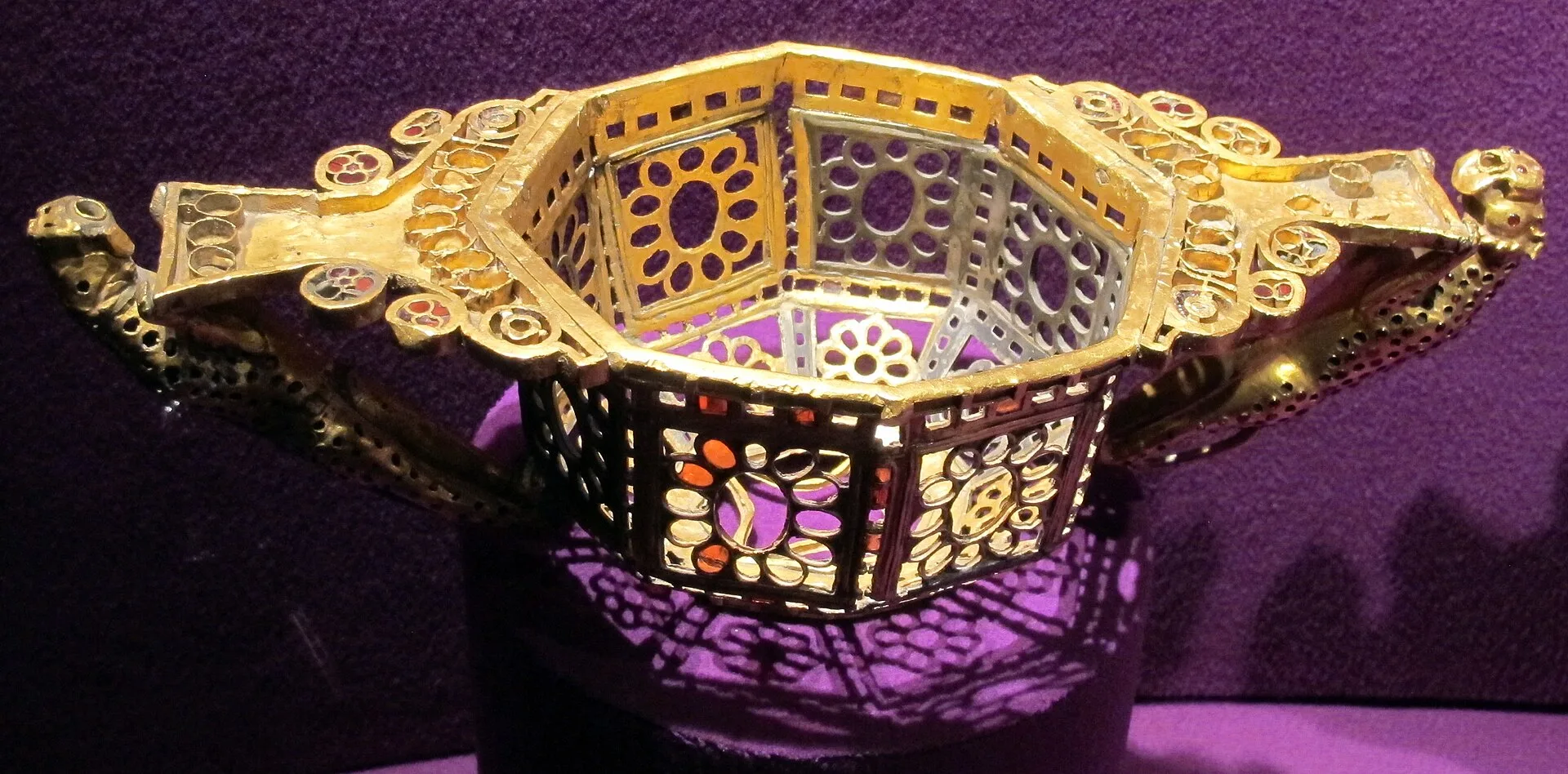
The 1837 discovery
In spring 1837 (March-April, according to the National Museum of Romanian History), two peasants from Pietroasa, Ion Lemnaru and Stan Avram, were quarrying stone on Istrița hill in Buzău County. They came upon a hoard of gold objects: vessels and jewellery, some set with coloured stones. According to the testimonies gathered later, the treasure originally had 22 pieces.
The two sold the objects to the contractor Atanasie Verussi, who was supervising the building of a bridge over the Câlnău stream. To make them more compact and easier to carry, he hacked them with an axe. The find became public in 1838, and the authorities recovered only 12 pieces, weighing almost 19 kg in total, mainly thanks to the interest of Mihalache Ghica, brother of the reigning prince Alexandru Ghica. The other ten pieces were lost.
What survived
Of the 12 pieces, five are made of gold alone: a large tray (broken into four shortly after the find), a jug (oenochoe), a patera with figures in relief and a statuette in the centre, an inscribed neck ring and a plain neck ring. The other seven are also set with stones: a hinged collar, four fibulae (brooches) and two polygonal vessels, one eight-sided and one twelve-sided.
The popular name, "Cloșca cu puii de aur" ("the hen with the golden chicks"), comes from the fibulae, which are shaped like stylised birds: the large fibula is the "hen" and the others are the "chicks".
Theft, fire and Moscow
For the 1867 Universal Exhibition in Paris the pieces were restored by a Parisian jeweller, supervised by Alexandru Odobescu, who later wrote a three-volume monograph on the treasure ("Le trésor de Pétrossa", 1889-1900).
At the end of November 1875 the treasure was stolen from the Museum of Antiquities, then housed in the University building in Bucharest. The thief, Dumitru Pantazescu, was caught and the pieces were recovered by early 1876, but some had been badly damaged. The inscribed neck ring suffered most: much of it was melted down and the inscription survives split between two fragments.
In 1884, during a fire, the treasure was thrown out of a window to save it. The same year it was restored in Berlin by the goldsmith Paul Telge, and the pieces largely owe their present appearance to this restoration. In 1917, during the First World War, the treasure was sent to Moscow together with Romania's national treasury. It came back only in 1956, when the Soviet Union returned the artistic valuables sent at that time.
The runic inscription and the question of ownership
The inscription on the neck ring is written in runes (the old Germanic runic alphabet) and has been the most studied piece of the treasure. Because one rune was almost destroyed when the ring was cut, the reading is uncertain. The National Museum of Romanian History considers the most likely reading to be "Gutan(e) Iowi hailag", translated "to the Jupiter of the Goths, consecrated". Other specialists have proposed different readings, for example "sacred and inviolable inheritance of the Goths". Scholars nevertheless agree that the language is a form of Gothic and that the text has a religious meaning ("hailag" means "holy").
Who buried the treasure, and when, is still debated. In the 19th century it was attributed to Athanaric, one of the leaders of the Visigoths, who would have hidden it before leaving for the Roman Empire (at the latest in 381, when he reached Constantinople). Archaeological study of the pieces suggests a later date, however: the patera would have been made around 360, the jug at the end of the 4th or the beginning of the 5th century, and the fibulae, neck rings and polygonal vessels probably in the first half of the 5th century. In that case the hoard would have been buried in the first half or the middle of the 5th century and could be attributed to the Ostrogoths. There is no definitive answer.
Where you can see it
The original pieces are at the National Museum of Romanian History (Calea Victoriei 12, Bucharest), in the permanent Historical Treasury exhibition. Check before your visit which rooms are open.
At Pietroasa Mică (Pietroasele commune, Buzău County), the find spot is marked by a monument and an amphitheatre with pieces of the treasure carved in stone, which can be visited. In the centre of Pietroasele village lies the site of a Roman fort: restored sections of its southern wall can be seen in the central park and in the town hall yard, while the rest of the fort lies under houses. Any link between the fort and the treasure is only a hypothesis. At the Buzău County Museum you can see a copy of the treasure, made by electroforming in Paul Telge's workshop.
Places in this story
- National Museum of Romanian History (Historical Treasury exhibition)București (Calea Victoriei 12, sector 3), București CountyAici sunt expuse cele 12 piese originale ale tezaurului, în expoziția permanentă Tezaur Istoric (verifică înainte ce săli sunt deschise).
- Find spot of the treasure ("Hen with the Golden Chicks" monument)Pietroasa Mică, comuna Pietroasele, Buzău CountyLocul unde a fost găsit tezaurul în 1837, marcat cu un monument și un amfiteatru cu piese ale tezaurului sculptate în piatră; vizitabil (acces pe DJ203C).
- Roman fort of PietroaselePietroasele, comuna Pietroasele, Buzău CountySit de castru roman (LMI BZ-I-m-A-02263.02) în vatra satului; porțiuni restaurate ale zidului de sud se văd în parcul central și în curtea primăriei, restul e sub case. Legătura cu tezaurul este o ipoteză.
- Buzău County MuseumBuzău (Bd. Nicolae Bălcescu 50), Buzău CountyPăstrează o copie galvanoplastică a tezaurului, realizată în atelierul lui Paul Telge (după Consiliul Județean Buzău); originalele sunt la MNIR.
Sources
- Muzeul Național de Istorie a României: Tezaurul de la Pietroasa (descoperire, componență, datare, inscripție, furt 1875, Telge 1884, Moscova 1917-1956)
- MNIR: Tezaurul de la Pietroasa, fișa de expoziție (texte Rodica Oanță-Marghitu): mijlocul sec. V, 22/12 piese, Verussi, restaurări
- MNIR: Expoziția permanentă Tezaur Istoric (include tezaurul de la Pietroasa)
- MNIR: Expoziția „Mari Tezaure Românești – Tezaurul de la Pietroasa” (2012): evacuat la Moscova, revenit în 1956
- Consiliul Județean Buzău: Tezaurul de la Pietroasele (Poiana Crudului, monument și amfiteatru, copia Telge la Muzeul Județean Buzău)
- Repertoriul Arheologic Național, sit 48496.04 „Ansamblul arheologic Pietroasele” (castru, terme, necropolă; LMI BZ-I-s-A-02263)
- Lista monumentelor istorice din județul Buzău – P (Wikipedia, după LMI): BZ-I-m-A-02263.02 Castru roman
- Ring of Pietroassa (Wikipedia en): inscripția runică și variantele de lectură, ipotezele despre proprietar
- Tezaurul de la Pietroasa (Wikipedia ro): furtul din 1875 (Dumitru Pantazescu), transportul la Moscova
- Pietroasele Treasure (Wikipedia en)