
UNESCO
The Dacian Fortresses of the Orăștie Mountains
Six Dacian fortresses in the Orăștie Mountains (Sarmizegetusa Regia, Costești-Cetățuie, Costești-Blidaru, Piatra Roșie, Bănița and Căpâlna), the core of the Dacian Kingdom. Inscribed on the UNESCO World Heritage List.
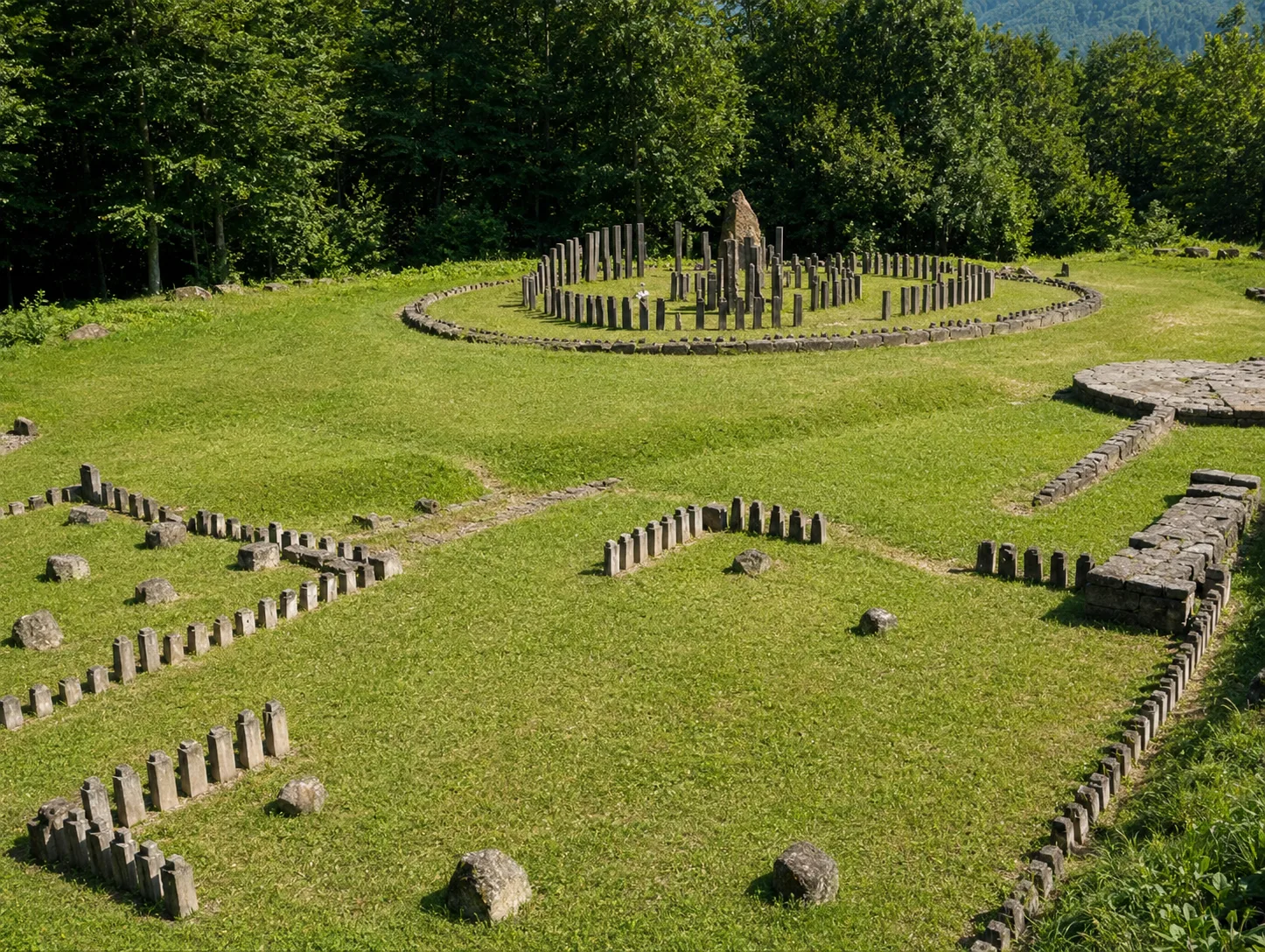
The Dacian Fortresses of the Orăștie Mountains comprise six strongholds built by the Dacians between the 1st century BC and the 1st century AD, inscribed on the UNESCO World Heritage List in 1999. Five lie in Hunedoara County — Sarmizegetusa Regia, Costești-Cetățuie, Costești-Blidaru and Piatra Roșie at Luncani, together with Bănița — while the sixth, Căpâlna, stands in Alba County. Together they formed the defensive system of the Dacian Kingdom in the time of King Decebalus.
At the heart of the ensemble is Sarmizegetusa Regia, the political, military and religious capital of the Dacian state, set at over 1,000 metres in the Șureanu Mountains. It encompassed the fortress itself, an extensive civilian settlement and a sacred precinct, whose circular and rectangular sanctuaries rank among the most significant testimonies of Dacian spirituality.
The fortifications were built using a technique known as murus dacicus, in which two parallel walls of dressed limestone blocks were tied together with wooden beams and filled with earth and stone, producing enclosures of great strength. Placed on heights that were difficult to reach, the fortresses commanded the valleys and ridge paths, guarding the approaches to the capital.
Beyond their military role, these sites served administrative, economic and religious functions, housing the nobility, craft workshops and places of worship. Conquered by the Romans at the end of the Dacian Wars in 106 AD, they remain the foremost testimony of classical Dacian civilisation.