
Attraction
The Devil's Lake, Covasna
A muddy pool kept bubbling, though cold, by gas from the ground, in the centre of Covasna.
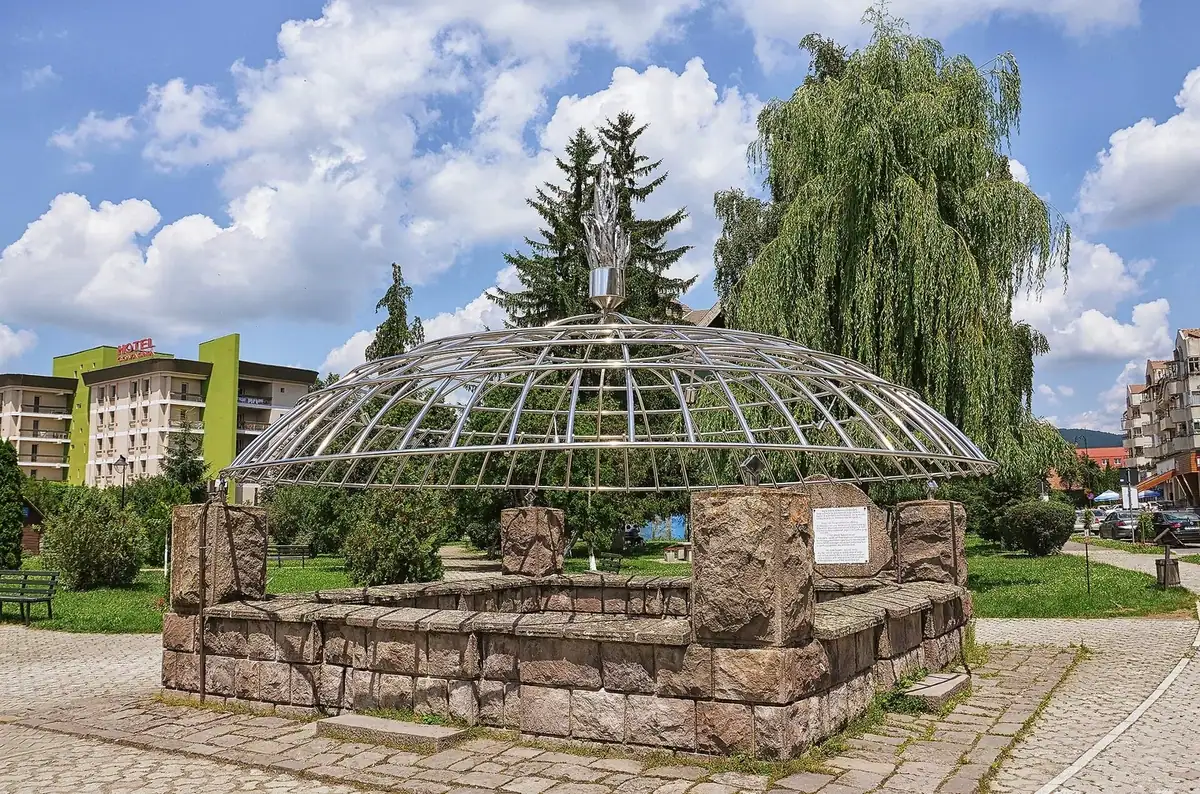
Foto: Pasztilla aka Attila Terbócs, CC BY-SA 4.0, via Wikimedia Commons
In the park in the centre of Covasna, a stone basin under a metal dome encloses the Devil's Lake (Balta Dracului), the symbol of the town. In Hungarian it is called Pokolsár, meaning hell's mud. The yellowish water seethes but is not hot: at the first analysis, in 1890, it measured 15.5 degrees.
What moves it is gas left over from the old volcanoes of the area, almost entirely carbon dioxide, rising through mineral water and mud. The first description of the place dates from 1818. Its outbursts were noted several times in the 19th century, the biggest in 1837. People once threw in hundreds of cartloads of stone and sand to calm it, then used it as a bath against rheumatism. The last big outburst of gas was in 1984.
Today the pool lies quietly under a grille and can be seen in passing, free, on any day. You can hear the bubbles from beside the stone edge. Do not lean over it: carbon dioxide, heavier than air, gathers above the water. A plaque in four languages explains what it is.
Did you know that, according to old accounts, in the 1700s the pool lay further north, and when it moved to the centre it left a smaller one behind, called the Little Devil's Lake?
Centrul orașului Covasna, județul Covasna