
Histria, the Greek city the sea left behind
Founded by colonists from Miletus in the 7th century BC, Histria was inhabited for about 13 centuries. What we know of its beginnings, why it was abandoned and what the excavations begun by Vasile Pârvan in 1914 have uncovered.
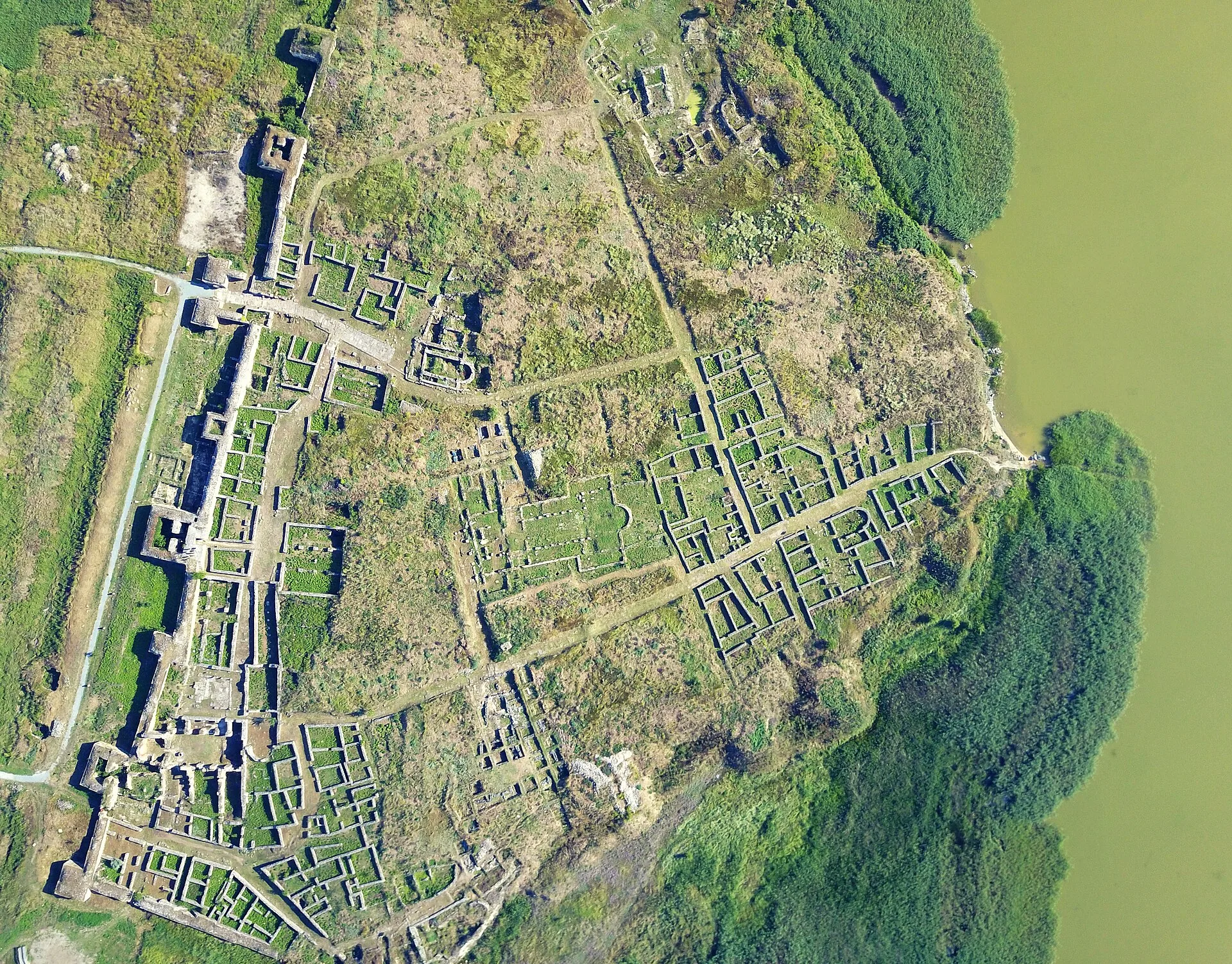
The oldest Greek colony on this coast
Histria (Istros or Istrie in Greek) was founded by colonists from Miletus, a Greek city on the coast of Asia Minor. Its name comes from Istros, the Greek name of the Danube. Herodotus, in the 5th century BC, already wrote that the Danube flows into the Euxine Sea "at Istria, which is inhabited by Milesian colonists" (Histories II.33). The National History and Archaeology Museum of Constanța (MINAC) describes it as the oldest Greek colony on the western shore of the Black Sea.
When it was founded, and how sure that is
The usual date, 657–656 BC, comes from the Chronicle of Eusebius of Caesarea, in Jerome's Latin version, which records under that year: "Histrus civitas in Ponto condita" (the city of Histrus was founded in the Pontus). This is also the date given by MINAC. Another ancient author, known as Pseudo-Scymnus, gives a somewhat later date, around 630 BC. Archaeology cannot fix the exact year: the oldest pottery from the city's Sacred Area is dated to the last quarter of the 7th century BC. What is certain is only the century: the second half of the 7th century BC.
Greeks, Romans and the last inhabitants
The Greek city had an acropolis on a rocky promontory, holding the Sacred Area, and a civil quarter on the plateau to the west. Around the middle of the 6th century BC stone temples were built here, among them those of Aphrodite and Zeus. In the 5th century BC the city struck its own silver coins, showing an eagle gripping a dolphin and the name IΣTPI.
After the campaign of the proconsul Marcus Licinius Crassus in 29–28 BC, Histria came under Roman domination. In the Roman period a new city wall, baths and other public buildings were built. An inscription from around AD 100, by the governor Manius Laberius Maximus, confirmed the limits of Histria's territory as far as the Danube Delta and noted that the city's income came almost entirely from salted fish. After the destructions of the 3rd century the city shrank back onto the old promontory, to about 7 hectares, inside a new wall. In the 4th–6th centuries it was a Christian centre: archaeologists have found six basilicas, including a large 6th-century episcopal basilica.
Why it was abandoned
Histria was inhabited for about 13 centuries. It was abandoned in the 7th century AD, and the sources point to two causes. The first is the invasions of the Avars and Slavs in that century. The second is the change of the coastline. A geomorphological study published in 2013 (Vespremeanu-Stroe and colleagues) shows that sediment from an old Danube branch 10–20 km to the north was carried south by the waves and built a continuous belt of sand ridges in front of the city, cutting it off from the open sea. The abandonment coincides with this isolation. The former bay is today Lake Sinoe, and part of the remains now lie under water.
Vasile Pârvan's excavations
The ruins were identified in the second half of the 19th century. Systematic research was begun in 1914 by Vasile Pârvan, who that year explored the wall of the late Roman city with a trench; between 1915 and 1927 he uncovered the baths. After his death in 1927 the excavations were led in turn by Scarlat Lambrino, Emil Condurachi, Dionisie M. Pippidi, Petre Alexandrescu and Alexandru Suceveanu. Research continues today, coordinated by the "Vasile Pârvan" Institute of Archaeology in Bucharest. Over more than a hundred years, walls from every ancient period, temples, baths and a cemetery of about 1,000 burial mounds (tumuli) have been found, and the results have been published in 15 monograph volumes.
Where you can see it
The Histria fortress lies on the shore of Lake Sinoe, near the village of Istria (Istria commune, Constanța County), and is part of the Histria Museum Complex run by MINAC. In the open air you can visit the late Roman city wall with its towers, the paved streets, the Sacred Area with its Greek temples, the baths and the basilicas, including the episcopal basilica.
The museum next to the site, opened in 1982, displays objects found in the excavations: pottery, coins, statuettes, inscriptions, architectural fragments and other objects from the Greek, Roman and Byzantine periods.
Places in this story
- Histria fortress (archaeological site)Istria, comuna Istria, Constanța CountyRuinele orașului greco-roman pe malul lacului Sinoe (LMI CT-I-s-A-02681): zidul cetății romane târzii, Zona sacră cu temple grecești, terme, bazilica episcopală; parte din Complexul Muzeal Histria (MINAC).
- Histria Museum (Histria Museum Complex)Istria, comuna Istria, Constanța CountyMuzeul de sit deschis în 1982, subordonat MINAC: ceramică, monede, statuete, inscripții și piese de arhitectură descoperite la Histria.
Sources
- MINAC: Complexul Muzeal Histria (657–656 î.Hr., Pârvan 1914, conducătorii șantierului, descoperiri, golful devenit lacul Sinoe)
- MINAC: Exponatul lunii august 2025, didrahme bătute la Istros în epoca clasică
- MINAC: Program și tarife (Complexul Muzeal Histria: muzeu și cetate)
- Repertoriul Arheologic Național (RAN 62039.01 / LMI CT-I-s-A-02681): Situl arheologic de la Histria - Cetate
- Eusebiu/Ieronim, Cronica (trad. engl. și text latin, tertullian.org): „Histrus civitas in Ponto condita”, 657 î.Hr.
- Herodot, Istorii II.33 (trad. A. D. Godley, Perseus Digital Library)
- Vespremeanu-Stroe A. et al. (2013), The impact of the Late Holocene coastal changes on the rise and decay of the ancient city of Histria, Quaternary International 293 (rezumat)
- Lista monumentelor istorice din județul Constanța (Wikipedia, după LMI)
- Histria (ancient city) (Wikipedia en): Pseudo-Scymnos 630 î.Hr., 29 î.Hr., inscripția lui Laberius Maximus, avari și slavi, Desjardins 1868
- Histria (Wikipedia ro): suprafața de circa 7 ha a orașului târziu, muzeul din 1982