
Zalmoxis, god of the Getae: what the sources say and what is legend
Herodotus and Strabo are the main ancient sources on Zalmoxis, the Getic god who promised immortality. Here is what they actually wrote, what is a Greek tale, and what archaeology can and cannot prove.
What history says
The oldest account of Zalmoxis comes from Herodotus, a Greek historian of the 5th century BC, in Book IV of his "Histories" (chapters 93–96). Describing the campaign of the Persian king Darius, he writes that the Getae, "the bravest and most just Thracians of all", believed they did not die: whoever perished went to the god Zalmoxis, whom some of them also called Gebeleizis (IV.94).
He also describes a ritual. At a set interval (every five years in some translations, every four in others), the Getae chose a man by lot and sent him as a messenger to Zalmoxis with their requests. Some men held three spears, while others tossed the messenger into the air so that he fell onto the points. If he died, the god was favourable; if not, he was judged a bad man and another was sent. Herodotus adds that during thunder and lightning these Thracians shot arrows at the sky, threatening the god, since they believed in no god but their own.
The story of Pythagoras' slave
Separately, Herodotus repeats a story he had heard from the Greeks living by the Hellespont and the Black Sea (IV.95). According to this story, Zalmoxis was a man, a slave on the island of Samos to Pythagoras, son of Mnesarchus. Once freed and wealthy, he went home, built a hall where he feasted the leading men and taught them that they and their descendants would not die but would go to a place where they would live forever. Meanwhile he had an underground dwelling made, where he hid for three years; the Thracians mourned him as dead, and in the fourth year he reappeared, so they believed what he had taught them.
Herodotus himself keeps his distance from the story (IV.96): he says he neither disbelieves nor fully believes it, that in his view Zalmoxis lived many years before Pythagoras, and that he leaves aside the question of whether he was a man or a god of the Getae.
The Greek geographer Strabo takes up the tradition in his "Geography" (VII.3.5) with other details: Zalmoxis learned about the heavenly bodies from Pythagoras, travelled as far as Egypt, then became a priest and adviser to the king, and was eventually called a god. He lived in a cave-like place on a mountain held sacred, called Kogaionon (like the river beside it). Strabo adds that the custom lasted into his own time: under King Burebista the office was held by Deceneus.
How scholars have interpreted him
Where Kogaionon was is not known. Several Carpathian mountains have been proposed (for example Gugu peak, near the Sarmizegetusa area), but these remain hypotheses. Mircea Eliade noted that the name, attested only in Strabo, "is suspect".
Eliade devoted a long study to Zalmoxis in "De la Zalmoxis la Genghis-Han" (published in French in 1970 as "De Zalmoxis à Gengis-Khan"). His interpretation is that the banquet hall, the hiding in the underground dwelling and the reappearance bring Zalmoxis close to the Greek mystery cults: an initiation involving a ritual "death" followed by a "rebirth". Other scholars are more cautious: Dan Dana considers Herodotus the only truly relevant ancient source on Zalmoxis, which means any reconstruction of the cult remains an interpretation.
What archaeology can tell us
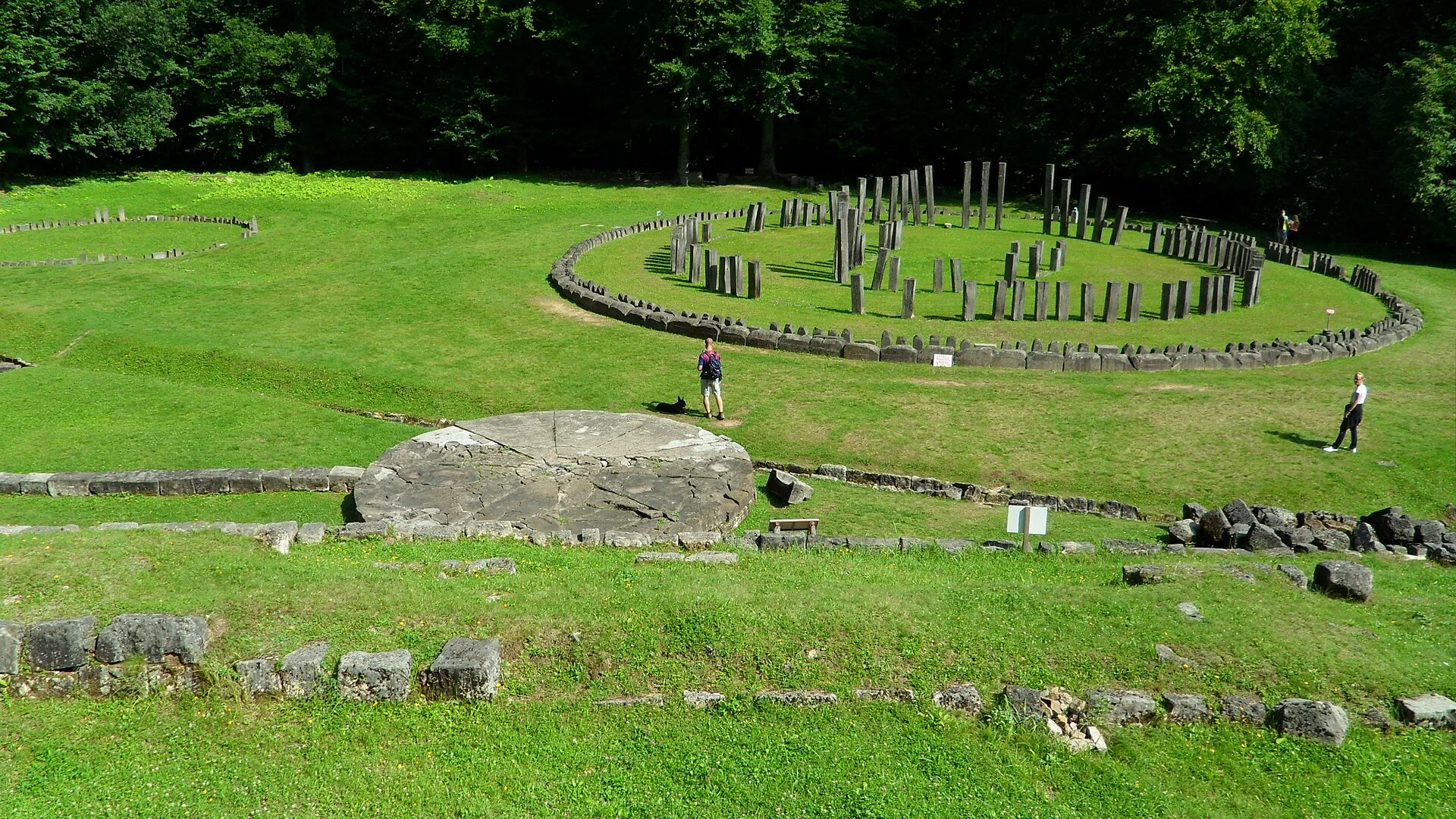
At Sarmizegetusa Regia, in the Orăștie Mountains, about 100 metres east of the fortress gate, lies the sacred area of the Dacian capital: several rectangular sanctuaries, two circular sanctuaries and a sun-shaped andesite pavement. Sarmizegetusa Regia is considered the most important religious, military and political centre of the Dacians before the wars with Rome. Yet it is not known to whom the sanctuaries were dedicated. Eliade himself wrote: "We do not know which god or gods were worshipped in these sanctuaries." Linking them to Zalmoxis is therefore an interpretation, not a proven fact.
Where you can see it
The sacred area of Sarmizegetusa Regia (Grădiștea de Munte, Hunedoara County) can be visited: the sanctuaries are in the open air, and the site belongs to the "Dacian Fortresses of the Orăștie Mountains", a UNESCO World Heritage property. Opening times may be reduced during restoration works, so check before you go.
The Museum of Dacian and Roman Civilisation in Deva, which manages the site, is housed in the Magna Curia palace and holds in its archaeology collection objects found at Sarmizegetusa Regia and in the surrounding area. Exhibitions change, so check what is on display when you visit.
Places in this story
- Sacred area of Sarmizegetusa RegiaGrădiștea de Munte, comuna Orăștioara de Sus, Hunedoara CountyPrincipalul centru religios dacic cunoscut: sanctuare dreptunghiulare și circulare și „soarele” de andezit, în aer liber; legătura cu Zalmoxis este o interpretare, nu un fapt dovedit.
- Museum of Dacian and Roman Civilisation (Magna Curia)Deva, Hunedoara CountyMuzeul care administrează Sarmizegetusa Regia; colecția de arheologie include piese descoperite la Sarmizegetusa Regia și în Munții Orăștiei (expozițiile se schimbă).
Sources
- Herodot, Istorii IV.93–96 (trad. A. D. Godley, Perseus Digital Library)
- Strabon, Geografia VII.3 (trad. H. L. Jones, LacusCurtius), §5 despre Zalmoxis, Kogaionon și Deceneu
- Mircea Eliade, De Zalmoxis à Gengis-Khan (Payot, 1970); ed. rom. De la Zalmoxis la Genghis-Han, Humanitas, 1995 (cap. „Zalmoxis”, pp. 51, 63–64, 68–69, 77), fișă bibliografică DAI Zenon
- Muzeul Civilizației Dacice și Romane Deva: Sarmizegetusa Regia (LMI HD-I-s-A-03190, UNESCO)
- MCDR: Informații pentru vizitatorii Sarmizegetusa Regia (program redus în timpul lucrărilor)
- MCDR: Piese reprezentative din colecția de arheologie a muzeului (Magna Curia)
- MCDR: Aspecte din viața dacilor din Munții Orăștiei (piese de pe terasele Sarmizegetusei Regia)
- Lista monumentelor istorice din județul Hunedoara (Wikipedia, după LMI)
- Sarmizegetusa Regia (Wikipedia ro): zona sacră, sanctuare, soarele de andezit
- Sarmizegetusa Regia (Wikipedia en): cel mai important centru militar, religios și politic al dacilor
- Zalmoxis (Wikipedia en): Dan Dana despre Herodot ca sursă unică
- Kogaionon (Wikipedia en): localizare nesigură, ipoteza Gugu