
Ulpia Traiana Sarmizegetusa, capital of Roman Dacia
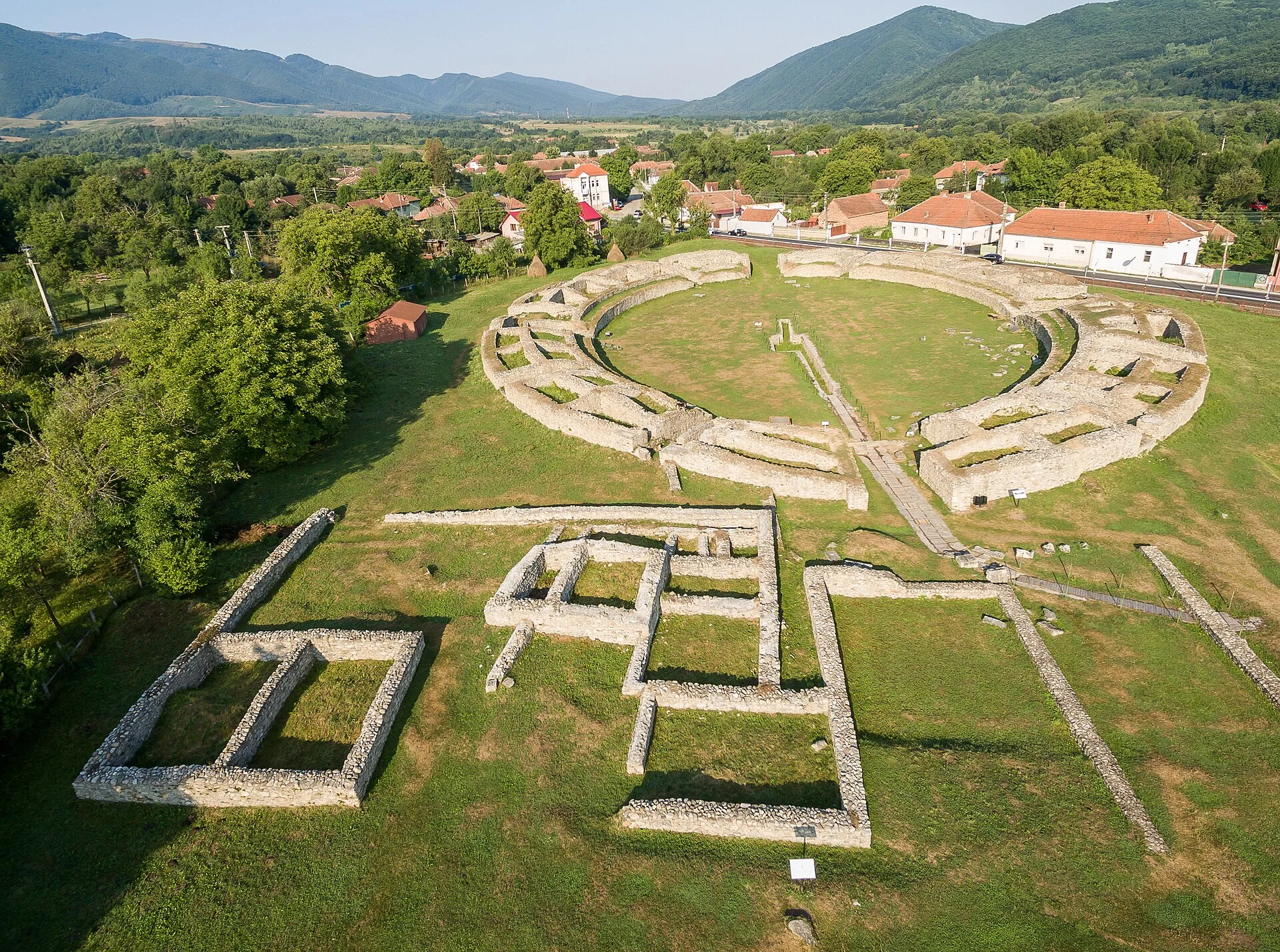
After the conquest of 106, the Romans founded the capital of Dacia in the Hațeg Country: Colonia Ulpia Traiana Augusta Dacica Sarmizegetusa. Its forum, amphitheatre and temples can be seen today, 42 km from Sarmizegetusa Regia.
The capital of a new province
After Emperor Trajan conquered the Dacian kingdom in 106, the Romans founded in the Hațeg Country the capital of the new province of Dacia, the only town Trajan founded there. Its full name was Colonia Ulpia Traiana Augusta Dacica Sarmizegetusa. It should not be confused with Sarmizegetusa Regia, the capital of the Dacian kings in the Orăștie Mountains, about 42 km away in a straight line: the Romans built a new town elsewhere but gave it the name of the old capital.
An inscription known from old copies, two fragments of which were found in the town's forum in the 1990s, says the colony was founded on Trajan's orders through the governor Decimus Terentius Scaurianus. The exact year is unknown: the inscription is fragmentary, and specialists propose dates between 106 and 112. The first builders were soldiers of the Fourth Legion Flavia Felix. The town was founded directly with the rank of colonia, which other Roman towns reached only after a long "career"; it later received the "ius Italicum", which brought tax exemptions, and was the only town in Dacia called "metropolis". Its walls, about 500 by 600 m, enclosed some 33 hectares, and settlement extended beyond them.
The forum and the "Palace of the Augustales"
The forum was the heart of the town, at the crossing of the two main streets. It was entered through a monumental four-pillared gate flanked by public fountains. The courtyard was paved with marble and held statues of emperors, of which fragments in gilded bronze survive. Beyond lay the basilica, where the town's two chief magistrates sat in judgement, and the curia, the town council's hall, with two vaulted treasury rooms below.
Constantin Daicoviciu and Octavian Floca, who excavated here from 1924, interpreted the building as the "Palace of the Augustales". Later research showed that it is the forum of the colony. The seat of the Augustales (aedes Augustalium), an association of wealthy residents, was only one hall of the forum, built by Marcus Procilius Nicetas and his sons, most likely in the late 2nd century. South of this forum there was a second one, from the reign of Antoninus Pius, with a Capitolium.
The amphitheatre and the temples
The amphitheatre, outside the walls, measures 88 by 69 m and held about 5,000 spectators. It was first built of wood and later rebuilt in stone on the same outline. The front rows, on stone benches, were for members of the town council, some seats being reserved by inscriptions. Beneath the arena was a room that probably housed a stage-effects machine (pegma), known from an inscription naming C. Valerius Maximus.
Next to the amphitheatre lay a sacred area, only partly excavated: the temple of Nemesis, protector of gladiators, the sanctuary of Aesculapius and Hygieia, gods of medicine, the Great Temple and the temple of Silvanus. Outside the walls, a temple of the Syrian gods and one of Mithras were also excavated.
After 271
The Roman army and administration withdrew south of the Danube in 271-275, but the town was not abandoned at once. At some point in the 4th century, the remaining inhabitants blocked the amphitheatre gates with gravestones brought from the cemeteries, turning it into a stronghold. A building from the late 4th and early 5th century is the last trace of ancient settlement. The ruins then served as building material: Roman pieces can be seen in churches of the Hațeg Country, for example at Densuș. The village was called Grădiște and took the name Sarmizegetusa only in modern times.
The excavations
The ruins were recognised as early as around 1500. The first systematic excavations were made in the 19th century by Hungarian archaeologists from Deva (the History and Archaeology Society, founded in 1880). From 1924 Constantin Daicoviciu and the University of Cluj team dug here, and after 1973 the Cluj school resumed work, with large-scale excavations in the forum in the 1990s. Much of the town has still not been excavated.
Where to see it
The Ulpia Traiana Sarmizegetusa archaeological site, in the village of Sarmizegetusa (Hunedoara County), is an open-air site: the forum, the recently restored amphitheatre, the sacred area and the palace of the financial procurator. The Sarmizegetusa Archaeology Museum, right next to the site, holds finds from here and has a lapidarium with large marble monuments in its courtyard.
Places in this story
- Ulpia Traiana Sarmizegetusa archaeological site: the forumSarmizegetusa, comuna Sarmizegetusa, Hunedoara CountyForul lui Traian, centrul orașului roman: curtea pavată, basilica, curia; aici s-au găsit fragmentele inscripției de întemeiere. Sit în aer liber (LMI HD-I-s-A-03205).
- Amphitheatre of Ulpia Traiana SarmizegetusaSarmizegetusa, comuna Sarmizegetusa, Hunedoara CountyAmfiteatrul de circa 5.000 de locuri, din lemn la început, apoi din piatră; restaurat și redeschis vizitatorilor. Lângă el, templul lui Nemesis și zona sacră.
- Sarmizegetusa Archaeology MuseumSarmizegetusa, comuna Sarmizegetusa, Hunedoara CountyMuzeul sitului (Muzeul Civilizației Dacice și Romane Deva): echipament militar, fragmente de statui din bronz aurit din for, inscripții; lapidariu în curte.
Sources
- Muzeul Civilizației Dacice și Romane Deva: Muzeul de Arheologie și complexul de monumente „in situ” Sarmizegetusa (text dr. Gică Băeștean)
- Alicu D., Diaconescu A., Piso I. et al., Sarmizegetusa, forul coloniei Dacica și amfiteatrul, raport 1994, Cronica Cercetărilor Arheologice (RAN 91063.01)
- Judaism and Rome: Foundation of Dacica (CIL III 1443), text, traducere și comentariu (datare 106-117, Scaurianus, Wolff, Piso-Diaconescu)
- Cîmpeanu A.-N., Edificii publice în Sarmizegetusa, rezumatul tezei de doctorat, UBB Cluj 2018 (forum vetus, forum novum, Capitoliul; bibliografie Piso 2017: „Forul lui Antoninus Pius (forum novum) și Capitoliul”)
- Lista monumentelor istorice din județul Hunedoara (Wikipedia, după LMI): HD-I-s-A-03205
- Ulpia Traiana Sarmizegetusa (Wikipedia en): metropolis sub Severus Alexander, forul nou cu Capitoliu
- Ulpia Traiana Sarmizegetusa (Wikipedia ro): muzeul fondat în 1924, augustalii
- OpenStreetMap: forul (way 480377655), amfiteatrul (way 228772162), muzeul (node 2634652907)