
Tropaeum Traiani: the trophy Trajan raised at Adamclisi
In 109 Trajan raised a trophy to Mars at Adamclisi, linked to the fighting against the Dacians and their allies in winter 101–102. The original metopes are in the village museum, and the ruins of the Roman town lie nearby.
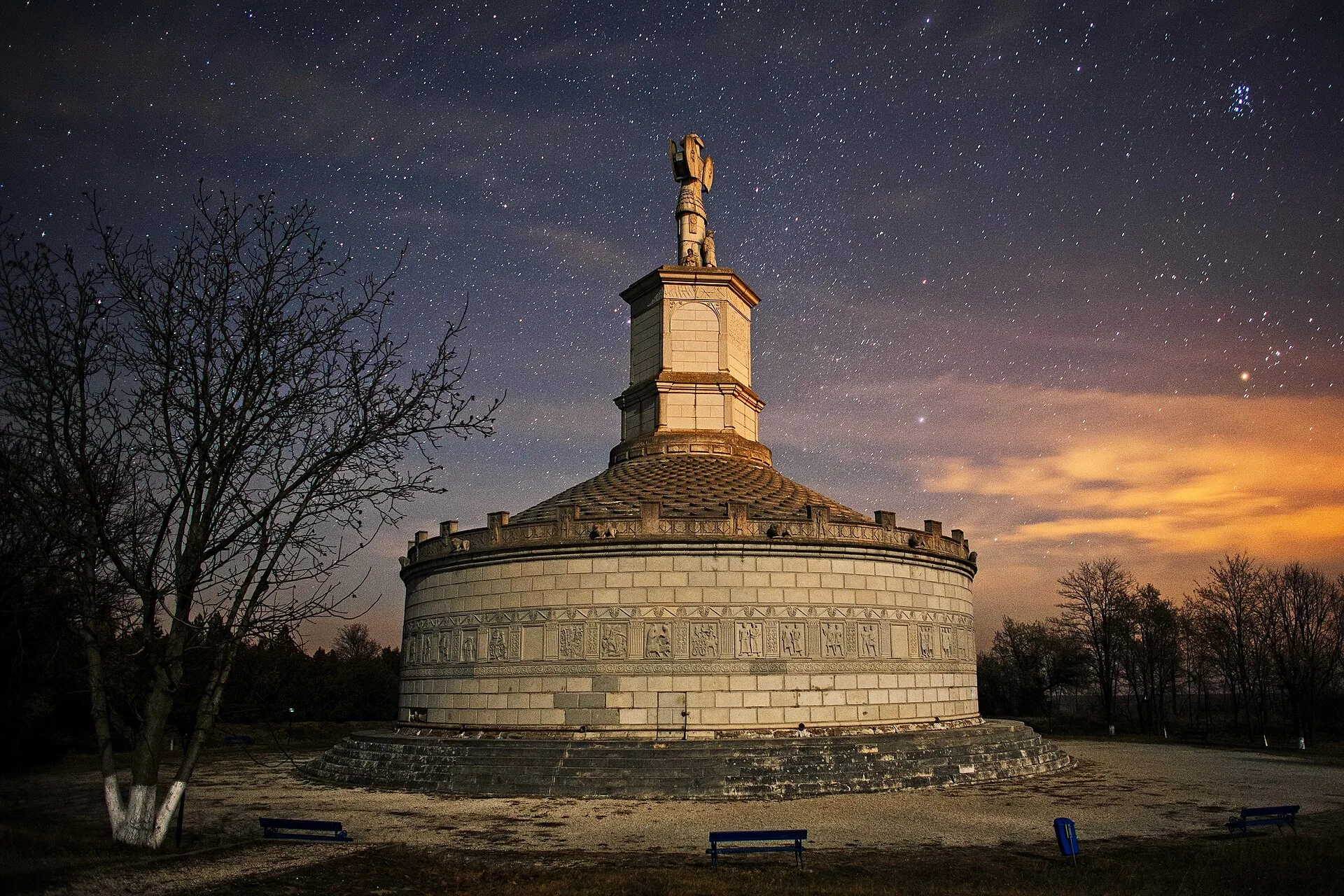
Trajan's trophy
On a hill near the village of Adamclisi, about 1.5 km north-east of it, Emperor Trajan raised a triumphal monument known today as Tropaeum Traiani ("Trajan's trophy"). Its date comes from the dedication inscription itself, preserved in fragments: the monument was dedicated to Mars Ultor ("the Avenger"), and Trajan bears the titles Germanicus and Dacicus, holds tribunician power for the 13th time, has been acclaimed imperator for the 6th time and is consul for the 5th time. The 13th tribunician power covers the period from 10 December 108 to 9 December 109, which is why the monument is usually dated to 109. The inscription records the victory over the army of the Dacians; scholars restore the text differently (one version names King Decebalus, another also mentions the Sarmatians).
The monument was a huge stone cylinder with a conical roof of scale-shaped slabs, topped by the statue of the trophy: a set of Roman armour with three captives at its foot (two seated women and a standing man with his hands bound behind his back). Its height and diameter were both about 40 m.
The battle it commemorates
In the winter of 101–102, during the First Dacian War, Decebalus' Dacians and their allies from north of the Danube (modern historians mainly name the Roxolani, a Sarmatian people) attacked the Roman province of Moesia, south of the river, and Trajan came with his army to stop them. The museum considers that the Adamclisi metopes tell the story of these battles, with a great battle fought right here; scenes of the fighting in Dobruja also appear on Trajan's Column in Rome. The surviving text of the ancient historian Cassius Dio, however, does not describe this campaign, so the exact place and course of the fighting are inferred mainly from the monuments. The museum itself stresses that the metopes are not a "campaign diary" but a work of imperial propaganda.
What the metopes show
Around the cylinder ran 54 metopes (relief-carved slabs), grouped, according to the museum's reconstruction, into six scenes of nine: a cavalry fight, the battle around the wagons, the surrender of civilians and prisoners before Trajan, then the march, the great battle and the acclamation of the emperor. They show Roman horsemen with lances and oval shields, standard-bearers, musicians, "barbarians" in their own dress and even scenes of local life: a family carrying its belongings in a cart, flocks of sheep and goats. Above them, the battlements show prisoners with bound hands, leaning against trees. The style is that of provincial sculptors, far from that of the Column; the archaeologist Ian Richmond judged them "barely equal to the task".
Over time the monument fell into ruin: only its core of stone and mortar remained, with the carved blocks scattered around it. Systematic excavations were begun in 1882 by Grigore Tocilescu. In 1977 the monument was rebuilt under the scientific supervision of Adrian Rădulescu, following one of the models proposed for its original shape. Copies of most of the carved pieces were mounted on it; the originals are in the village museum, which holds 48 of the 54 metopes.
The altar, the tomb and the town
Next to the monument are the remains of a funerary altar whose walls bore the names of fallen Roman soldiers (praetorians, legionaries, auxiliaries), "in memory of the bravest men, who died fighting for the state". Their number, estimated at about 3,800, is calculated from the presumed space of the inscription. The altar's date is debated: the museum places it in 102, after the battle of winter 101–102, but other scholars think it commemorates an earlier Roman defeat under Emperor Domitian (the 80s AD). About 100 m from the monument, a mound holds the foundations of a mausoleum, probably of an important Roman officer; his name is not known.
On the plateau near the monument, Trajan founded the town of Tropaeum Traiani, on the site of a Getic settlement. Before 170 it had become a municipium, under Marcus Aurelius. According to an inscription of 316, the town was rebuilt from its foundations under Constantine the Great, with walls almost 1,200 m long. In the 5th–6th centuries it was a bishop's seat, with five basilicas inside the walls and two outside, and it was destroyed during an Avar and Slav invasion in 586.
Where you can see it
The reconstructed triumphal monument (outside the village of Adamclisi, Constanța County) can be visited in the open air; next to it you can see the site of the altar and the mausoleum mound. The Tropaeum Traiani Museum, in the village centre, opened in 1977, displays the original metopes, the trophy statue, fragments of the dedication inscription and of the altar walls. The ruins of the town of Tropaeum Traiani, about 1.5 km south-west of the monument, can be walked through: the towered walls, the gates, the paved main street and the basilicas. All three are run by the Museum of National History and Archaeology in Constanța.
Places in this story
- Tropaeum Traiani triumphal monumentAdamclisi, comuna Adamclisi, Constanța CountyReconstituirea din 1977 a trofeului ridicat de Traian în 109, cu copii ale metopelor; alături, locul altarului funerar și movila mausoleului.
- Tropaeum Traiani Museum (Adamclisi Archaeological Museum)Adamclisi, comuna Adamclisi, Constanța CountyMuzeul de sit deschis în 1977 (MINAC Constanța): 48 de metope originale, statuia trofeului, fragmente din inscripția de dedicație și din altarul funerar.
- Tropaeum Traiani Roman town (ruins)Adamclisi, comuna Adamclisi, Constanța CountyOrașul întemeiat de Traian, municipiu înainte de 170, refăcut sub Constantin cel Mare și distrus în 586: ziduri cu turnuri, porți, stradă pavată, bazilici.
Sources
- MINAC Constanța: Tropaeum Traiani, complexul muzeal (monument, inscripție, metope, altar, tumul, cetate, muzeu)
- Epigraphic Database Heidelberg HD042859: inscripția de dedicație a trofeului (CIL III 12467), datată 108–109, păstrată la Muzeul Adamclisi
- Epigraphic Database Heidelberg HD018451: al doilea exemplar al inscripției (reîntregire cu „regele Decebal”)
- Epigraphic Database Heidelberg HD017350: inscripția altarului funerar (datare disputată: Domițian sau Traian)
- Institutul Cultural Român, Plural Magazine: The Adamclisi Monument (restaurarea din 1977, copii, originalele în muzeul local)
- ERC „Judaism and Rome” (C. Barron): The Tropaeum Traiani at Adamklissi (metope, I. Richmond)
- ERC „Judaism and Rome”: Dedicatory Inscription from the Tropaeum Traiani (altarul, estimarea de 3.800, datări diferite)
- B. Turner, War Losses and Worldview: Re-Viewing the Roman Funerary Altar at Adamclisi, American Journal of Philology 134.2 (2013), 277–304 (fișă)
- Cassius Dio, Istoria romană LXVIII.8–10 (trad. E. Cary, LacusCurtius)
- Lista monumentelor istorice din județul Constanța (Wikipedia, după LMI): CT-I-s-A-02567 și subcodurile
- Tropaeum Traiani (Wikipedia ro): reconstituirea din 1977, Adrian Rădulescu, Tocilescu 1882
- Tropaeum Traiani (Wikipedia en): starea monumentului înainte de reconstituire
- Battle of Adamclisi (Wikipedia en) și Bătălia de la Adamclisi (Wikipedia ro): atacul din Moesia, iarna 101–102, roxolanii