
The Tărtăria tablets: signs on clay and a debate still open
In 1961, at Tărtăria (Alba), archaeologists found three small clay tablets with incised signs. Some see them as the oldest writing, but their age and meaning are still debated.
Three clay tablets found in 1961
In 1961 a team led by archaeologist Nicolae Vlassa, of the history museum in Cluj, excavated the prehistoric settlement at Tărtăria, at the place called Gura Luncii (Săliștea commune, Alba County). The site lies next to the Tărtăria railway halt, on a small promontory on the first terrace of the Mureș. It had been discovered in 1906 by Endre Orosz and excavated by Kurt Horedt in 1942-1943.
In a pit, the team found three small tablets of unfired clay, clay and stone figurines, a shell bracelet and the bones of a woman. The anthropological study published in 2005 describes her as a woman aged 50-55, about 1.47 m tall. Two tablets are rectangular and the third is round (about 6 cm). Two are pierced. The signs are incised on one face only: on one tablet a horned animal and a plant motif can be recognised, while the others carry mostly abstract signs. The find belongs to the Neolithic Vinča-Turdaș culture.
Why their age is not certain
Vlassa compared the signs with Sumerian tablets and believed the tablets were related to proto-Sumerian writing. At the time, the Vinča culture was dated much later than it is today. The excavation report had gaps, however, and for decades the tablets were not treated as securely dated objects. Some specialists considered that they might come from a younger layer of the site, carried down by a later pit.
The tablets cannot be radiocarbon dated directly. Shortly after the find they were cleaned with acid and treated for conservation, including with heat. The woman's bones were dated instead: a laboratory in Rome obtained 6310 ± 65 BP, roughly 5370-5140 BC. That date applies to the tablets only if they were buried at the same time as the bones. Gheorghe Lazarovici and Marco Merlini, who re-examined the excavation, argue that they were. A test trench dug in 1989 found part of the pit drawn by Vlassa, and archaeologist Horia Ciugudean called this "a first confirmation". Even so, in 2026 the manager of the Cluj museum, Felix Marcu, said that the tablets might come from a later context and that "at the moment we have no certainty" that they are the oldest writing.
Writing or symbols?
If the date of over 5000 BC were correct and the signs were writing, the tablets would be older than the first writing in Mesopotamia and Egypt. This is where the phrase "the oldest writing in the world" comes from. Specialists do not accept it as a proven fact.
Some researchers, among them Marija Gimbutas, Harald Haarmann, Gheorghe Lazarovici and Marco Merlini, believe that a Neolithic sign system existed in the Danube basin, which Gimbutas called the "Old European script" and the others the "Danube script". Yet Merlini himself concluded that the Tărtăria signs do not fully fit this repertoire, and he interprets them as sacred symbols understood only by initiates, not as a text. Others are more sceptical. Colin Renfrew wrote that the resemblance to Sumerian signs "carries very little weight", because simple drawings look alike in any culture. Sarunas Milisauskas notes that it is extremely difficult to show archaeologically that a set of signs is writing, and that the first writing systems arose in organised states, for which there is no evidence in Neolithic Europe.
What we do not know
We do not know for certain which layer the tablets came from, what the signs mean, or whether they carried a message someone else could read. Some voices have called them fakes. Archaeologist Horia Ciugudean, who took part in the 1989 test trench, says there are, "at present", no "very solid grounds" to deny the find. Excavations at Gura Luncii resumed in 2010 under Sabin Adrian Luca and continued after 2015.
Where to see it
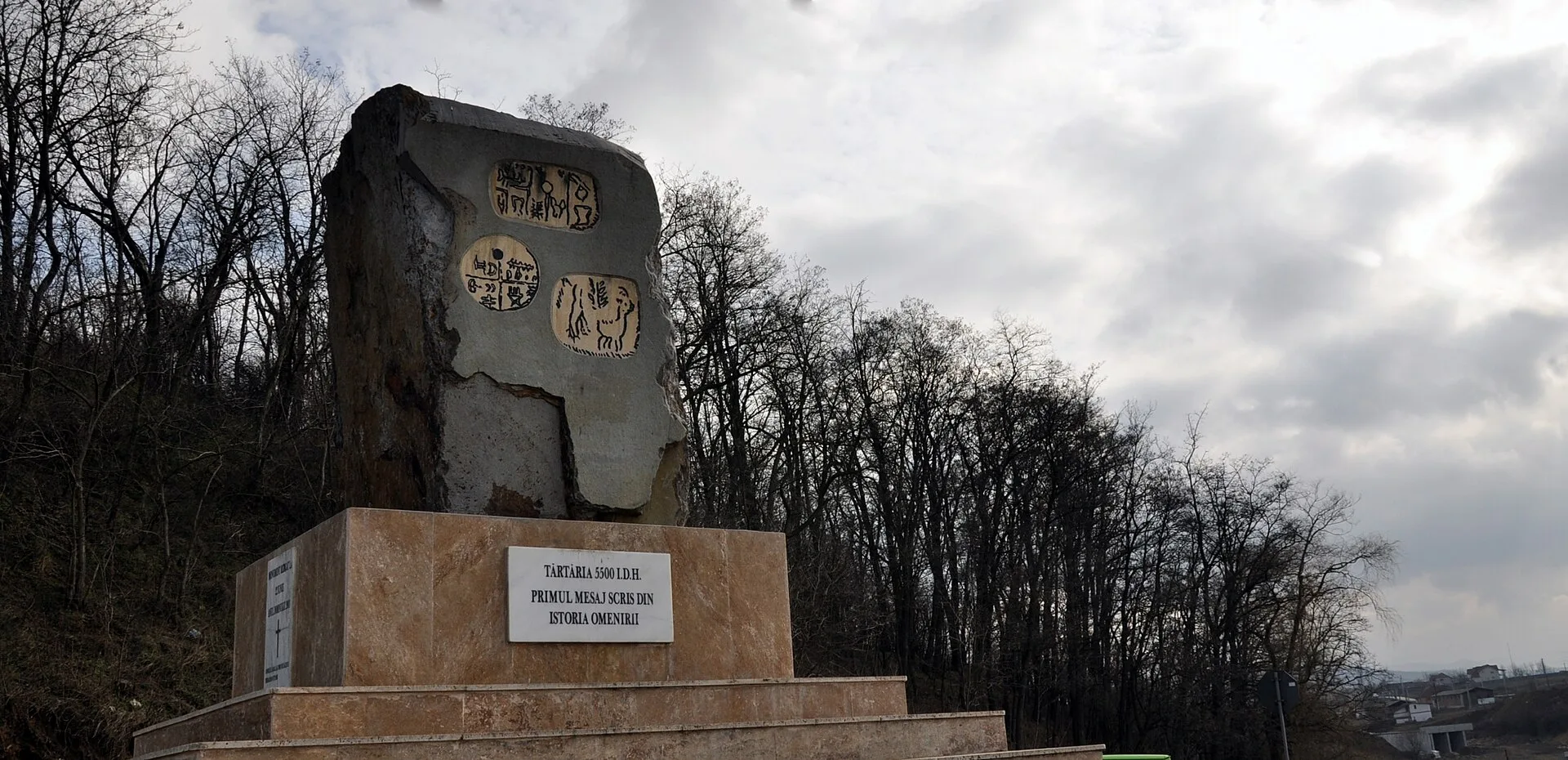
Since 1961 the tablets have belonged to the National Museum of Transylvanian History in Cluj-Napoca. According to the museum's manager, in 2026 they were shown in the exhibition "Comori nespuse. Istoria Transilvaniei prin obiecte" (Untold treasures: the history of Transylvania through objects), open since January 2026. The Tărtăria-Gura Luncii site is an archaeological research area with no visitor facilities. At the entrance to the village, by the national road, stands a granite monument that reproduces the tablets' signs at a larger scale; its inscription ("Tărtăria 5500 BC. The first written message in human history") presents as certain what specialists still debate.
Places in this story
- National Museum of Transylvanian HistoryCluj-Napoca, Cluj CountyDeține tăblițele din 1961; potrivit managerului muzeului (Agerpres, 2 feb. 2026) sunt prezentate în expoziția „Comori nespuse”, deschisă din 15 ian. 2026. Nu s-a confirmat dacă în vitrină sunt originalele sau copii.
- Monument to the Tărtăria tabletsTărtăria, comuna Săliștea, Alba CountyMonument modern de granit (circa 8 t) cu semnele tăblițelor reproduse mărit; inscripția îl prezintă drept „primul mesaj scris din istoria omenirii”, afirmație nedovedită.
Sources
- Lazarovici Gh., Merlini M., New archaeological data refering to Tărtăria tablets, Documenta Praehistorica XXXII (2005), 205-219 (context, groapa, antropologie, datare Rome-1631, tratarea cu acid)
- Merlini M., About the signs and symbols... Tracing Europe's earliest script, Acta Terrae Septemcastrensis XXIV (2025), 7-73 (istoria dezbaterii, lipsurile raportului lui Vlassa, Gimbutas, Haarmann, concluzia că semnele de la Tărtăria nu se integrează direct în „Danube script”)
- Luca S.A., Perianu F., Teodorescu R., Some ideas about the absolute dating of the Tărtăria-Gura Luncii site, ECAART 14, Sibiu 2022 (prezentare: istoricul cercetărilor, promontoriul, R-1631 6310±65 BP, femeia de 50-55 ani, 1,47 m)
- Cronica Cercetărilor Arheologice, Tărtăria - Gura Luncii, campania 2019 (RAN 7080.01; amplasare lângă halta Tărtăria; descoperit de E. Orosz în 1906; conservarea săpăturii)
- MNIT: Comori nespuse. Istoria Transilvaniei prin obiecte (din 15 ianuarie 2026)
- Agerpres (2 februarie 2026): Cluj: Tăblițele de la Tărtăria, considerate de unii specialiști cele mai vechi scrieri, expuse la muzeu (declarațiile lui Felix Marcu)
- Stiripesurse (2 februarie 2026): Tăblițele de la Tărtăria, exponat de excepție la muzeul de istorie din Cluj
- Alba24 (6 aprilie 2015): Autenticitatea tăblițelor... ce spune arheologul Horia Ciugudean (sondajul din 1989)
- Alba24 (17 noiembrie 2015): Tăblițele de la Tărtăria (monumentul de granit, patrimoniul MNIT)
- Alba24 (16 noiembrie 2016): Expoziția „Cinci ani de cercetări sistematice la Tărtăria-Gura Luncii” (istoricul săpăturilor, Horedt 1942-1943, Luca din 2010)
- Wikipedia (en): Tărtăria tablets (descriere, dimensiuni, citatele Renfrew și Milisauskas, ipoteza falsului)
- Wikipedia (ro): Lista monumentelor istorice din județul Alba (AB-I-s-A-00078, Tărtăria, „Gura Luncii”)