
Master Manole and the Argeș Monastery: what is history and what is legend
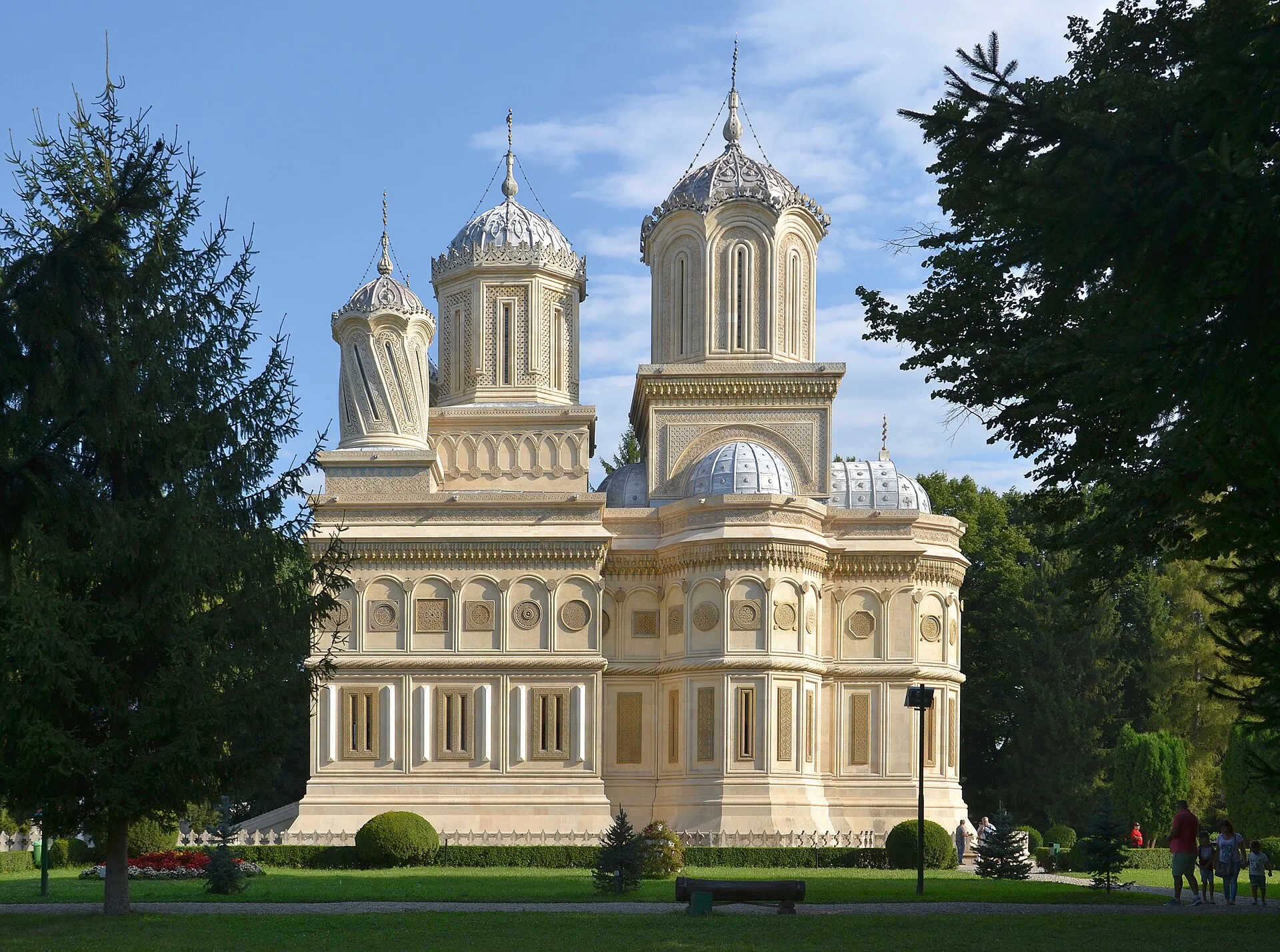
The church at Curtea de Argeș was built by Neagoe Basarab and consecrated in 1517, but its architect's name has not survived. Master Manole and his walled-in wife come from the ballad Alecsandri published in 1852.
What history says
The church of the Argeș Monastery was founded by Neagoe Basarab, Prince of Wallachia from 1512 to 1521. Building began on an unknown date, probably in the first year of his reign, and the church was consecrated on 15 August 1517 by Patriarch Theoleptus of Constantinople. The interior painting was only finished in 1526, under Radu de la Afumați, by the painter Dobromir; fragments of it are kept at the National Museum of Art of Romania. The church was built of limestone, which is rare in Wallachia, and the carved decoration of its façades is clearly related to Ottoman architecture of the time.
Who designed it is not known. The file submitted in 2024 by Romania's National Heritage Institute for the UNESCO Tentative List states plainly that no reliable record of the architect or craftsmen has survived, despite a rich oral tradition about a legendary Manole. Some old writings credit the design to Neagoe Basarab himself. There is no historical evidence that a builder called Manole existed or that anyone was walled into the church.
The restoration and the royal necropolis
In 1793 the church became a bishop's cathedral. After the fires of 1866 and 1867, which destroyed a large part of the monastery buildings and the church interior, Carol I (then reigning prince, king from 1881) backed a major restoration, led from 1875 to 1886 by the French architect André Lecomte du Noüy, a pupil of Viollet-le-Duc. The work saved the monument but also changed it a great deal: the monastery buildings were demolished, the old frescoes were replaced with new oil painting, and the roof and some of the ornaments were remade according to the architect's own ideas.
Since 1914 the church has also been a royal necropolis. In the church, next to the tombs of Neagoe Basarab and his family, lie King Carol I, Queen Elisabeth, King Ferdinand and Queen Marie. Queen Anne (in 2016) and King Michael I (in 2017) were buried in the new Archiepiscopal and Royal Cathedral, built in front of the monastery gate.
What the legend says
The story of Master Manole became widely known through the ballad "Monastirea Argeșului" (The Argeș Monastery), published by Vasile Alecsandri in his 1852 collection of folk poetry. Alecsandri did not simply transcribe the folk text: he rewrote and polished it. Other variants were recorded later, for example by G. Dem. Teodorescu in 1883. The folklorist Ion Taloș counted 242 variants of the ballad and 38 variants of the prose legend in Romanian tradition.
In the ballad, the prince who orders the building is not Neagoe Basarab but Negru-Vodă. He sets out with "nine great masters, journeymen and masons" and with Manole, the tenth. Whatever they build by day collapses by night. Manole dreams that the wall will stand only if they wall into it the first wife or sister who comes the next morning bringing food. Ana, his wife, comes. Manole prays for rain and wind to stop her, but she arrives, and he walls her in. At the end, the prince leaves the masters on the roof so that they cannot build a more beautiful church. They make wings out of shingles and fall. Where Manole falls, "a gentle fountain" appears.
A story with many relatives
The motif of a woman walled in so that a building will stand is widespread, especially in the Balkans. In the Greek ballad of the Bridge of Arta, whatever is built by day falls down by night, and the master builder must wall in his wife. Similar themes appear in the Serbian song about the building of Skadar (Scutari) and in the Hungarian ballad of the wife of the mason Kelemen. Mircea Eliade wrote about the legend in "Comentarii la legenda Meșterului Manole" (Commentaries on the Legend of Master Manole, 1943), where he reads it as a myth of sacrifice for the sake of creation. That is a literary interpretation, not information about how the church was actually built.
Where you can see it
The Curtea de Argeș Monastery (town of Curtea de Argeș, Argeș County) can be visited: Neagoe Basarab's church, with the tombs of the princes and of Romania's first kings and queens, and, nearby, the new cathedral with the tombs of King Michael I and Queen Anne.
Manole's Fountain stands across the road from the monastery, in a park on Strada Eroilor. The stone fountain is linked to Manole only by legend. The verse inscription on it, published by Nicolae Iorga in 1905, does not mention Manole: it says the spring was found and brought to this spot by Bishop Iosif of Argeș, together with the oikonomos (steward) Meletie.
Places in this story
- Curtea de Argeș Monastery (Neagoe Basarab's church)Curtea de Argeș, Argeș CountyBiserica ctitorită de Neagoe Basarab (sfințită în 1517, restaurată 1875–1886), cu mormintele ctitorilor și ale regilor Carol I și Ferdinand și reginelor Elisabeta și Maria (LMI AG-II-m-A-13628.01).
- Manole's FountainCurtea de Argeș, Argeș CountyFântână de piatră peste drum de mănăstire, legată de Manole doar prin legendă; inscripția ei îi pomenește pe episcopul Iosif și pe iconomul Meletie (LMI AG-IV-m-A-13942).
Sources
- UNESCO World Heritage Centre, Tentative List: Princely religious foundations in Wallachia and Moldavia (ref. 6763, depus 15.04.2024 de Ministerul Culturii / INP): construcție, sfințire 15.08.1517, pictura 1526, 1793 catedrală episcopală, incendii 1866–1867, restaurarea Lecomte du Noüy 1875–1886, „nicio mențiune sigură” despre arhitect, Manole legendar
- N. Iorga, Inscripții din bisericile României, fasc. I, București, 1905, pp. 146–155 (Mănăstirea Argeșului: pisanii, mormântul lui Neagoe, Dobromir, inscripția „la fântâna zisă a meșterului Manole”), scan Internet Archive / dacoromanica.ro
- Agerpres, „Orașul regal Curtea de Argeș, în așteptarea ultimului rege” (6.12.2017): Carol I, Elisabeta, Ferdinand, Maria în biserica lui Neagoe; regina Ana în noua necropolă din 2016
- TVR Info, Regele Mihai I a fost înmormântat în noua Catedrală Arhiepiscopală de la Curtea de Argeș (16.12.2017), alături de regina Ana
- O. Bartosiewicz-Nikolaev, „The Margins versus the Centre of the National Literary Canon: The Reception of ‘The Legend of Master Manole’”, Colloquia 53 (2024), pp. 105–120: publicată de Alecsandri în 1852, motivul femeii zidite în Balcani, Eliade 1943
- O. Bartosiewicz-Nikolaev, „Mitul jertfei creatoare din balada Mănăstirea Argeșului…”, Studia Romanica Posnaniensia 50/4 (2023), pp. 55–70: variantele Alecsandri 1852 și G. Dem. Teodorescu 1883; 242 variante de baladă și 38 în proză (după I. Taloș)
- Vasile Alecsandri, „Mănăstirea Argeșului” (text și notele lui Alecsandri), Wikisource
- Lista monumentelor istorice din județul Argeș – C (Wikipedia, după LMI): AG-II-a-A-13628, AG-II-m-A-13628.01, AG-IV-m-A-13942
- Mănăstirea Curtea de Argeș (Wikipedia ro): restaurare, necropola regală din 1914, Fântâna lui Manole
- Curtea de Argeș Cathedral (Wikipedia en): înmormântări, legenda
- Meșterul Manole (Wikipedia ro): balada maghiară a soției zidarului Kelemen
- Bridge of Arta (Wikipedia en): balada greacă, paralela sârbească Skadar
- Fântâna Meșterului Manole (Wikipedia ro)