
The Thinker of Hamangia: the clay couple from Cernavodă
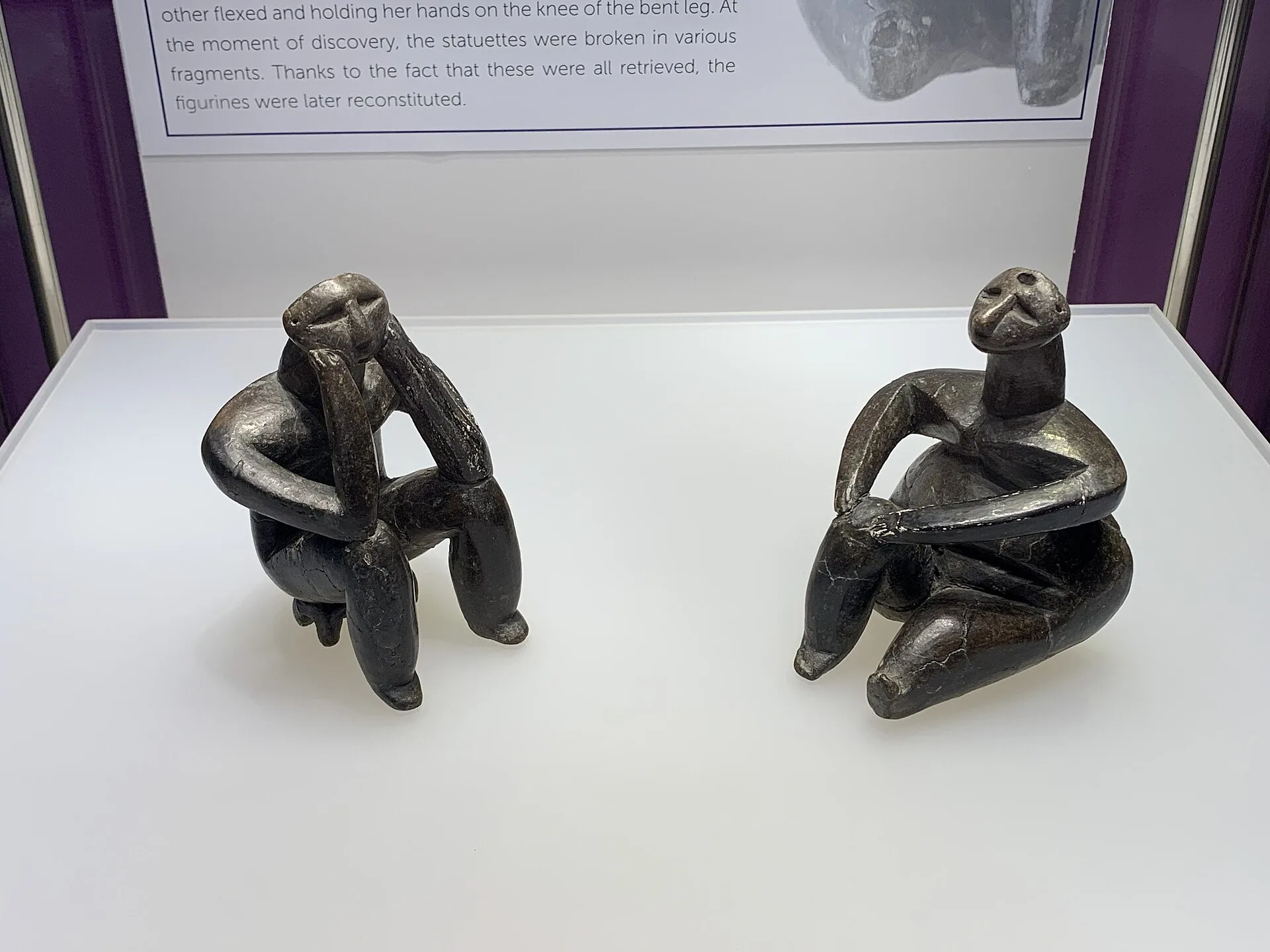
In 1956, in a Neolithic cemetery at Cernavodă, archaeologists found two clay statuettes about 11.5 cm tall: the Thinker and the Seated Woman. What is known for certain about them is less than has been written.
The Hamangia culture
The Hamangia culture is the name archaeologists gave to Neolithic communities that lived between the Danube and the Black Sea, in Dobruja. Finds of the same kind also occur in north-eastern Bulgaria, for example in the cemetery at Durankulak. The name comes from Hamangia station on the Medgidia-Babadag railway, which served the commune of Baia (the village of Hamangia had been renamed Baia in 1929). The archaeologist Dumitru Berciu began excavating around Baia in 1952, gave the culture its name and published the monograph "Cultura Hamangia" in 1966.
Recent radiocarbon dates place these communities roughly between 5200 and 4500 BC: the settlement at Cheia gave dates between 5200 and 4800 BC, and the one at Ceamurlia de Jos was inhabited, in at least two phases, between about 5000 and 4500 BC. People lived in open settlements, buried their dead in cemeteries and placed in the graves vessels, flint blades, stone axes and ornaments made of Spondylus shell. The origin of the culture is still debated by specialists.
The discovery at Cernavodă
The cemetery lies at the point called Columbia D, on the northern edge of the town of Cernavodă, near the road to Capidava. The place is named after the Franco-Romanian oil company "Colombia", with which the local refinery worked from 1913. Under communism the area became a camp for political prisoners forced to work on the Danube-Black Sea Canal. Earthworks that altered the terrace caused landslides, so the archaeologists dug largely to rescue what could still be saved. The team of the Institute of Archaeology in Bucharest, led by Dumitru Berciu and Sebastian Morintz, identified more than 400 graves in the 1950s, many of them destroyed or displaced by the landslides.
In 1956, next to a skeleton disturbed by the landslide, the fragments of two fired-clay statuettes came to light. Most fragments were found in 1956, others in 1957, when the excavation was extended. The pieces were then reassembled. The Thinker is 11.5 cm tall and the female figure 11.4 cm.
What the two statuettes show
The Thinker is a figure, probably male, seated on a stool with four short legs. It rests its elbows on its knees and holds its palms to its cheeks, supporting its head. The second figurine is a woman sitting directly on the ground, with both arms resting on her left knee; the left leg is bent, while the right one, only partly preserved, seems to have been stretched forward.
The name "The Thinker" was given by analogy with Auguste Rodin's statue. For the female figure the name "Seated Woman" prevailed, although in 1965 Berciu described her as a woman "who rests and ponders". The pair is unusual: Hamangia clay figurines are almost all female, and male ones are very few.
What is known and what is interpretation
The find spot, the years of excavation, the material and the attribution to the Hamangia culture are certain; the National History Museum of Romania dates the pieces to the 5th millennium BC. The rest is interpretation. Berciu saw them as a single group, probably a married couple, and the museum considers that they very probably express a belief in two principles, male and female. A study published in 2025 by the archaeologists of the Franco-Romanian mission now re-examining the Hamangia sites points out, however, that there is no firm archaeological proof that the statuettes come from a single grave or that they were made as a pair. Berciu considered the link with the skeleton certain; the context nevertheless remains unclear because of the landslides.
Where to see it
The originals belong to the National History Museum of Romania in Bucharest, whose symbol they have become (the Thinker also appears on the 200 lei banknote). They are not part of the permanent Historical Treasury exhibition: the museum shows them in temporary exhibitions and has often lent them abroad (Liège in 2019, Aarhus in 2024-2025). Before visiting, it is worth checking on the museum's website whether the originals are on display.
In Cernavodă, the "Axiopolis" Museum houses the Hamangia Centre, set up between 2018 and 2024 with EU and Cernavodă town hall funds, with more than 500 objects from the collection of the Constanța museum: clay figurines from the Cernavodă cemetery, a reconstructed grave, a rebuilt Hamangia house and replicas of figurines from Cernavodă and Cheia. The find spot, Columbia D, is not on the List of Historic Monuments and is not presented as a place to visit; what was found there is shown in museums.
Places in this story
- National History Museum of RomaniaBucurești, București CountyDeține originalele „Gânditorul” și „Femeie șezând”; expuse doar în expoziții temporare (nu în lista Tezaurului Istoric); replică tactilă în expoziția „…la îndeMână”.
- "Axiopolis" Museum – Hamangia CentreCernavodă, Constanța CountyCentrul Hamangia (2018-2024, concept MINAC): peste 500 de piese Hamangia, figurine din cimitirul de la Cernavodă, mormânt și locuință reconstituite, replici de figurine.
Sources
- MNIR: expoziția „…la îndeMână” (fișa replicii „Gânditorul” și „Femeie șezând”: 1956, Dumitru Berciu, necropola de lângă Cernavodă, lut ars, 11,5 cm, mileniul V a.Chr., descriere, interpretare)
- MNIR: expoziția temporară „Capodopere din patrimoniul Muzeului Național de Istorie a României” (Holul Central, iunie 2024 - octombrie 2026, include „Gânditorul” și perechea sa)
- MNIR: Expoziții temporare prezente (date de închidere)
- MNIR: Expoziția permanentă Tezaur Istoric (lista pieselor expuse; statuetele nu apar)
- MNIR: Exponatul lunii martie 2012, „Gânditorul” și „Femeie șezând” (expuse în Suedia, Germania, Elveția, Anglia, Grecia, SUA)
- Carozza L., Burens A., Micu C., Le penseur, la femme qui songe et la culture Hamangia (2025), HAL hal-05748875 (contextul descoperirii 1956-1957, Columbia D, alunecări, interpretări Berciu, numele Hamangia/Baia 1929, datări Cheia și Ceamurlia de Jos, bancnota de 200 lei)
- MINAC: 7 mai, Cuplul „Gânditorul și femeia șezând”: o poveste de la începuturile omenirii (2026; Berciu și Morintz, peste 400 de morminte, dimensiuni 11,5 / 11,4 cm, gara Hamangia)
- MINAC: Columbia D, istoria locului unde au fost descoperite „Gânditorul și femeia șezând” (2026; rafinăria Colombia, lagărul Canalului)
- MINAC: Muzeul Axiopolis, Centrul Hamangia și Atelierul Gânditorul (conținutul expoziției)
- MINAC: Activități la Muzeul „Axiopolis” – Centrul Hamangia Cernavodă (octombrie 2025, centrul funcționează)
- INP/cIMeC, Ghidul muzeelor: Muzeul „Axiopolis” (Str. Ovidiu 19, Cernavodă)
- Newsweek România (6 mai 2025): statuetele împrumutate Muzeului Moesgaard, Aarhus, 10 octombrie 2024 - 10 august 2025
- Wikimedia Commons: Roots — The civilizations of the Lower Danube 02.jpg (statuetele la Grand Curtius, Liège, Europalia 2019)
- Wikipedia (en): Thinker of Hamangia
- Wikipedia (en): Hamangia culture
- Wikipedia (ro): Lista monumentelor istorice din județul Constanța (Cernavodă: fără necropola Hamangia de la Columbia D)