
Attraction
Sibiu City Walls
Sibiu's medieval fortifications were built in several stages between the late twelfth and the seventeenth century and are a listed historic monument (LMI code SB-II-a-A-12010). The best preserved stretch is on Cetății Street, with the wall and three guild towers, while the Haller and Soldisch bastions are, together with Oradea Fortress, the only remains in Romania of the sixteenth-century Italian fortification system.
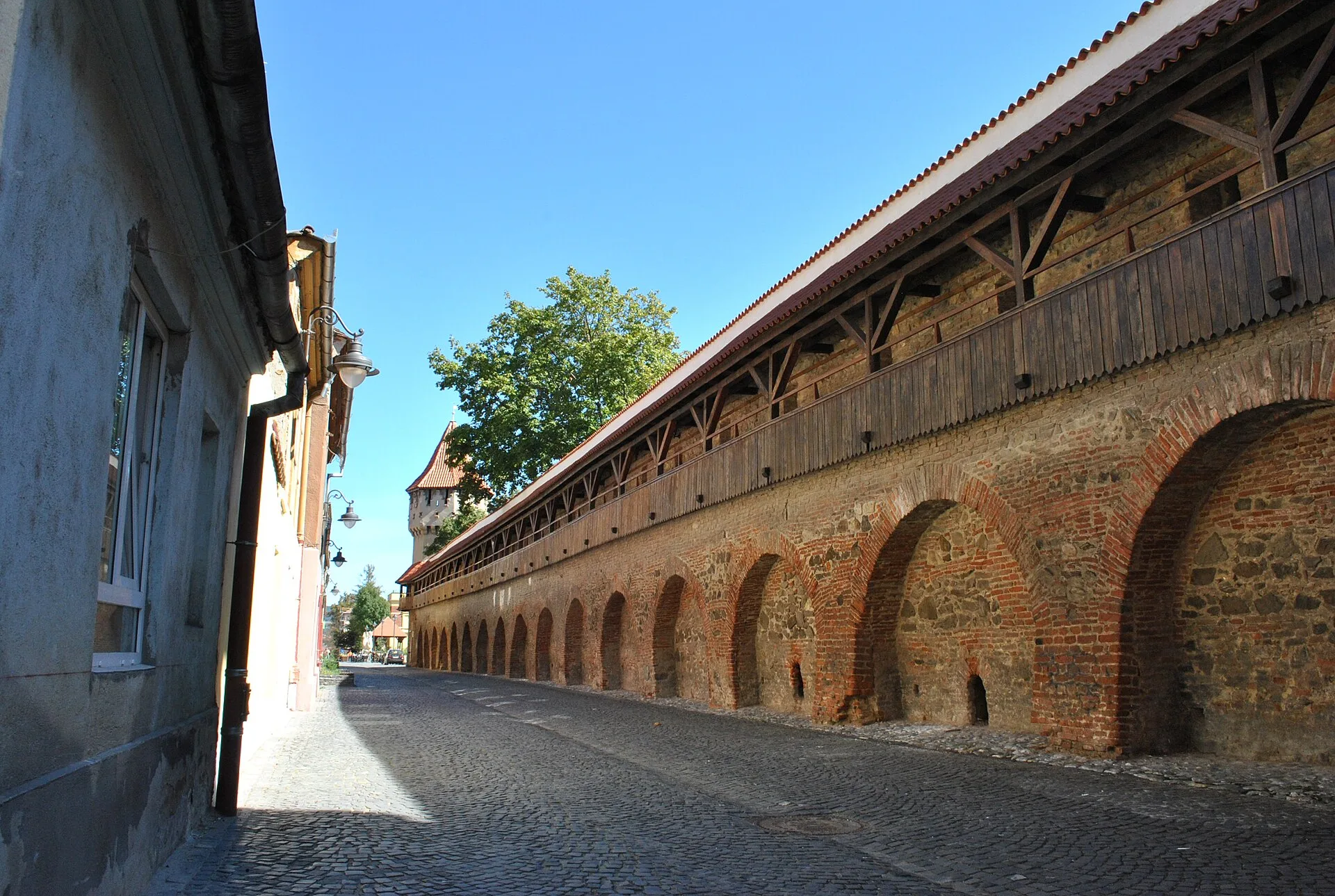
Foto: Andrei kokelburg, CC BY-SA 3.0 RO, via Wikimedia Commons
The ensemble of the fortifications of medieval Sibiu is listed as a historic monument with the code SB-II-a-A-12010 and dated to the twelfth to seventeenth centuries. The List of Historic Monuments divides it into stages. Of the first enclosure (1191-1224), the Stairs Tower and fragments of curtain wall survive on Huet Square. The second enclosure (1224-1241) includes the Council Tower and the Goldsmiths' Stair Tower. The third and fourth enclosures are dated to 1357-1366; the fourth includes the Tanners' Tower and the Blacksmiths' Tower. The late fortifications of the sixteenth and seventeenth centuries include the Haller and Soldisch bastions and fragments of artillery roundels and curtain walls.
The best preserved stretch is on Cetății Street, south of the Large Square, where the wall of the third enclosure links three towers: the Carpenters' Tower, the Potters' Tower and the Arquebusiers' Tower; the first two were built by the carpenters' and potters' guilds. At the end of the street, towards Corneliu Coposu Boulevard, stands the Thick Tower, the only artillery roundel left of those built in 1540-1552, raised around 1540 by the royal judge Markus Pempflinger. In 1788 the printer Martin Hochmeister set up the city's first theatre here, and since 2004 the tower has housed the Thalia Hall of the State Philharmonic. In 2019-2020 City Hall rehabilitated the three towers on Cetății Street and the walls on Corneliu Coposu Boulevard.
After the imperial troops of General Giovanni Battista Castaldo entered Sibiu in 1551, the Italian architect Alessandro Clippa designed a reinforcement of the walls with large corner bastions. The Haller Bastion, at the south-eastern end, was built in 1551-1553 under mayor Peter Haller; a riding school was built on it in 1771, and the present Neurology Hospital in the early twentieth century. The Soldisch (Mercenaries') Bastion, at the western end on Bastionului Street, was built in 1622-1627, the last of the five bastions, and still has five cannonballs from the siege of 1659-1660 lodged in its walls. Only these two of the five bastions survive, and together with the bastioned fortress of Oradea they are the only remains of the sixteenth-century Italian fortification system in Romania.
The walls can be followed on foot along Cetății Street and Corneliu Coposu Boulevard, and other fragments appear on Centumvirilor, Bastionului and Avram Iancu streets and in Goldsmiths' Square. Since 2020 the Carpenters' and Potters' towers can also be visited inside.
Strada Cetății și bulevardul Corneliu Coposu, Sibiu, județul Sibiu