
Attraction
The Enclosure Wall of Tomis Fortress
The enclosure wall of Tomis fortress is the defensive remnant of the ancient city of Tomis, built in several stages beginning in the second half of the 3rd century AD, with subsequent restoration work carried out during the reigns of Constantine the Great and Justinian. It follows the route of the present-day Bulevardul Ferdinand, from the North-East Gate towards the port. The only section open to the public, measuring 100–150 m, is located in the Archaeological Park in Constanța, alongside the Butchers' Tower, dated to the 4th century AD.
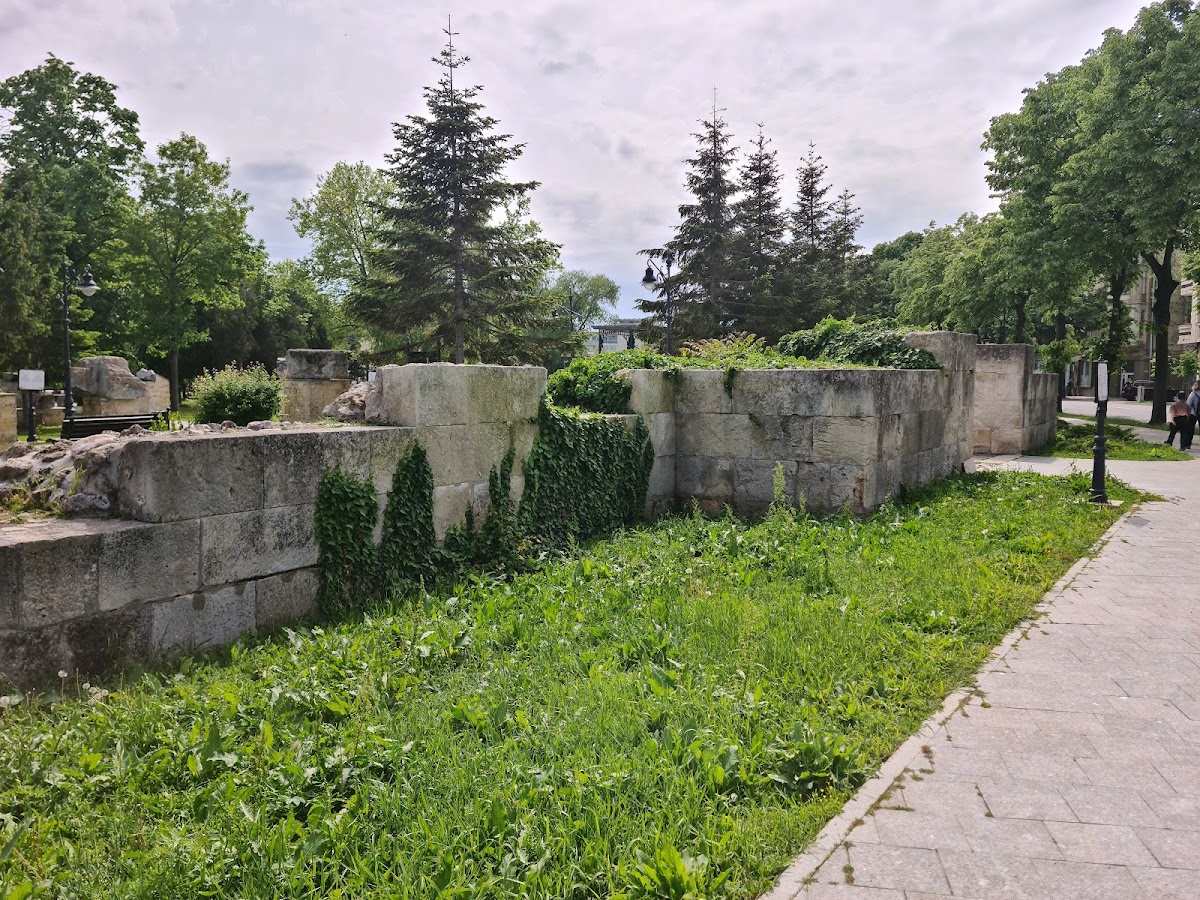
The enclosure wall of Tomis fortress is the principal defensive component of the archaeological site of ancient Tomis — one of the 12 historical monuments that make up the fortress complex, LMI code CT-I-m-A-02553.08. Tomis was founded by Greek colonists from Miletus around the 6th century BC and became the metropolis of the Roman province of Moesia Inferior, one of the most important cities on the Pontic coast. The Romano-Byzantine enclosure wall, the ruins of which are visible today, was built in the second half of the 3rd century AD, when barbarian pressure on the imperial frontiers had intensified. Subsequent restoration and consolidation works were carried out in the 4th century, during the reign of Constantine the Great, and especially during the reign of Emperor Justinian (527–565 AD). Constructed from massive limestone blocks on the exterior and mortar, the wall reaches a thickness of approximately 3 m and follows a route from north-east to south-west, connecting the two shores of the peninsula on which Constanța is situated. The estimated length from the Great Gate (the Modern beach area) to the intersection of Bd. Ferdinand with str. I.G. Duca is approximately 800 m. The wall includes three gates — the North-East Gate with the Butchers' Tower, the West Gate, and a secondary entrance — as well as several defensive towers. The section open to the public, measuring 100–150 m, is located in the Archaeological Park in Constanța, near the City Hall. The first scientific study of the wall was carried out by archaeologist Vasile Pârvan in 1914–1915. A large part of the ancient structure lies buried beneath the buildings of the modern city — in February 2022, segments dated to the 3rd–6th centuries were discovered beneath the very floor of the Teatrul de Stat Constanța. It is well worth a visit, as it offers direct contact with the layered history of a city with over 2,500 years of continuous habitation.
Constanta judetul Constanta