
Attraction
Black Tower and White Tower
The Black Tower and White Tower are medieval defensive structures built in the second half of the 15th century, on the slope of Warthe Hill (Romurilor Hill) in Brașov, part of the Saxon town's fortification system. Both towers were maintained by the tinsmiths' and coppersmiths' guilds. The Black Tower, only about 11 meters tall, got its name after its walls were blackened by a 1559 lightning strike and further by the 1689 fire; the White Tower, 18-20 meters tall, takes its name from the white plaster on its walls. Both are reached on foot from Brașov's historic center via marked trails on Cetățuia Hill, standing as concrete evidence of medieval military organization and guild structure in Transylvania.
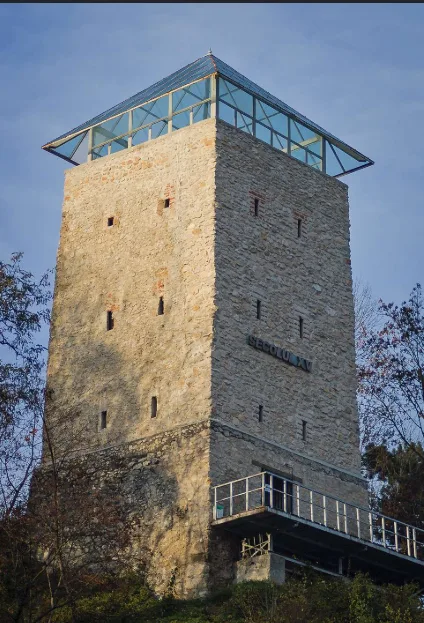
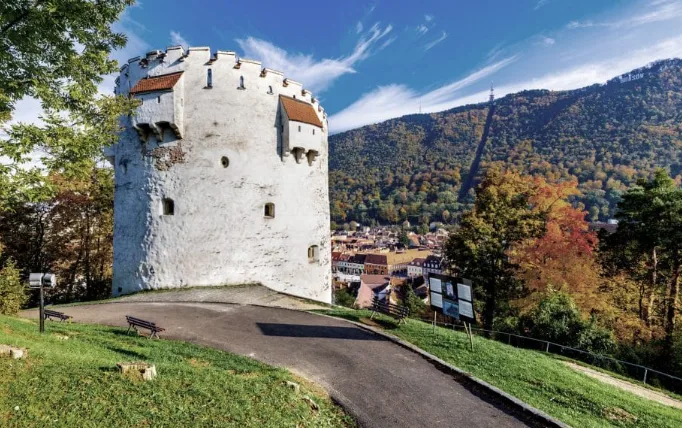
The Black Tower and White Tower are two medieval defensive structures on the slope of Warthe Hill (also called Romurilor Hill or Straja) in Brașov, an integral part of the town's fortification system, built in the second half of the 15th century. Both were outer towers, standing independently from the city wall, meant to control the surrounding area and keep the enemy from approaching the walls.
The Black Tower, first documented in 1541, has a square base of 50 sqm and stands only about 10.6 meters tall, with natural stone walls 1.7 m thick. Its original pyramidal roof was destroyed by a lightning strike on 23 July 1559, an event that blackened its walls — the source of its current name. The tower was hit again by the great fire of 21 April 1689 and by another lightning strike in 1696, only being rebuilt in 1735. In 1756, during a plague epidemic, it served as shelter for the guards of the sanitary cordon around the city — its last defensive/watch function.
The White Tower, built between 1460 and 1494, is the tallest historic fortification in Brașov, horseshoe-shaped, 19 meters in diameter and 18 to 20 meters tall, depending on the terrain. Its walls, 4 meters thick at the base, are painted white — hence its name. Located 59 meters from the city wall, it was connected to it by a drawbridge from the Graft Bastion. The tower was also damaged in the 1689 fire, only restored in 1723, with further work in 1902, 1972-1974, and 2002-2006.
Both towers were maintained and defended by the tinsmiths' and coppersmiths' guilds; from 1678, defense duties fell solely to the coppersmiths, as the tinsmiths' numbers had dwindled too low. Today, both towers house branches of the Brașov County History Museum, with exhibits dedicated to Brașov's medieval craftsmen. They are reached on foot via marked trails on the slope of Cetățuia Hill, starting from the city's historic center. Both towers are worth visiting to understand the organization of Brașov's medieval defense system and the administrative structure of the Saxon guilds that guarded the citadel.
Strada Castelului Brașov