
Attraction
National Theatre, Cluj-Napoca
The National Theatre building in Cluj-Napoca was built between 1904 and 1906 by the Viennese firm Fellner and Helmer in Neo-Baroque style and houses the Lucian Blaga National Theatre and the Romanian National Opera. It stands on the south side of Avram Iancu Square, towards Ștefan cel Mare Square.
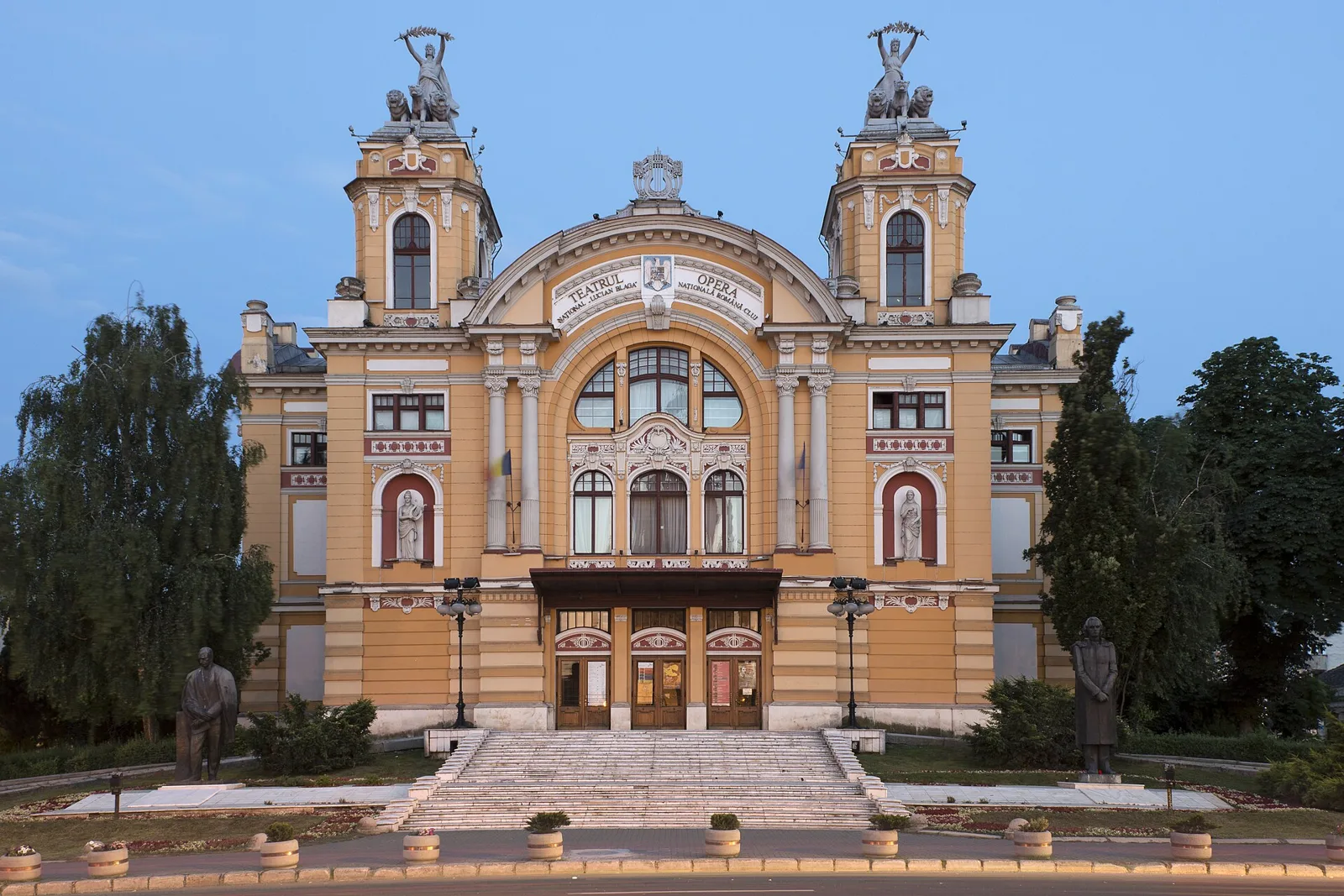
Foto: ZARAKA Z, CC BY-SA 4.0, via Wikimedia Commons
The National Theatre building stands in central Cluj-Napoca, between Avram Iancu Square and Ștefan cel Mare Square, facing the Metropolitan Cathedral. It is home to two institutions: the Lucian Blaga National Theatre and the Romanian National Opera of Cluj-Napoca.
The first municipal theatre, in Hungarian, opened in 1821 on Mihail Kogălniceanu Street. The new building was erected between 1904 and 1906, on the site of the town's former timber market, by the Viennese architects Ferdinand Fellner and Hermann Helmer, who also designed the theatres of Iași, Oradea and Timișoara. It was inaugurated on 8 September 1906 as the home of the Hungarian National Theatre led by Jenő Janovics. On 14 May 1919 the building was taken over by the Directing Council, through Onisifor Ghibu, and in the autumn of that year the Romanian National Theatre and the Romanian Opera were founded here, with Zaharia Bârsan as the theatre's first director. Between 1940 and 1945, after the Second Vienna Award, the Romanian company moved to Timișoara and the building was used again by the Hungarian theatre.
The façade and auditorium are Neo-Baroque, with Secession touches in the foyer decoration; the hall seats about 930, with three tiers of boxes. Since 1990 the façade niches have held statues of Thalia and Euterpe by sculptor Vasile Rus-Batin. The building is best visited by attending a theatre or opera performance; the theatre also holds occasional open-house events such as "Open Doors Night". Tickets are sold at the box office on Ștefan cel Mare Square or online.
The building is a category A historic monument, LMI code CJ-II-m-A-07355, and is part of the urban ensemble "Historic centre of the city of Cluj".
Did you know that the Romanian company's first performance, on 1 December 1919, was Zaharia Bârsan's "Poemul Unirei" (The Poem of the Union), staged on the first anniversary of the Great Union? Just two months earlier, on 30 September 1919, the Hungarian company had taken its leave of the same stage with "Hamlet".
Piața Ștefan cel Mare, Cluj-Napoca, județul Cluj