
Attraction
Hațeg Country
The Hațeg Country is a historical and ethnographic region in south-western Transylvania, in Hunedoara County, corresponding to the Hațeg Depression, with the town of Hațeg as its centre. Recorded as "terra Harszoc" in 1247, it preserves the oldest group of Romanian stone churches and several fortresses of the medieval knezes.
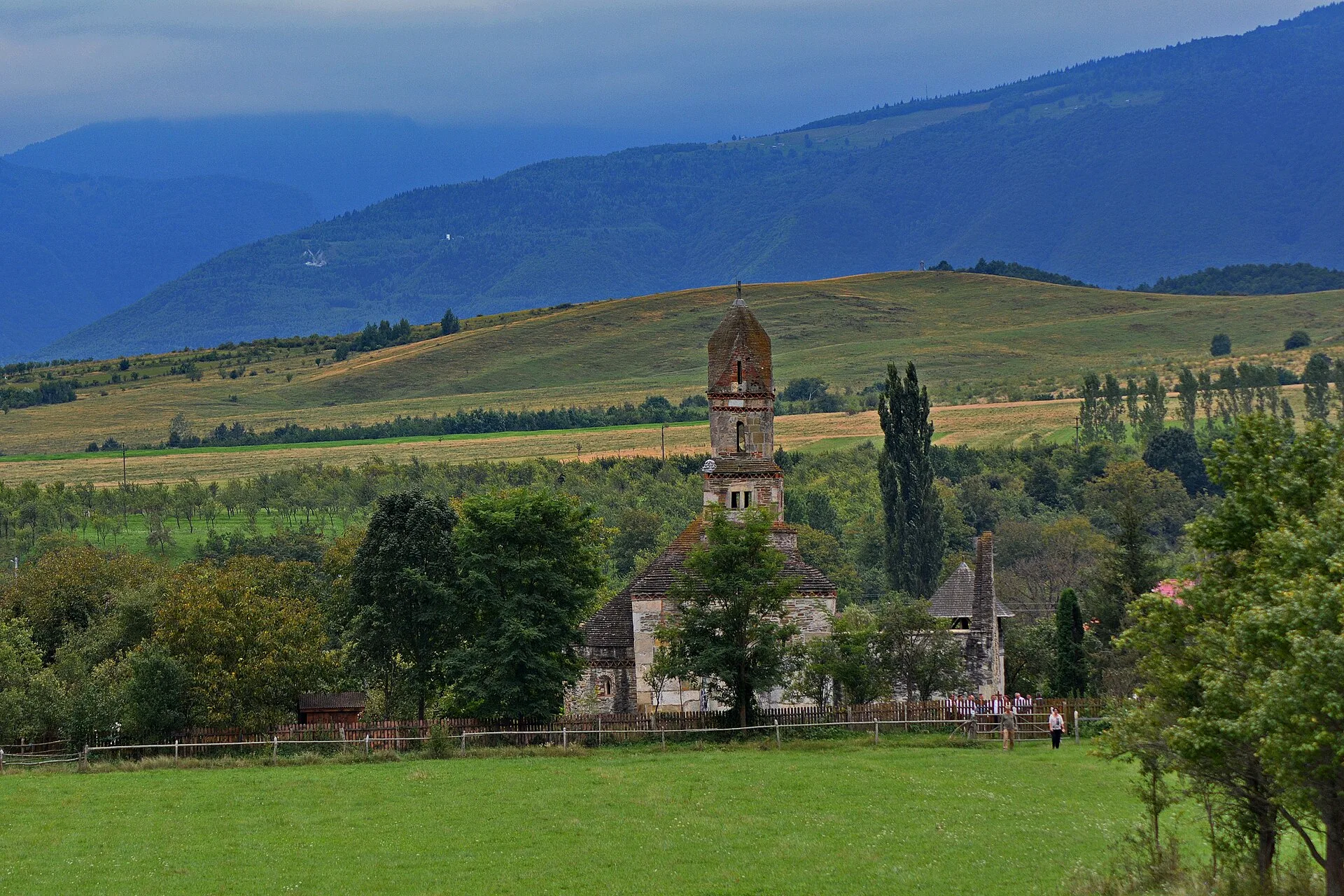
Foto: Mihaibursesc, CC BY-SA 4.0, via Wikimedia Commons
The Hațeg Country is a historical and ethnographic region in the south-western corner of Transylvania, in Hunedoara County. Geographically it coincides with the Hațeg Depression, bounded by the Retezat Mountains to the south, the Șureanu Mountains to the east and north-east, the Țarcu Mountains to the west and the Poiana Ruscă Mountains to the north, and covers about 1,300 km². It is drained by the Strei, Râul Mare and Galbena rivers, and its centre is the town of Hațeg. It is reached by three routes: from Simeria along the Strei valley, from the Banat through the Iron Gate of Transylvania, and from Petroșani over the Merișor-Bănița pass.
Traces of Middle Palaeolithic humans have been found in Bordu Mare cave at Ohaba-Ponor. After the conquest of Dacia, the Romans founded the provincial capital, Ulpia Traiana Sarmizegetusa, in the west of the region. The first mention of the land, "terra Harszoc", appears in the Diploma of the Knights Hospitaller of 1247, when it belonged to the voivodeship of Litovoi. The historian Radu Popa identified 11 large knezates here; the knezes' assemblies held courts until the fourteenth and fifteenth centuries, and noble families such as Kendeffy (Cânde) and Kenderessy (Cândreș) rose from among the Hațeg knezes.
Surviving medieval sites include the royal fortress of Hațeg at Subcetate, recorded in 1317, the tower at Răchitova, the knezes' fortresses of Colț and Mălăiești, and the ruins of the knezes' manor courts at Râu de Mori and Sălașu de Sus. Radu Popa regarded the stone churches of the Hațeg Country as "the oldest and most important group of surviving Romanian medieval monuments". The oldest group, from the twelfth and thirteenth centuries, comprises the churches of Streisângeorgiu, Densuș, Peșteana, Ostrov, Sântămăria-Orlea and Strei, followed by those of Sânpetru, Râu de Mori and Suseni (Colț).
In the eighteenth century, Hațeg was one of the three districts whose Romanian inhabitants, in the petitions of Inochentie Micu and the Greek Catholic clergy, asked for officials from among their own people. In the 1760s, part of the region was militarised, with companies of the First Border Regiment at Hațeg and Râu Alb. The noble castles of Sântămăria-Orlea, Nălațvad and Săcel were built in the late eighteenth and the nineteenth centuries.
Țara Hațegului, județul Hunedoara (centru: orașul Hațeg)