
Attraction
Bâtca Doamnei Dacian Site
The archaeological site on Bâtca Doamnei hill, about 4 km south-west of central Piatra Neamț, comprises a Dacian fortified settlement from the second century BC to the first century AD and a settlement from the eleventh to thirteenth centuries. The fortress was discovered in 1928 by Constantin Mătasă, and archaeological excavations began in 1957.
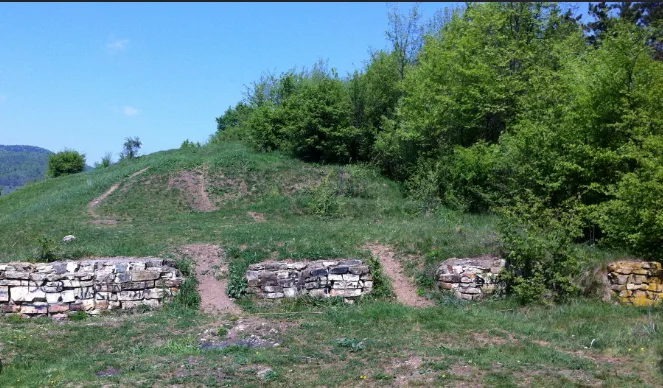
The Bâtca Doamnei archaeological site lies on the hill of the same name (462 m), about 4 km south-west of central Piatra Neamț and south of Lacul Bâtca Doamnei. It is a listed historic monument (LMI code NT-I-s-A-10480) with two components: the Dacian fortified settlement, dated from the second century BC to the first century AD (NT-I-m-A-10480.02), and a settlement from the eleventh to thirteenth centuries (NT-I-m-A-10480.01). The remains cover almost 20,000 m² on the hilltop.
The fortress was discovered in 1928 by the priest and archaeologist Constantin Mătasă, and excavations began in 1957. The oldest traces belong to the Neolithic (Cucuteni culture), followed by a Bronze Age level and the Geto-Dacian layer. Two Dacian occupation levels have been identified, one from the second century BC and one from the first century BC to the first century AD, the period of greatest development. The finds at Bâtca Doamnei, Cozla and Piatra Șoimului are the basis for locating Petrodava, a settlement mentioned in Ptolemy's Geography, in the Piatra Neamț area.
Excavations uncovered a stone wall forming an irregular quadrilateral, well preserved only on its southern side, and a sanctuary of aligned stone drums of the type found at the Dacian centres in the Orăștie Mountains. Finds include plain and painted pottery, ornaments, and iron weapons and tools. Excavations carried out in 1980 and published in 2022 by Virgil Mihăilescu-Bîrliba showed that the wall interpreted as defensive was in fact a retaining wall for the upper terrace, and that the hill had a single large terraced sanctuary rather than two sanctuaries from different periods.
The medieval settlement has yielded wheel-made pottery, a coin of King Béla III of Hungary, two swords and two Byzantine reliquary crosses decorated with niello, with the Crucifixion on one side and busts of Saints Peter, Paul and Nicholas on the other, held by the Museum of History and Archaeology in Piatra Neamț. A paved road leads close to the rocks at the foot of the hill, and from there a wide path climbs to the ruins.
Dealul Bâtca Doamnei, Piatra Neamț, județul Neamț