
Attraction
Great Synagogue of Bucharest
The Great Synagogue, originally known as the "Polish Synagogue," is located at 11 Vasile Adamache Street in Bucharest and was built between 1845 and 1846 by the Ashkenazi Jewish community from Poland. Since 1991 it has housed the Holocaust Museum of Romania and the "Chief Rabbi Dr. Moses Rosen" Memorial to Jewish Martyrs. Worth visiting for its Baroque-Rococo architecture and its unique memorial role within Romania's Jewish heritage.
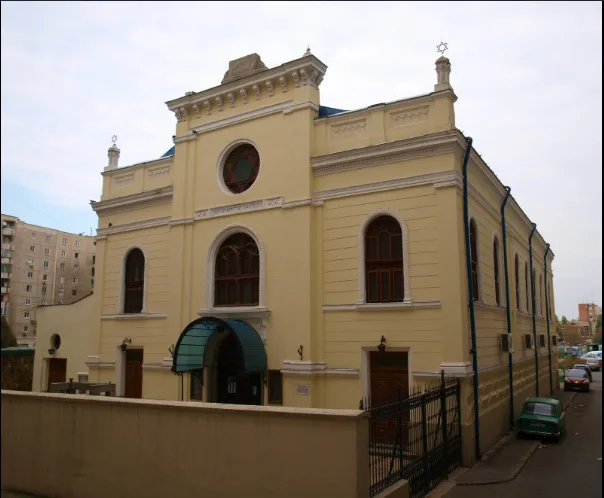
The Great Synagogue of Bucharest stands at 11 Vasile Adamache Street, in the old Jewish quarter near Unirii Square. Built between 1845 and 1846 by the Ashkenazi Jewish community from Poland, it was inaugurated for Rosh Hashanah in 1847 and became known as the "Great Synagogue" because, for a long time, it was the largest Jewish house of prayer in the capital.
The building, covering 715 square meters, blends Baroque and Rococo styles, with a semi-cylindrical vault and a main facade framed by pilasters. It was repainted in Rococo style in 1936 by Ghershon Horowitz. The synagogue was damaged in the 1940 earthquake and vandalized by the Legionnaires in 1941, repaired in 1945, and reinforced in 1980. In the 1980s, the surrounding area was enclosed by ten-story apartment blocks built during communist urban restructuring, leaving the building hidden from public view; its facade was restored in 2007.
Since 1991, the Great Synagogue has housed the Holocaust Museum of Romania and the permanent exhibition "Memorial to Jewish Martyrs — Chief Rabbi Dr. Moses Rosen," and is no longer in regular religious use. It is reached by metro, with Piața Unirii station just a few minutes' walk away. Worth visiting for its well-preserved historic architecture and its role as a memorial to the victims of the Holocaust in Romania.
Strada Vasile Adamache 11, 030167 București