
Attraction
The Great Synagogue of Constanța
The Great Synagogue of Constanța, also known as the Israelite Temple, stands at 2 C.A. Rosetti Street, in the peninsular quarter, and is the only surviving synagogue in the city. It was built in 1911 in Moorish style to designs by the architect Adolf Linz, making it a contemporary of the Casino. After 1989 it fell into ruin, roofless, the only synagogue in Romania to reach that state. It was fully restored and reopened in May 2026, now also serving as a cultural centre.
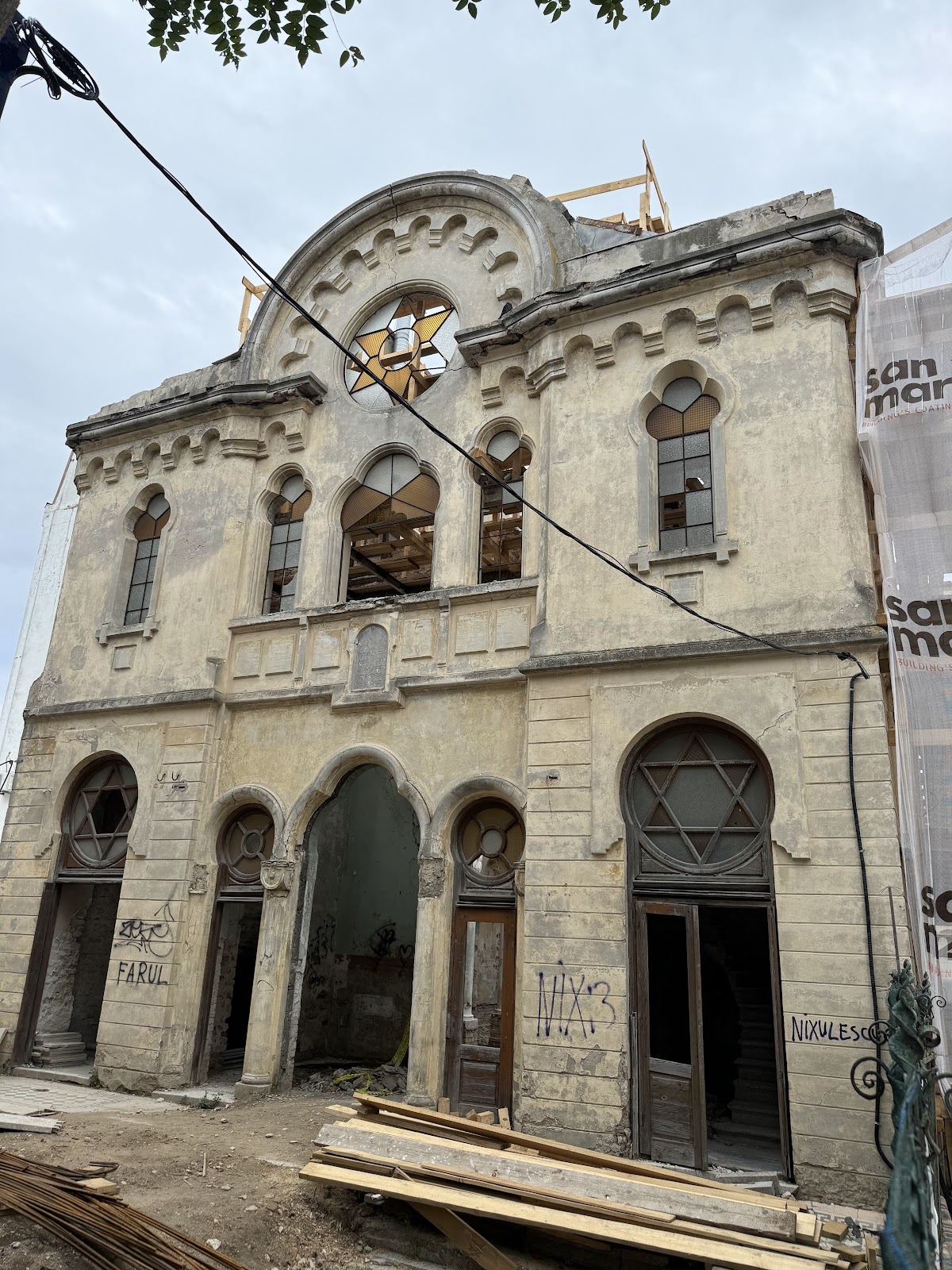
The Great Synagogue of Constanța, also known as the Ashkenazi Israelite Temple, stands at 2 C.A. Rosetti Street, on the corner of Petru Rareș, in the peninsular quarter of the city. It is the only synagogue left in Constanța.
The building was raised in 1911 in Moorish style, to designs by the architect Adolf Linz, who drew dozens of houses in the old town. It is a contemporary of the Casino on the seafront. It is organized in three horizontal registers, plinth, ground floor, and upper floor, and reaches roughly thirteen metres in height. The windows and doors carry Moorish decoration on the exterior, while inside the space is divided into three naves, the central one strongly expressed in the exterior massing. Traditional Jewish decorative motifs appear within as well.
Between the wars, Constanța had two great synagogues. The other, of Sephardi-Romaniote rite, stood at what is now 18 Mircea cel Bătrân Street: a monumental building of Gothic influence, raised near the Greek Church of the Transfiguration and the Armenian Church. Damaged in the 1977 earthquake, it was demolished in 1980. Its site is now a vacant lot turned into a car park.
During the Second World War, in the period of persecution of the Jews, the Great Synagogue was turned into a depot for the German army, which stored there ammunition, non-perishable food, and fodder for the horses of troops on the Eastern Front. After 1944 the building was almost entirely restored and returned to the Jewish community.
The paradox of this building is that it passed through the communist regime untouched but nearly perished in freedom. After 1989 it entered a rapid decline. A hole in the roof, left unrepaired, widened until the whole roof collapsed. For years only four walls remained standing, along with monumental wooden doors half destroyed, a few ornamented columns, and strips of the original blue arabesque decoration. Vegetation grew inside. It was the only synagogue in Romania to become a ruin, in a city known precisely for its ethnic mosaic and for the peaceful coexistence of its communities.
Restoration took more than a decade of administrative effort, with successive tenders annulled. The works themselves, carried out through the National Investment Company and funded by the Ministry of Development, Public Works and Administration with an investment of roughly 15.7 million lei, began in 2023-2024. Final handover took place in April 2026, and the synagogue was reinaugurated a month later, in May 2026. It now also serves as a multifunctional cultural centre, restored to the Jewish community and to the city's tourist circuit alike.
The synagogue is not a listed historic monument, though its architectural value drew the attention of the County Directorate for Culture as early as 2012. The Jewish Community of Constanța today numbers around fifty registered members.
The Great Synagogue is worth visiting for its Moorish architecture, rare in Romania, for the three naves with their blue arabesques recovered from ruin, and because it is, quite literally, a building brought back from death: few monuments in the country came so close to disappearing and were nevertheless saved.
Strada Sarmizegetuza Constanta judetul Constanta