
Attraction
Rock-Cut Hermitages of the Bozioru Mountains
The Rock-Cut Hermitages of the Bozioru Mountains are a nationally significant historic monument, located in the area of Nucu village, Bozioru commune, Buzău County, on the Ivănețu Ridge. The monument comprises 12 distinct points — cells, caves, and rock-cut enclosures — including Fundătura, Agatonul Vechi and Nou, Fundul Peșterii, Piatra lui Iosif, and Dionisie Torcătorul's Cave. Research suggests they were in use from the 3rd-4th centuries AD, continuing through the 16th-17th centuries. The site offers concrete evidence of the interaction between local geology and the history of hermit settlement in the Curvature Subcarpathians.
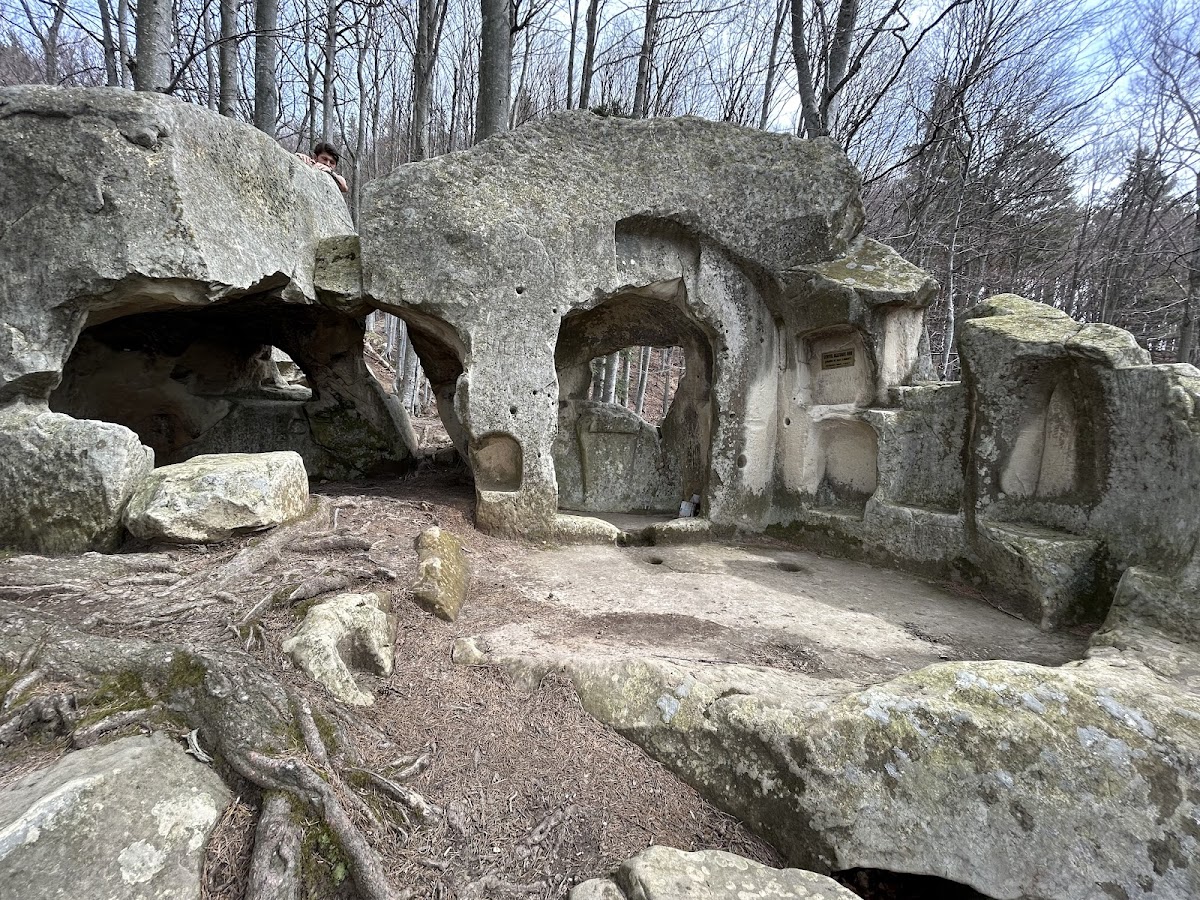
The Rock-Cut Hermitages of the Bozioru Mountains are one of only two nationally significant historic monuments within Bozioru commune, Buzău County, located in the area of Nucu village, on the Ivănețu Ridge — a Paleogene sandstone spur about 1,000 m high. The official monument comprises 12 distinct points: Fundătura, Agatonul Vechi, Agatonul Nou, Fundul Peșterii, Văgăuna I, Văgăuna II, Piatra Îngăurită, Piatra lui Iosif, Dionisie's (Torcătorul) Cave, Piatra Șoimului I, and Piatra Șoimului II.
The complex includes monastic cells, galleries, and chambers hand-carved into sandstone, a local sedimentary rock of relatively low hardness, well suited to manual carving. Archaeological research suggests the enclosures most likely came into use starting in the 3rd-4th centuries AD, with continued use through the 16th-17th centuries, during a period of historical instability in the Middle Ages. One theory, supported by some research but not firmly established, suggests the earliest excavations were made by populations from Anatolia (Turkey), who temporarily settled in the area, with the enclosures later occupied by Orthodox hermits. Archaeologists from Germany, Austria, and Switzerland have repeatedly studied the hermitages, monasteries, and cells of the Buzău Mountains, though no complete, universally accepted dating study yet exists.
Research in the area has identified evidence of continuous habitation, indicating these structures functioned over several centuries. The first documentary mention of monastic life in the area appears in a 1587 document, related to a visit by ruler Mihnea the Turned. With the 1864 secularization of monastery estates, organized monastic life faded, and the settlements were left sparsely populated, becoming hamlets.
The site is reached from Bozioru commune, estimated at 65-90 km north of the city of Buzău (the figure varies significantly depending on the route), via national road DN10 and county roads, through the village of Măgura. From Bozioru, a sign marks a further 10 km on an unpaved, red-marked road, leading to the starting point of the "Luana's Road" themed trail, at Poiana Cozanei. Completing the full circuit, covering all the main landmarks, takes about 7-8 hours; trails are partly marked but require moderate fitness and proper footwear, as some sections are steep and slippery in wet weather. The site lacks developed tourist infrastructure. The Bozioru rock complex is worth visiting for the concrete evidence it offers of human adaptation to the local geological environment and the continuity of monastic life in the Curvature Subcarpathians.
Bozioru judetul Buzau