
Attraction
Cacica Salt Mine
The Cacica salt mine, in Cacica commune, Suceava County, was opened by the Habsburg administration in 1791, with miners brought mainly from Galicia, most of them Poles. Run by the National Salt Company (Salrom), the mine still produces salt and is open to visitors. Underground are the Roman Catholic chapel of St Barbara, inaugurated in 1806 at a depth of 29 m, an Orthodox chapel, a salt lake and a ballroom carved in the salt.
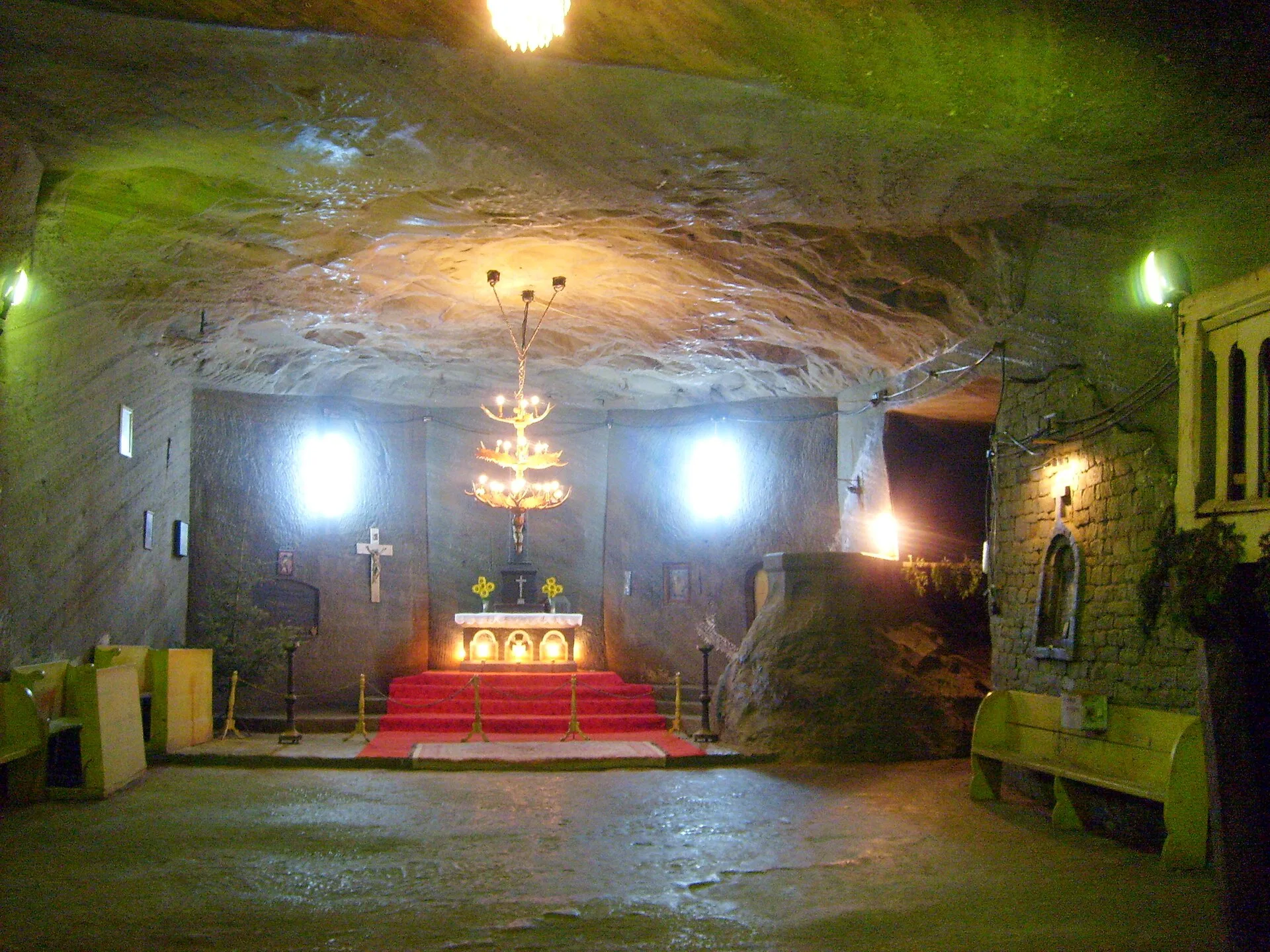
Foto: Tomasz Kuran aka Meteor2017, CC BY 2.5, via Wikimedia Commons
The Cacica salt mine lies in the centre of Cacica commune, Suceava County, on Strada Republicii, about 18 km from Gura Humorului and 40 km from Suceava. Salt has been exploited here for a very long time: excavations in 1952, 1968 and 1989 found traces of salt production from the Starčevo-Criș culture of the Early Neolithic (fifth millennium BC), and there are still salt springs in the area.
After the Habsburg administration took over Bukovina in 1775, works were carried out to open the deposit, and the mine began operating in 1791. Workers and technicians were brought from several provinces of the empire, mainly from Galicia (Wieliczka, Bochnia), most of them Poles, who founded the village's Polish community. Salt is also extracted by dissolution: brine was obtained in underground basins between levels I and III, and since 1956 through wells drilled underground. The mine is run by the National Salt Company (Salrom) and still produces salt.
Visitors go down an old fir-wood staircase spiralling around the shaft. Three levels were opened from the main shaft, at depths of 35, 55 and 70 m. At the foot of the stairs, at 29 m, is the Roman Catholic chapel of St Barbara, inaugurated in 1806 on the initiative of the Polish priest Jakub Bogdanowicz, with its altar and pulpit carved in salt. On level I, at 35 m, is an Orthodox chapel with salt bas-reliefs and an icon of St Daniil Sihastrul. The tour also includes an artificial salt lake dug by hand by the miners, the „Ing. Agripa Popescu” ballroom with three salt-carved balconies, and the „Dwarves' Grotto”.
A salt museum in the administration building displays tools, maps, photographs, minerals and archaeological finds. Nearby stands the Roman Catholic Basilica of the Assumption, linked to the Polish community that grew up around the mine.
Strada Republicii nr. 9, Cacica, județul Suceava