
Attraction
Canaraua Fetii Forest Nature Reserve
The Canaraua Fetii Forest Nature Reserve lies in southwestern Dobruja, south of the town of Băneasa, near the Bulgarian border. Across its 172 hectares, some one thousand species of higher plants are known, more than a quarter of Romania's wild flora. The reserve's core is a canyon-like valley with limestone walls up to 40 metres high, pierced by fissures, niches, and grottoes. It was protected for the Egyptian vulture, the Balkan festoon butterfly, and the spur-thighed tortoise.
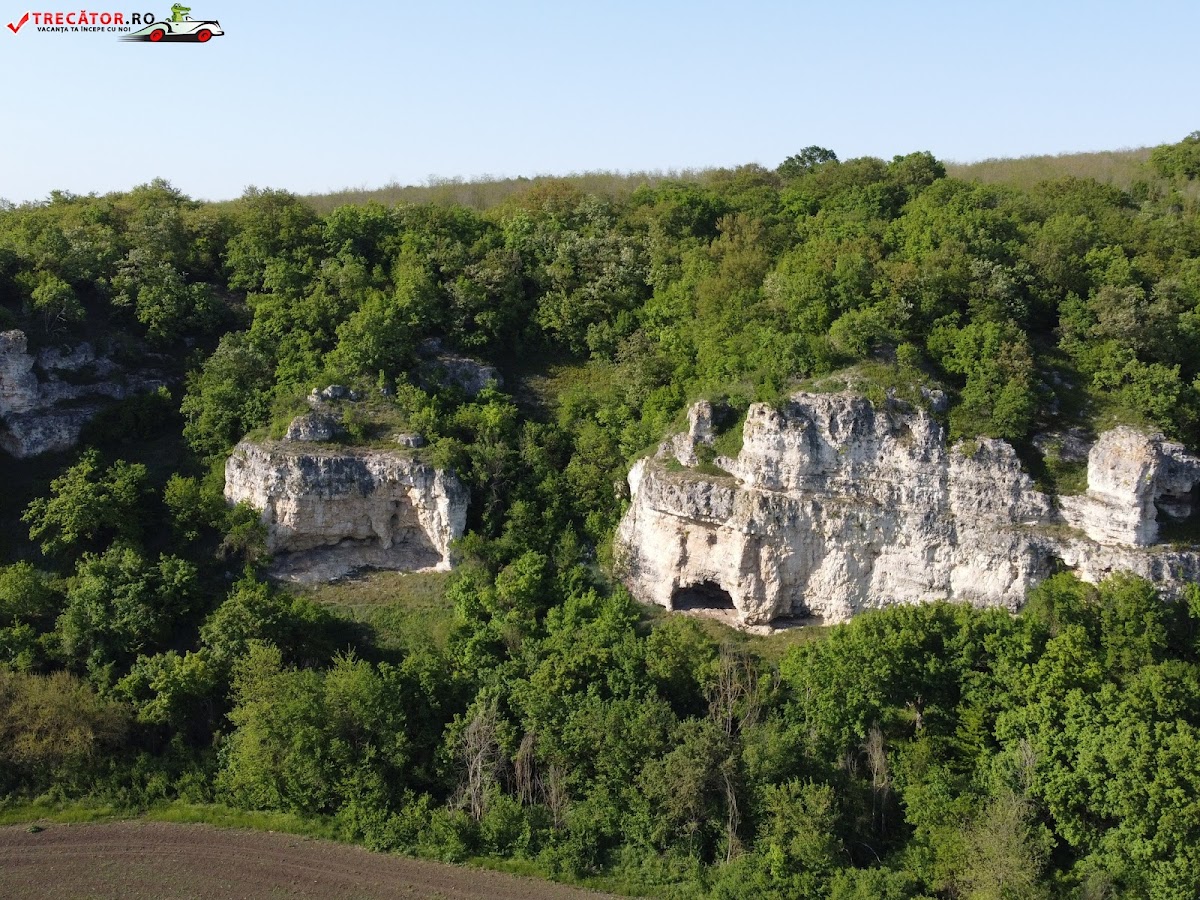
The Canaraua Fetii Forest Nature Reserve lies in the southwest of Constanța County, south of the town of Băneasa and north of the Bulgarian border, near the commune of Lipnița. It covers 172 hectares and is classified as an IUCN category IV nature reserve, coded RONPA0380, listed as a protected area of national interest under Law 5/2000, code 2363. It sits within the Natura 2000 sites "Canaraua Fetii-Iortmac Forest and Valley" and "Băneasa-Canaraua Fetei."
The name comes from the word kanara, which in Bulgarian means rock. It was first given to a single stone formation and later extended to the whole valley.
The reserve's heart is the Canaraua Fetii Valley, a deeply incised depression bounded by steep slopes, canyon-like in appearance. Sarmatian limestone walls rise up to forty metres, furrowed by fissures, niches, and grottoes. Here too lies Canaraua Fetii Cave, developed on two levels, 54 metres long. Unlike ordinary caves, which follow the vertical fissures splitting limestone masses, the caves of this area formed through the differential dissolution of limestone beds by groundwater, or by seawater when its level stood far higher.
The valley's enclosed microclimate and karst relief have allowed an exceptional biodiversity to concentrate in a small territory. Roughly one thousand species of higher plants are known here, about 27% of Romania's wild flora. The forest is thermophilous, with downy oak (Quercus pubescens), grey oak, oriental hornbeam (Carpinus orientalis), and manna ash (Fraxinus ornus), alongside calcicolous steppe and scrub. Of particular botanical interest are the common hornbeam (Carpinus betulus) and the common ash (Fraxinus excelsior): very rare in southern Dobruja though common elsewhere in Romania, they grow here at the edge of their tolerance. The limestone escarpments hold rare species adapted to lime and drought.
As early as 1963, the entomologists N. Săvulescu and A. Popescu-Gorj observed that southwestern Dobruja resembles, entomologically, the southern regions around the Mediterranean: a Mediterranean fragment strayed into Romania, where species recorded in the Balkans, Greece, and Asia Minor meet.
Protection was established for three species: the Egyptian vulture (Neophron percnopterus), since grown extremely rare; the Balkan festoon (Zerynthia cerisyi), of the Papilionidae family; and the spur-thighed tortoise (Testudo graeca ibera), strictly protected across Europe. Among other reptiles recorded here are Hermann's tortoise (Testudo hermanni), the Balkan green lizard, the green lizard, the common wall lizard, the Balkan wall lizard, the snake-eyed skink, the Caspian whipsnake (Coluber caspius), the Aesculapian snake, and the nose-horned viper (Vipera ammodytes).
The mammal fauna is equally rich. Jackals can be heard calling at night, and the wolf, once exterminated here, has returned in recent years. Wildcat, badger, marbled polecat, beech marten, European ground squirrel, lesser mole rat, edible dormouse, and forest dormouse live here, alongside wild boar, roe deer, and red deer. The grottoes shelter several bat species, among them Mehely's horseshoe bat, the greater and lesser horseshoe bats, and Schreiber's bent-winged bat. The area matters for birds too: two globally threatened species nest here, the red-footed falcon (Falco vespertinus) and the European roller (Coracias garrulus).
The protection regime permits visits for scientific and educational purposes. The reserve has no tourist facilities.
Canaraua Fetii Forest is worth visiting for a contrast hard to find elsewhere in Romania: a limestone canyon in the middle of the Dobrujan steppe, where more than a quarter of the country's flora grows across a hundred and seventy hectares, and whose fauna belongs more to the Balkans and Asia Minor than to the Carpathians.
Baneasa judetul Constanta