
Attraction
Unirii Square Bucharest
Union Square is one of the largest public spaces in Bucharest, shaped into its current form during the communist-era urban systematization of the 1980s. It functions as a key transport hub, with a metro station at the crossing of lines M1 and M3, and it brings together Unirii, I.C. Brătianu, Corneliu Coposu, Regina Maria, and Dimitrie Cantemir boulevards. It offers a direct view of the architecture and urban planning characteristic of the Ceaușescu era.
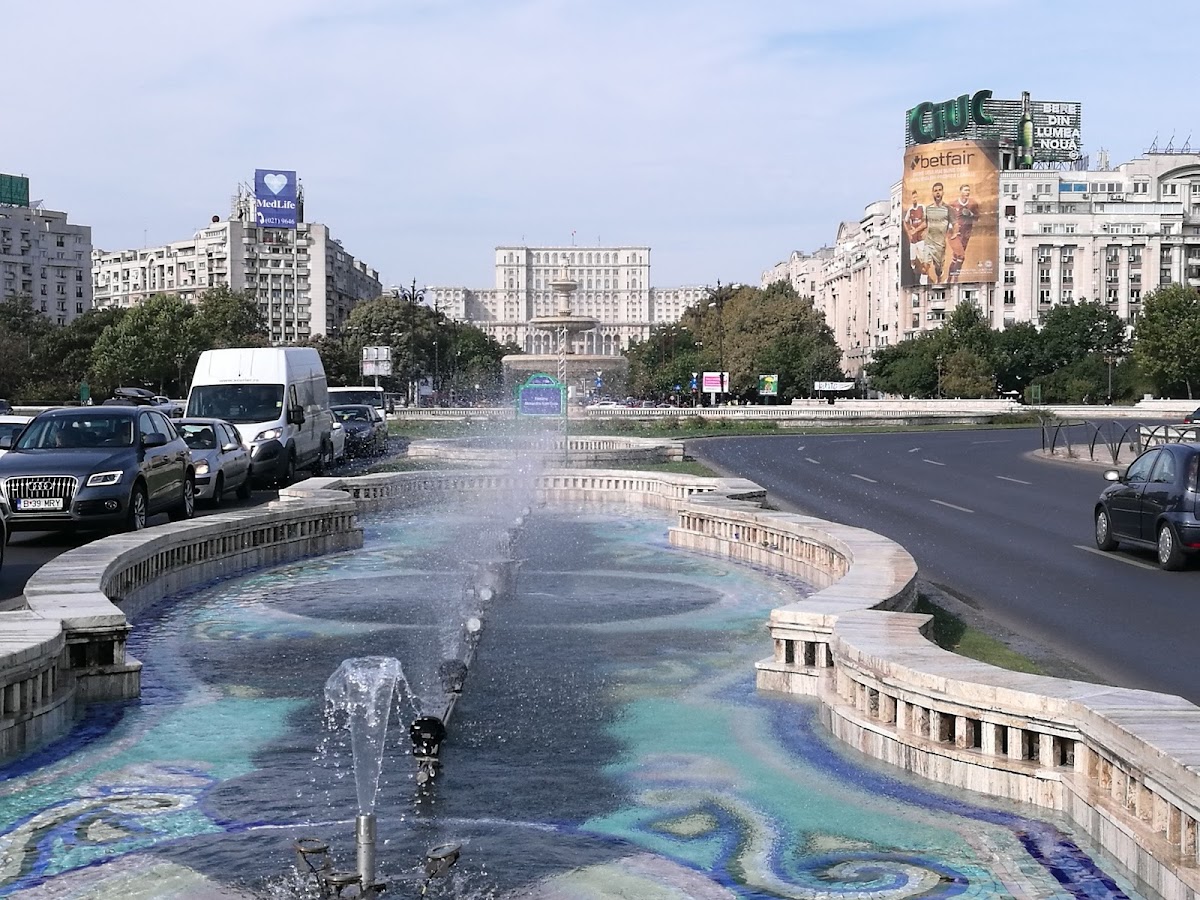
Union Square is one of the largest urban squares in Bucharest and in Romania. Located in the central part of the capital, at the crossing of several major arteries, the square functions as a major traffic hub, connecting Unirii, I.C. Brătianu, Dimitrie Cantemir, Regina Maria, and Corneliu Coposu boulevards, as well as Splaiul Unirii.
Its current layout dates from the communist era, when, as part of the 1980s urban systematization project initiated by Nicolae Ceaușescu, dozens of apartment blocks, churches, and historic streets were demolished to create the east-west vista toward the People's House.
The square houses one of Bucharest's most important metro stations — the Piața Unirii platform on lines M1 and M3 opened in 1979, while the M2 line station opened in 1986 — handling hundreds of thousands of passengers daily. The fountains at the center of the square, restored several times over the years, are lit up at night. Beneath the square lies the Unirii Underpass, a road and pedestrian tunnel inaugurated in 1987.
Historically, the area now occupied by the square was once home to Spirii Hill and neighborhoods representative of interwar Bucharest architecture, before systematization. Union Square is worth visiting for the direct view it offers of the radical urban transformations of the communist period, and as a landmark for understanding the capital's recent history.
Piata Unirii Bucuresti