
Attraction
Avram Iancu Square, Cluj-Napoca
Avram Iancu Square is the second large square of central Cluj, laid out in the early 20th century on the site of the former cattle and timber market. It is dominated by the Metropolitan Cathedral, the National Theatre and the 1993 statue of Avram Iancu, surrounded by administrative palaces from the Austro-Hungarian period.
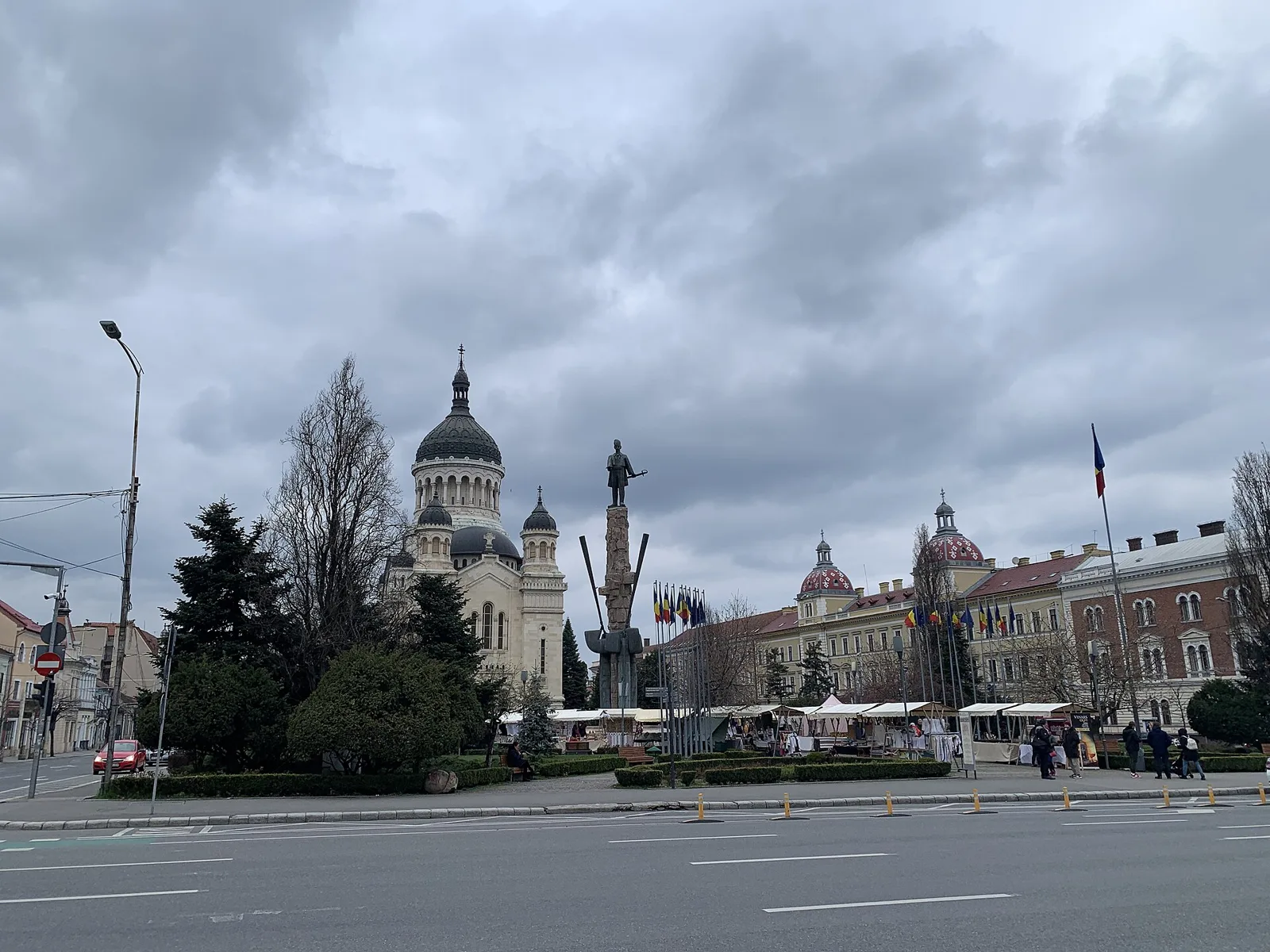
Foto: Chainwit., CC BY 4.0, via Wikimedia Commons
Avram Iancu Square lies in the centre of Cluj-Napoca, about 600 metres east of Unirii Square, to which it is linked by Eroilor and 21 Decembrie 1989 boulevards. The Orthodox Metropolitan Cathedral rises in its middle, and to the south, towards Ștefan cel Mare Square, stands the building of the National Theatre and Romanian Opera.
Until the second half of the 19th century the site was in turn a military drill ground, a pasture and then a cattle and timber market. In the Belle Époque the area was redesigned as an extension of the civic centre, with two adjoining squares: the southern one became Ștefan cel Mare Square, while the northern one was named in turn after EMKE, Bocskai, Cuza Vodă (from 1923), Malinovsky after the Second World War, and then Victory Square. It received its present name in 1993, when, on the initiative of mayor Gheorghe Funar, the statue of Avram Iancu by sculptor Ilie Berindei was unveiled here on 30 November 1993.
Around the square you can see the Metropolitan Cathedral (consecrated in 1933), the National Theatre (1904-1906, architects Fellner and Helmer), the Palace of Justice (1902), the Prefecture Palace (1910), the Orthodox Archbishop's Palace, the Finance Palace and the former EMKE headquarters, now the regional office of the Romanian Railways. The base of the Avram Iancu statue bears three women blowing the tulnic, the alpine horn, calling the mountain people to fight; the group, originally planned to include Iancu's tribunes as well, was never completed. Behind the cathedral stands the "Glory to the Romanian Soldier" monument. The square is easy to explore on foot as part of a walk through the historic centre.
The square has no LMI code of its own, but several buildings around it are historic monuments: the National Theatre (CJ-II-m-A-07355), the Metropolitan Cathedral (CJ-II-m-B-07354), the Palace of Justice (CJ-II-m-B-07316), the Prefecture Palace (CJ-II-m-B-07267) and the Orthodox Archbishop's Palace (CJ-II-m-B-07359).
Did you know that the square changed its name at least six times in a century? During the Second World War the Hungarian authorities even named it Adolf Hitler Square, and after the war it was named after the Soviet marshal Rodion Malinovsky, a name replaced under Ceaușescu by Victory Square.
Piața Avram Iancu, Cluj-Napoca, județul Cluj