
Attraction
Limanu Cave
Limanu Cave, in the commune of the same name in Constanța County, is Dobruja's longest cave, with roughly 3.6 kilometres of galleries cut into Sarmatian limestone. Its network has no main or secondary passages but branches in every direction, and seen in plan it resembles the street map of a city. It shelters significant bat colonies, and archaeological finds attest to its use since antiquity. It is a protected area, undeveloped for tourism, with a real risk of getting lost and of ceiling collapse.
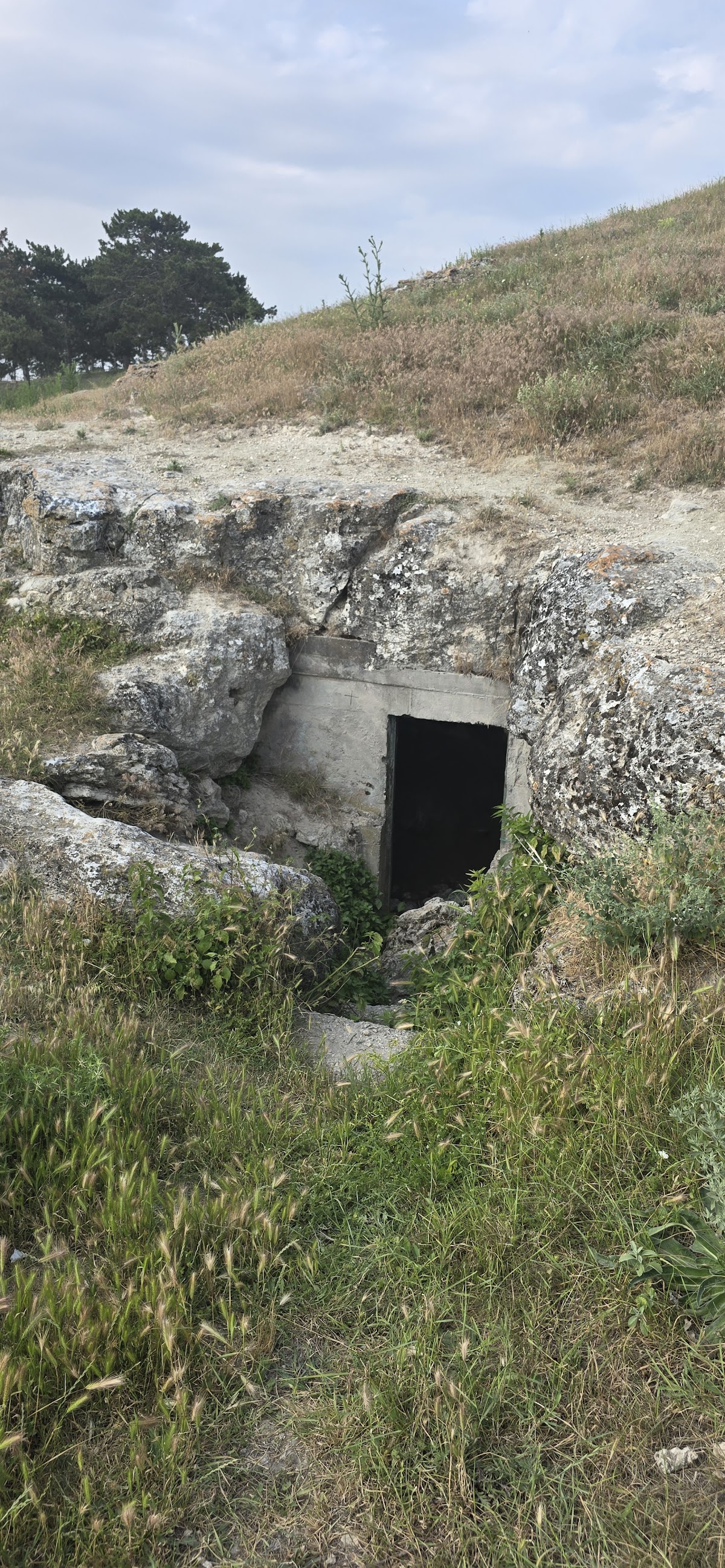
Limanu Cave lies in Limanu commune, Constanța County, about 5 kilometres from Mangalia, in southern Dobruja, on the shore of Lake Mangalia. It is also known as Caracicola Cave, after the settlement's old name, the Cave of Icons, after the stone faces at its entrance, or the Cave of Bats.
With a recorded length of 3.64 kilometres, it is by far the longest cave in Dobruja. It formed in Sarmatian limestone with horizontal bedding, cut by vertical fractures. What makes it unusual is its configuration: being a plateau cave, the water did not flow along a principal direction but pooled and cut galleries in every direction. The result is a labyrinth without hierarchy, in which secondary passages do not converge on underground boulevards, as happens in most caves. Seen in plan, the network resembles the street map of a badly planned city.
Some galleries have a strikingly regular rectangular cross-section, as if carved by human hands. This is a morphology characteristic of caves developed in tabular structures, found also in Mammoth Cave in the United States, the longest in the world. Researchers do allow, however, that some galleries may indeed have been shaped by people, the chiselling of the walls being evident in certain places.
The cave lacks stalactites and stalagmites entirely, owing to the absence of water infiltration from the surface. The entrance, facing south, sits at 25 metres altitude and measures roughly 3.5 metres wide and 1.40 metres high. The cave develops almost horizontally, with elevation differences from the entrance not exceeding five metres.
The network is divided into three sectors, linked by very narrow passages, some only 50 to 60 centimetres high. The sector nearest the entrance holds numerous bat colonies, and the floor is covered in places by guano deposits over 50 centimetres thick. Microclimatic conditions are stable: a constant temperature of about 12°C, humidity of 85 to 90 percent, and an almost complete absence of air currents. These conditions support a rich fauna of troglobitic invertebrates feeding on the guano. Besides bats, other vertebrates turn up by chance: snakes, tortoises, foxes, polecats.
Human traces are old and numerous. In the more accessible galleries, Greek pottery and oil lamps have been found, and the inhabitants of the fortress of Callatis carved altars here, coming to worship the god Mithras, born of stone. In the central sector, fragments of Roman amphorae have been recovered, alongside the skeletons of wild and domestic mammals. The archaeologist Vasile Boroneanț identified incisions and charcoal drawings which he judged very old, possibly Neolithic, others possibly Dacian.
From this comes the site's best-known legend. The Limanu cave may be Keiris, the cavern where the Dacians of Dobruja took refuge from the Romans after the death of Burebista, around 30 BC. The territory was then divided among the Getic kings Dapyx, Roles, and Zyraxes. In the struggle for power, Dapyx was defeated by Romans summoned by Roles, and his people fled into the cave of Keiris, prepared to cross the labyrinth and emerge elsewhere. The Romans walled them in. Archaeologists have never identified the site of Keiris with certainty, but Limanu fits the description best, through its labyrinth and its seemingly chiselled walls.
The cave is a designated protected area, in the custody of the GESS speleological association. That custody is exercised with great difficulty: the 350-kilogram metal gate protecting the entrance was torn out with machinery and sold for scrap. Over the years the galleries have suffered from rubbish, walls blackened by smoke, and bats disturbed by visitors.
The cave is not developed for tourism. It has neither lighting nor markings. Access to certain galleries is dangerous because of the risk of ceiling collapse, and visitors have become lost in the network. A visit requires proper equipment, a backup light source, and, in any case, a guide. Do not enter alone.
Limanu Cave rewards a careful, guided visit for a kind of underground labyrinth without equivalent in Romania, for the archaeological context linking Callatis, the cult of Mithras, and the legend of King Dapyx, and for the bat colonies that make it a site of real biospeleological importance.
Limanu judetul Constanta