
Attraction
Fundul Peșterii Cave
Fundul Peșterii Cave, near Nucu village in Bozioru commune, is the most important prehistoric rock-art monument in the Buzău Mountains. More than 140 surviving engravings on the grotto's walls depict daggers, spear and arrow points, geometric figures, and solar symbols, in a combination unique in southeastern Europe. The cave was inhabited and used for ritual purposes from the Bronze Age until the 19th century. Access to the interior is now closed off by a metal grille, for conservation.
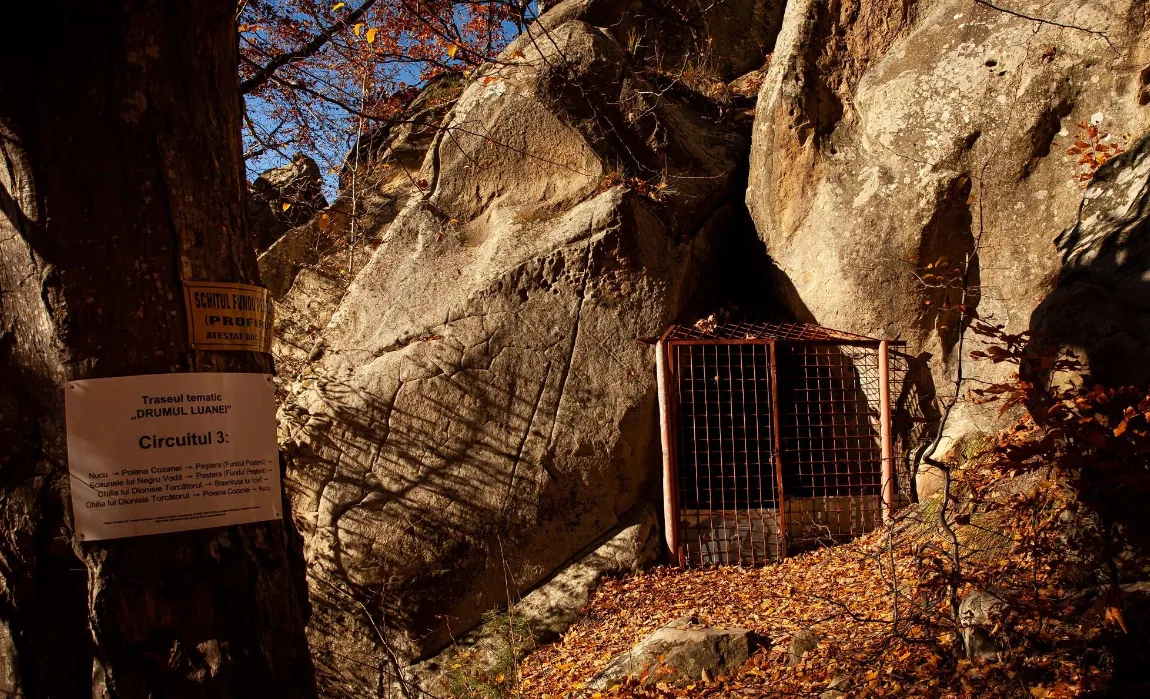
Fundul Peșterii Cave lies 2 km west of Nucu village, Bozioru commune, Buzău County, on the southern slope of a spur off Culmea Spătarului, roughly 150 m from Dionisie the Spinner's Cell. It is a natural grotto, formed by erosion and rockfall, later adapted for habitation. It belongs to the Aluniș-Nucu-Ruginoasa rock-cut complex, a group of some 29 identified settlements across Bozioru, Brăești, and Colți communes, clustered around the Ivănețu ridge, the densest concentration of rock-cut hermitages and monastic dwellings in Romania. The area is popularly known as the Land of Luana.
All the rock-cut settlements here are carved into the same sandy rock, Kliwa Sandstone, formed on the floor of a prehistoric sea and characteristic of the Carpathian Oligocene. The whole region falls within the UNESCO Buzău Land Geopark, accredited in April 2022, Romania's second UNESCO geopark.
What makes Fundul Peșterii exceptional are the more than 140 surviving engravings on its interior walls, made by incision and scratching. Depictions of weapons dominate: daggers, spear points, arrow and javelin heads with or without wooden shafts, fringed blades, halberds. Alongside them appear a drawn bow with its arrow about to fly, a pentagram, a right hand, anthropomorphic figures, angles, triangles, X-runged ladders, and solar designs. The weapon depictions are unique not only in Romania but across southeastern Europe; parallels have been identified in the Iberian Peninsula, France, Italy, and Morocco, and within Romania at Basarabi and in the Danube Gorges.
The engravings mark three superimposed periods of occupation. The first corresponds to the late Bronze Age and early Iron Age, when Monteoru-type communities practised a cult of weapons. The second belongs to the late Hallstatt, the 6th to 4th centuries BC, when akinakes daggers were carried by the Geto-Dacians; their presence has raised unresolved questions about these communities' contacts with the Scythian and Near Eastern worlds. The third spans the medieval period, the 13th to 19th centuries, when hermits and monks overlaid the prehistoric designs with crosses, liturgical objects, names in modern Greek and Cyrillic script, and dates.
In the medieval period the grotto housed the Profiru, or Porfirie, hermitage, first documented in 1639 and last mentioned in 1733, though archaeological evidence points to use into the 18th century. Some studies suggest the small cave served, in prehistory, for the initiation of warrior elites and the coming of age of young men destined to become fighters.
In 1871, Alexandru Odobescu surveyed these remains, accompanied by the Swiss painter Henri Trenk, whose sketches and watercolours are kept at the Print Room of the Romanian Academy Library. Given the monument's importance and the damage caused by vandalism, the Buzău County History Museum closed off interior access with a metal grille; the grotto can be viewed from outside.
Colti judetul Buzau