
Attraction
Tăbăcărie Park
Tăbăcărie Park spreads over roughly 100 hectares around the lake of the same name, in the northern part of Constanța, making it one of the largest parks in Romania. Tăbăcărie Lake, a fluvio-marine liman of about 99 hectares with depths ranging from 1.5 to 4.4 metres, forms part of the Siutghiol lake complex. The park is home to the Constanța Dolphinarium, opened on 1 June 1972, the first in southeastern Europe and the only one in Romania, as well as the Maramureș wooden church of Saint Menas and the permanent Expoflora flower exhibition.
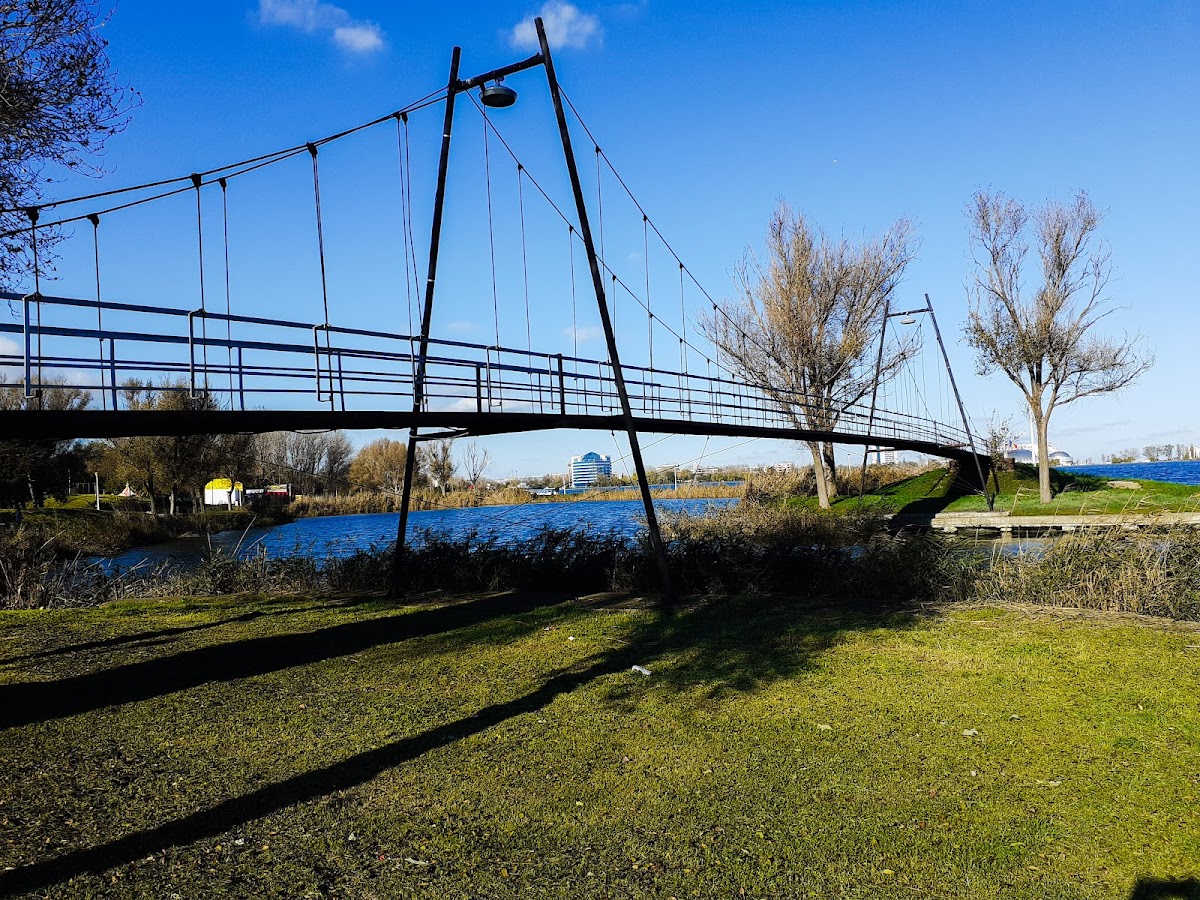
Tăbăcărie Park lies in the northern part of Constanța and covers roughly 100 hectares around the lake of the same name. It is among the largest parks in Romania and the city's principal green space. Its name comes from the leather-tanning trade once practised here, when the tanners' workshops stood close to the water.
Tăbăcărie Lake is a fluvio-marine liman of about 99 hectares, with depths varying between 1.5 and 4.4 metres. It belongs to the Siutghiol lake complex, alongside the lake of that name; locals have long called them "the small ghiol" and "the great ghiol." Its water level depends on inflow from Siutghiol, while surplus water is discharged into the Black Sea through a sluice at the point known as "Pescărie."
The park holds several inner lakes, with islands, peninsulas, and isthmuses connected by bridges and footbridges. The vegetation is typical of lakeside settings: willows, poplars, bald cypresses, and red oak, alongside chestnuts, birches, beeches, and magnolias. Four hectares are given over to Expoflora, a permanent exhibition holding thousands of plants of many species. The park also contains the Maramureș wooden church dedicated to Saint Menas. The lake serves as a stopover for migrating birds, and its waters hold carp, crucian carp, and bream.
The park's best-known institution is the Constanța Dolphinarium, which opened on 1 June 1972. It was the first dolphinarium in southeastern Europe and remains the only institution of its kind in Romania. Over the years it has housed dolphins of the three species native to the Black Sea: the harbour porpoise, the common dolphin, and the bottlenose dolphin. The Dolphinarium is the most visited site within the Natural Sciences Museum Complex, an ensemble covering some 13 hectares that also includes the Danube Delta Micro-Reserve, the Planetarium, the Astronomical Observatory, and the Exotic and Ornamental Bird Exhibition.
In October 2023, Constanța City Council approved the technical and economic documentation for rehabilitating and reinforcing the lake's banks, an investment estimated at roughly 36.8 million lei including VAT. Technical assessment concluded that the bank defences had deteriorated and that delaying the work would accelerate erosion.
Tăbăcărie Park is worth visiting for its unusual scale in a coastal city, for its liman landscape of islands and footbridges, unlike any other urban park in Romania, and for the concentration within a single perimeter of a dolphinarium, a planetarium, an astronomical observatory, and a Maramureș wooden church.
Parcul Tabacarie Constanta judetul Constanta