
Attraction
Cișmigiu Park (Cișmigiu Garden)
Cișmigiu Park, laid out starting in 1845 on the site of the former "Dura the Merchant's Marsh," is Bucharest's oldest public park, covering about 17 hectares, with a central lake used for boating in summer and skating in winter. It is home to centuries-old trees, some over 150 years old, and several cultural landmarks, including the Writers' Rotunda. It is reached from Regina Elisabeta Boulevard, near Izvor metro station.
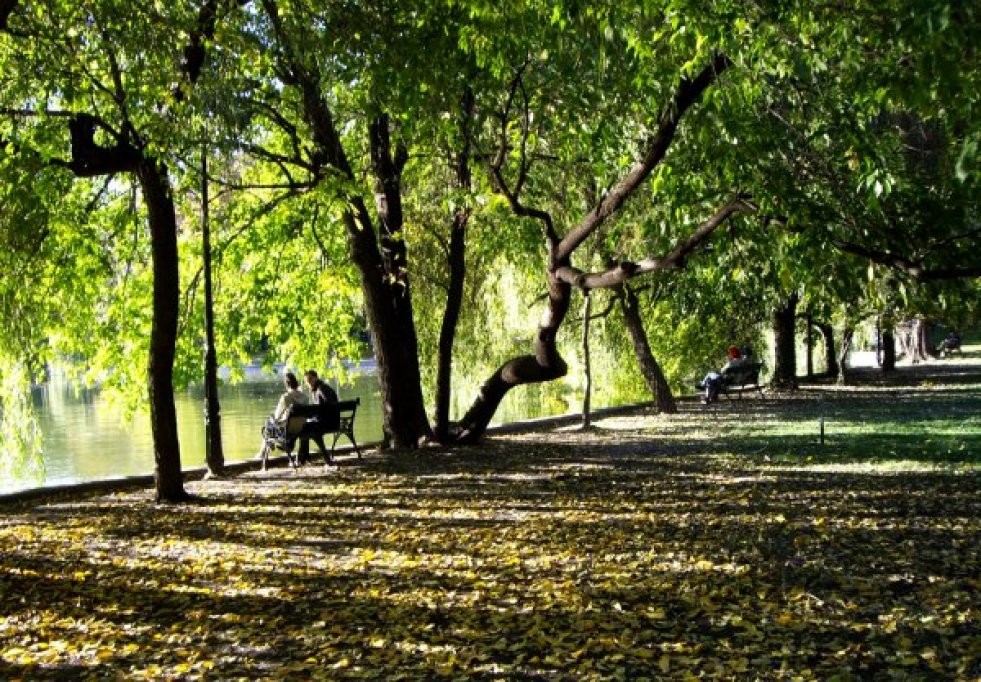
Cișmigiu Park is Bucharest's oldest public park, located in the heart of the capital, bordered by Regina Elisabeta Boulevard, Schitu Măgureanu Boulevard, and Știrbei Vodă Street. The area was known from the 17th century as "Dura the Merchant's Marsh" — a swamp fed by underground springs. In 1779, ruler Alexandru Ipsilanti ordered a public fountain (cișmea) built nearby; the park's current name comes from "cișmigiu," the keeper responsible for maintaining the city's fountains.
General Pavel Kiseleff ordered the marsh drained as early as 1830, but actual work began only in 1845, when the land passed to the city council. Landscape architect Carl Wilhelm Meyer, former director of Vienna's Imperial Gardens, was brought from Vienna to design the park, laying out winding paths, a boating lake, and planting over 30,000 trees and shrubs, sourced from around Bucharest as well as from Brașov and Vienna. Meyer died prematurely of typhoid fever in 1852, at just 38, before seeing the park finished; the work was completed by German landscape architect Friedrich Rebhuhn, and the park was officially inaugurated in 1854.
The park now covers about 17 hectares, with a central lake fed by a channel from the Dâmbovița River, used for boating in summer and sometimes as a natural ice rink in winter. It is home to mature trees — plane trees, lindens, oaks, weeping willows — some over 150 years old. Notable spots include the Writers' Rotunda (1943, with 12 busts of major Romanian writers), the Roman Garden, the ruins of "La Cetate" monastery (built by chancellor Văcărescu in 1756, with a secret tunnel to the Dâmbovița), and the historic "Monte Carlo" restaurant, built by architect Ion Mincu.
The park is listed as a category-A historic monument and a protected dendrological park. It is reached from Regina Elisabeta Boulevard, near Izvor metro station, or through its other entrances off Schitu Măgureanu Boulevard and Știrbei Vodă Street. Worth visiting for its historical value, its varied tree collection, and its standing as Bucharest's most representative example of 19th-century urban landscape design.
Bulevardul Regina Elisabeta Bucuresti