
Attraction
Royal Palace of Bucharest
The Royal Palace of Bucharest, in its current form built between 1930 and 1937 under the coordination of architect Nicolae Nenciulescu, stands on Calea Victoriei and now houses the National Museum of Art of Romania, with a collection of over 100,000 works. The building, covering more than 20,000 square meters, served as the official residence of the Romanian Royal House from 1837 to 1947. It stands as a key landmark for understanding Romania's modern political and cultural history.
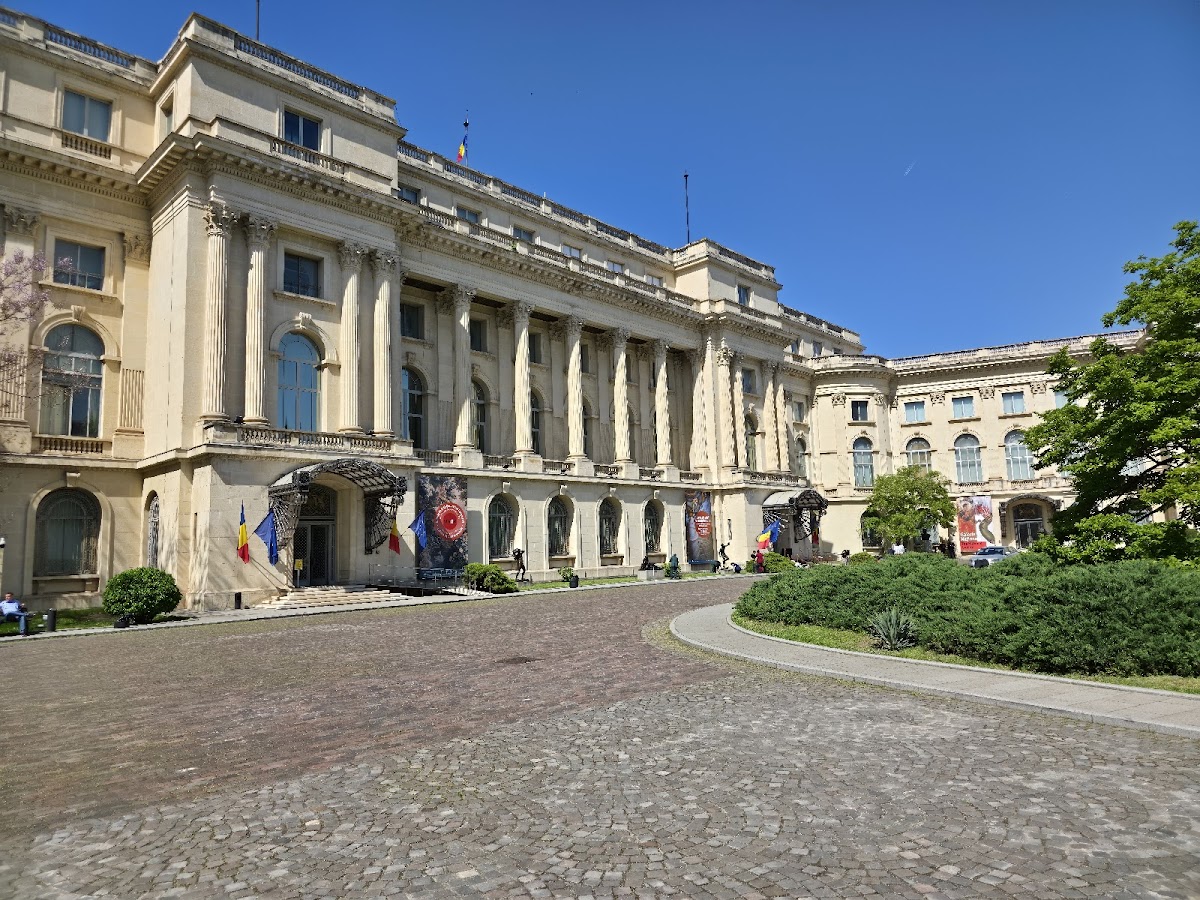
The Royal Palace of Bucharest stands at 49-53 Calea Victoriei, in the heart of the capital, and is one of Romania's most important historical and cultural buildings. The site was first built up in 1812 with the Golescu House; from September 1837 it became the Princely Court under Alexandru Dimitrie Ghica, later serving as the residence of Alexandru Ioan Cuza (1859-1866) and King Carol I, who substantially expanded it with the help of architects Paul Gottereau and Karel Liman.
A major fire on the night of 7/8 December 1926 completely destroyed the palace's central wing. The old Golescu House was demolished in 1935-1936, and the reconstruction, initiated by King Carol II, involved several architects — N.N. Nenciulescu, Karel Liman, Arthur Lorenz — under Nenciulescu's overall coordination, to whom the building's current layout is credited. Work was completed in 1937. The building is U-shaped, with three main wings grouped around a courtyard open toward Calea Victoriei, and the central column on the facade deliberately symbolizes the Monarchy as a unifying point for the nation.
The palace served as the official seat of Romania's Royal House throughout the constitutional monarchy and hosted state ceremonies, diplomatic audiences, and major political events — including King Michael I's oath, taken in the Throne Room on 6 September 1940. The total built area exceeds 20,000 square meters, with several wings arranged around an interior courtyard; the main facade, facing Calea Victoriei, is about 150 meters long.
After King Michael I's forced abdication in 1947, the building was taken over by the state and became home to the National Museum of Art of Romania, a role it still fulfills today, with a collection of over 100,000 works. In December 1989, during the Revolution, the building was damaged 80%, with more than 1,000 artworks destroyed or damaged; restoration took place in stages, with the last galleries reopening only in 2000-2002. It is reached from Calea Victoriei, near Revolution Square, by public transport — bus lines 61 and 69, or metro to Universitate station. Worth visiting for its national collection of Romanian and European art, as well as the architectural and historical value of the building itself.
Calea Victoriei 49-53 Bucuresti