
Attraction
Palace of Culture, Iași
The Palace of Culture in Iași is a Neo-Gothic building erected between 1906 and 1925 to designs by the architect I. D. Berindey, on the site of the old princely court, originally as the Administrative and Justice Palace. Since 1955 it has housed the Moldova National Museum Complex, with the Museum of the History of Moldavia, the Art Museum, the Ethnographic Museum of Moldavia and the Ștefan Procopiu Museum of Science and Technology.
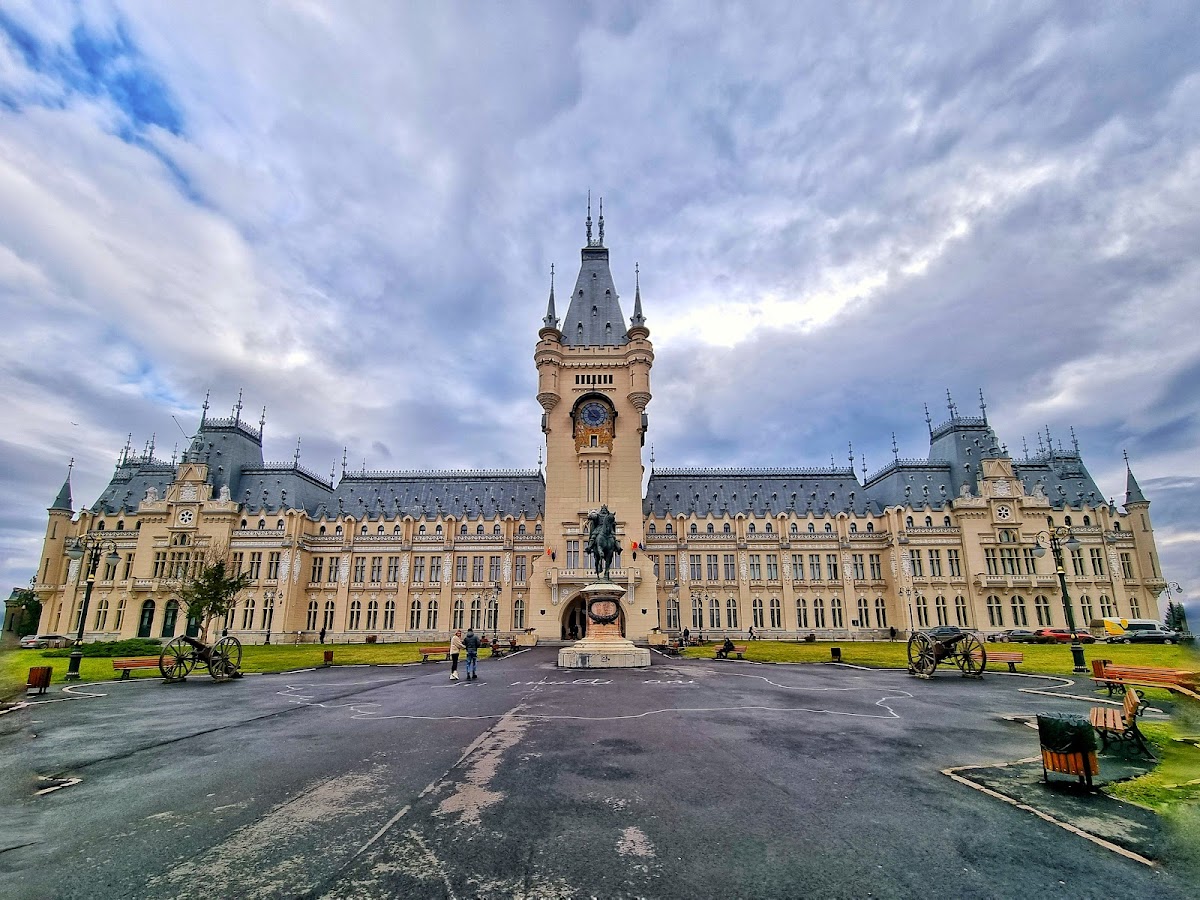
The Palace of Culture stands at 1 Piața Ștefan cel Mare și Sfânt in the centre of Iași, within the grounds of the former princely court of Moldavia, first documented in 1434. It was built on the foundations of the neoclassical princely palace raised in the time of Alexandru Moruzi and rebuilt by Mihail Sturdza in 1841-1843, keeping its foundations, ground floor and part of the upper walls. The new building, intended as the Administrative and Justice Palace, was constructed between 1906 and 1925 to designs by the architect I. D. Berindey, assisted by Filip Xenopol and Grigore Cerchez. Work was delayed by the First World War, and the official inauguration took place on 11 October 1925 in the presence of King Ferdinand and Queen Maria.
The style is mainly Neo-Gothic, with Romantic and Neo-Baroque elements. The central tower is 55 metres high, the building covers 7,330 square metres of ground and has a total floor area of more than 34,000 square metres. It was fitted with services that were modern for the time (electric lighting, pneumatic heating, ventilation), and the Neo-Gothic furniture was made by the Albert Goumain workshops in Paris and by an English firm. The tower clock has three dials 3.24 metres across, decorated with stained glass showing the twelve signs of the zodiac, and a carillon of eight bells that plays "Hora Unirii" every hour on the hour.
Inside, visitors can see the Hall of Honour, with a circular mosaic of fantastic animals (double-headed eagles, dragons, griffins, chimeras and lions) copied from the rosette of the abbey of Saint-Pierre-sur-Dives in Normandy, the Carrara marble staircases, the Hall of the Voivodes, with its gallery of portraits of the rulers of Moldavia and the kings of Romania and a marble fireplace carved with a "historical tree", and the Henri Coandă Hall, the former jury court room, finished with an oak-imitating material invented by Henri Coandă. The clock tower can only be visited on guided tours.
The palace served as the Administrative and Justice Palace until 1955, when it became the Palace of Culture. Today it is the seat of the Moldova National Museum Complex, with four museums: the Museum of the History of Moldavia, the Art Museum, the Ethnographic Museum of Moldavia and the Ștefan Procopiu Museum of Science and Technology, as well as the Centre for Research and Conservation-Restoration of Cultural Heritage. After a restoration completed in January 2016, the palace reopened to the public on 27 April 2016. The building is a class A historic monument, LMI code IS-II-m-A-03957.01, and the ruins of the princely court around it are listed under code IS-II-m-A-03957.02.
Piața Ștefan cel Mare și Sfânt 1, Iași, județul Iași