
Attraction
Cotroceni Palace
Cotroceni Palace, in Bucharest's 6th district, began as a monastery built in 1679 by Șerban Cantacuzino and was radically rebuilt between 1893 and 1895, in Venetian classical style, to designs by architect Paul Gottereau. It now houses the National Cotroceni Museum, with more than 35,000 objects from Romania's royal heritage. It stands as the main material documentary source on the history of the Romanian monarchy in the 19th and 20th centuries.
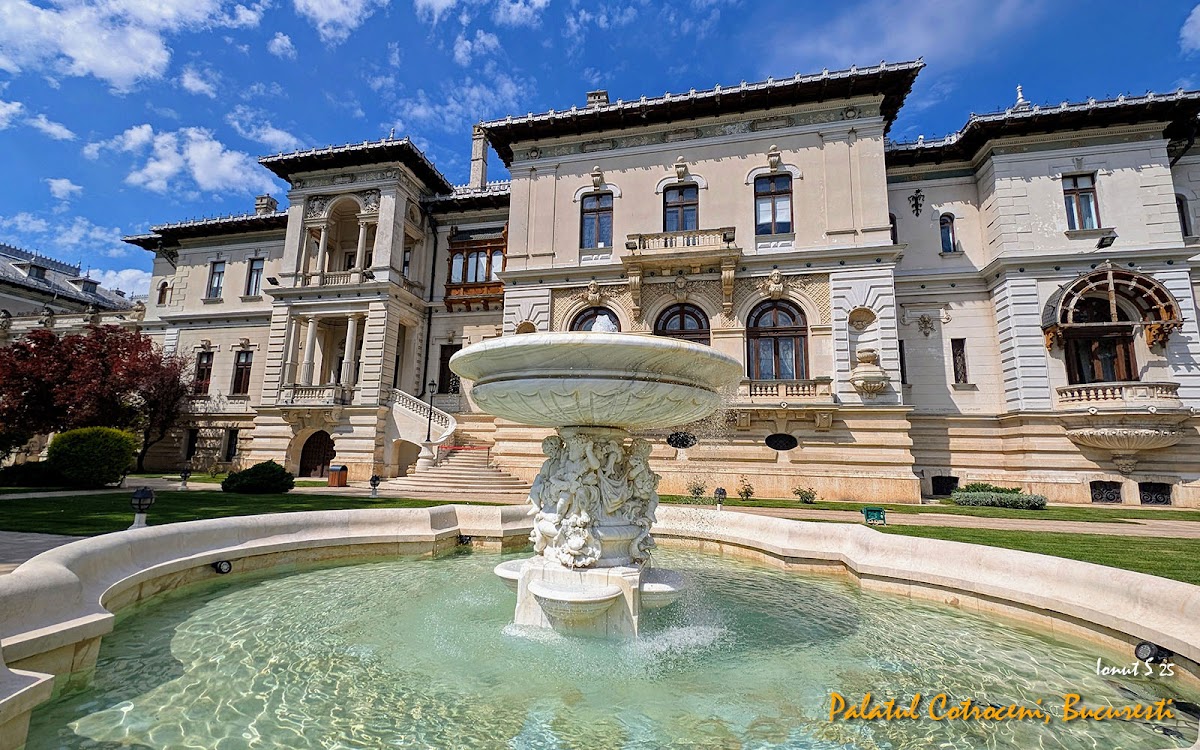
Cotroceni Palace is an architectural and historical complex in Bucharest's 6th district, at 1-3 Geniului Boulevard. Its earliest structure was built between 1679 and 1681 by ruler Șerban Cantacuzino, who founded a monastery and princely residence on the site. The complex later served as a summer residence for several rulers, including Alexandru Ioan Cuza from 1862.
On King Carol I's initiative, the old princely residence was demolished, and between 1893 and 1895 a new palace was built for the heirs to the crown — Crown Prince Ferdinand and Princess Marie — to designs by French architect Paul Gottereau, in Venetian classical style. Later, after World War I, Romanian architect Grigore Cerchez redesigned the north wing in Neo-Romanian style, at Queen Marie's initiative, adding the Cerchez Salon — the room where, in August 1916, the Crown Council decided Romania would enter World War I on the side of the Entente.
The building served as a royal residence for Ferdinand I, Carol II, and Michael I (Carol I preferred the Royal Palace on Calea Victoriei as his main residence). The monastery's original church, founded by Șerban Cantacuzino, was demolished overnight in 1984 on Nicolae Ceaușescu's orders; it was rebuilt by the Cantacuzino family's heirs and reconsecrated only in 2009. The palace's built area exceeds 20,000 square meters, and the complex includes gardens spanning about 9 hectares.
In 1977, a magnitude 7.2 earthquake significantly damaged the structure, requiring reinforcement and restoration work carried out through the 1980s, under architect Nicolae Vlădescu. Since 1990, the palace has served as the official residence of Romania's President, and since 1991 its historic wing has housed the National Cotroceni Museum, open to the public, with roughly 35,000 objects including royal furniture, documents, garments, and artworks from the 19th and 20th centuries. Visits require advance booking, with entry from Geniului Boulevard; the palace is reached by metro to Politehnica station or by public transport serving the Botanical Garden. Worth visiting for one of the most complete collections of decorative art and documents relating to the history of the Romanian monarchy.
Bulevardul Geniului 1-3, Bucuresti