
Attraction
National Museum of Contemporary Art (MNAC)
The National Museum of Contemporary Art, founded in 2001 and relocated in 2004 to the E4 (glass) wing of the Palace of Parliament, holds over 7,000 artworks created after 1945, including painting, sculpture, installations, and video art by Romanian and international artists. It is reached by metro to Izvor station or by public transport along Calea 13 Septembrie. The museum is Romania's leading institution dedicated to documenting and showcasing contemporary art.
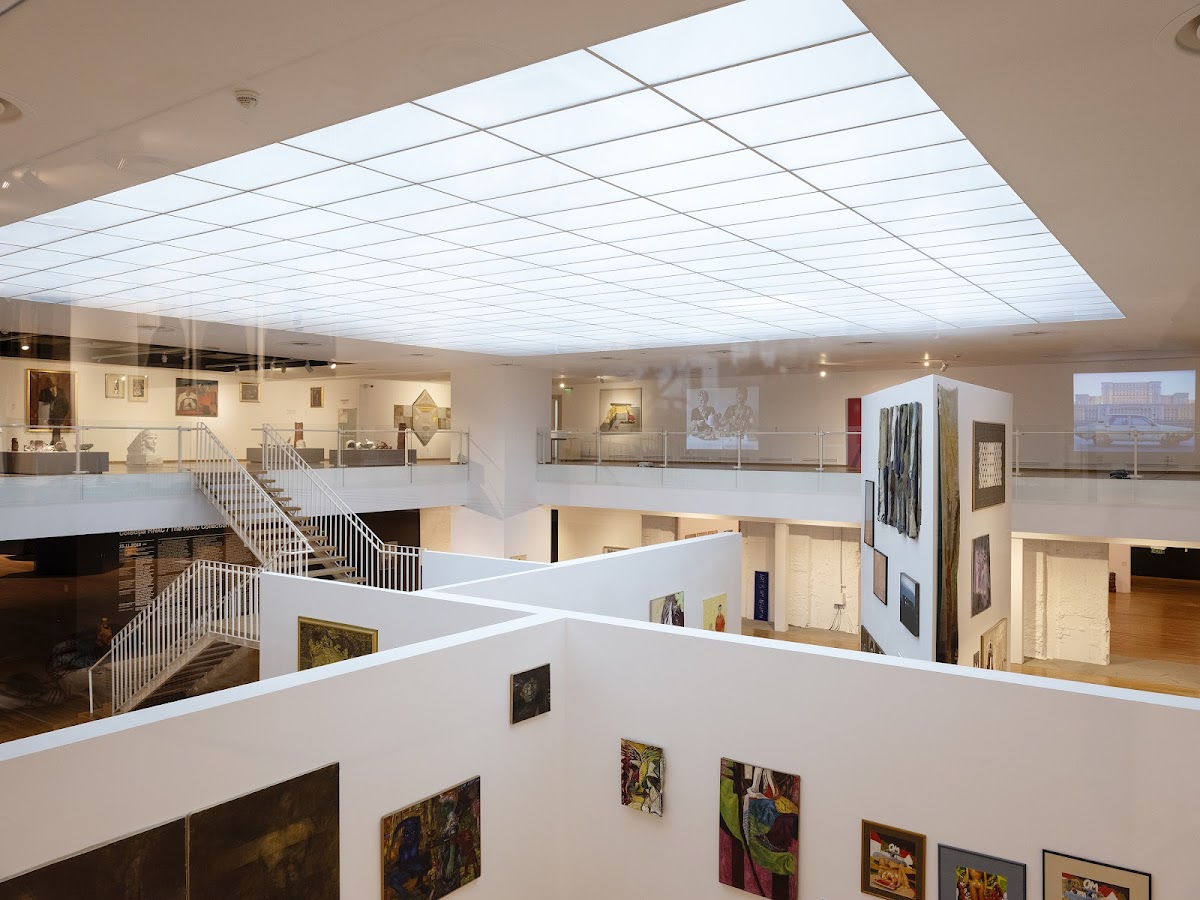
The National Museum of Contemporary Art (MNAC) is located in the E4 wing — the new glass wing — of the Palace of Parliament in Bucharest, with its entrance off Calea 13 Septembrie, occupying spaces spread across several floors. The institution was founded in 2001, by decision of the Romanian Government, through the merger of the Contemporary Art Department of the National Museum of Art of Romania with the National Office for Art Documentation and Exhibitions (ONDEA). Its first director, art historian, photographer, and collector Mihai Oroveanu, led the museum for 12 years, until 2013. Before its current location opened in October 2004, the museum operated out of the former Kalinderu Foundation, under the name Kalinderu Medialab.
MNAC is Romania's leading museum dedicated to contemporary art, collecting works mainly from after 1945, with a focus on the postwar period and the transformations following 1989. The permanent collection holds over 7,000 works — painting, sculpture, photography, installations, and video art — by Romanian and international artists, over 90% of it inherited from the merged institutions. The museum operates on the concept of a "museum in progress," offering a dynamic display rather than a passive archive.
The host building, the Palace of Parliament, built between 1984 and 1997 on Nicolae Ceaușescu's initiative, is itself a landmark structure, covering roughly 340,000-365,000 square meters, the world's second-largest administrative building after the Pentagon. MNAC occupies spaces originally intended for the communist regime's ceremonial functions, and the museum's placement here sparked controversy within the art community when it was founded. A particular draw is the panoramic terrace on the top floor, offering one of the most spectacular views of Bucharest.
Besides its main venue, MNAC also runs the MNAC Annex and Sala Dalles (18 Nicolae Bălcescu Boulevard), all open Wednesday through Sunday, 10:00 AM to 6:00 PM; admission is free on the first Wednesday of each month. It is reached directly from central Bucharest, by metro (Izvor station) or by numerous bus and tram lines along Calea 13 Septembrie. The museum regularly hosts national and international temporary exhibitions, educational programs, and artist residencies. Worth visiting for the unique context it offers for understanding the evolution of contemporary Romanian art, and because its location in a building with a well-documented political history adds a critical dimension to the cultural experience.
Calea 13 Septembrie 1 Bucuresti