
Attraction
Brukenthal National Museum
The Brukenthal National Museum is based in the Brukenthal Palace, built in 1778-1788 on the west side of Sibiu's Piața Mare by Baron Samuel von Brukenthal, governor of Transylvania. Opened to the public in 1817, it is the oldest museum on the territory of present-day Romania. The palace houses the European Art Gallery, with about 1,200 paintings from the fifteenth to eighteenth centuries, and the Brukenthal Library.
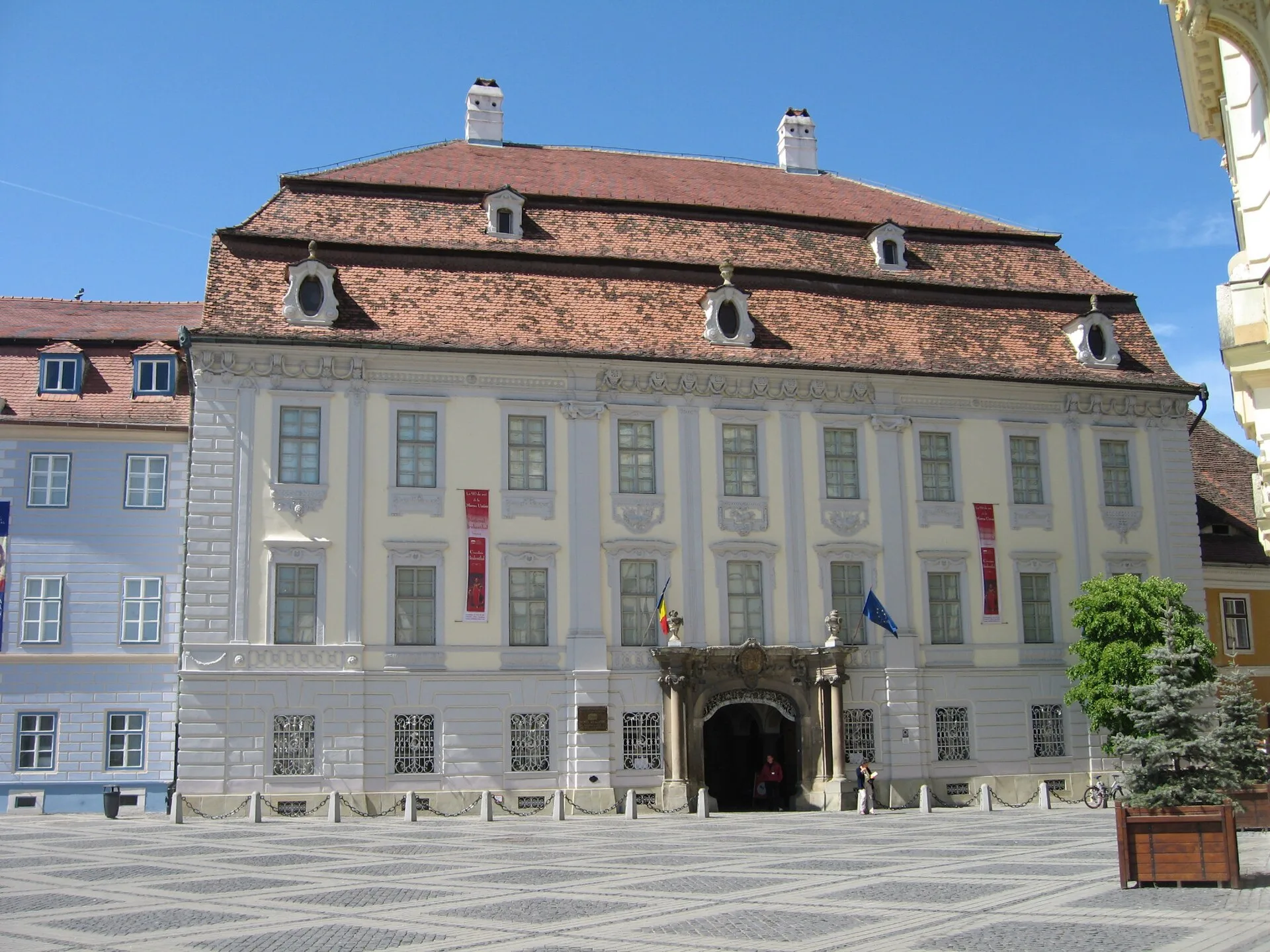
Foto: Cezar Suceveanu, CC BY-SA 3.0 RO, via Wikimedia Commons
The Brukenthal Palace stands on the west side of Piața Mare in Sibiu, at number 4, and is a listed historic monument (code SB-II-m-A-12094). It was built in stages between 1778 and 1788 by Samuel von Brukenthal, governor of the Grand Principality of Transylvania from 1777 to 1787, as his official residence and the home of his collections, in the late Baroque style modelled on Viennese palaces. It replaced two medieval houses. The façade, in an austere Baroque, projects in front of the line of the other buildings on the square; the stone portal, supported by columns, carries the baron's gilded coat of arms. A passage leads into the first inner courtyard, and a second portal, supported by atlantes, into the second.
Brukenthal began collecting art around 1754 in Vienna, and his collections could be visited from 1790. In his will he left the palace and collections to his heirs, on condition that if the family died out they would pass to the Evangelical Church and the palace would become a public museum, which happened in 1817. The museum was nationalised in 1948, when 19 paintings were moved to the National Museum of Art in Bucharest; they returned to Sibiu in 2006. Over time the group added the Natural History Museum (1957), the Hunting Museum (1966), the Pharmacy Museum (1972), the History Museum in the Altemberger House (1988), the Museum of Contemporary Art (2006) and the National Art Gallery in the Blue House (2024).
The palace houses the European Art Gallery, with about 1,200 paintings from the Flemish, Dutch, German, Austrian, Italian, Spanish and French schools of the fifteenth to eighteenth centuries. The permanent exhibition, rearranged between 2015 and 2019, is divided into thematic sections on the first and second floors, including the "Masterpieces" room with 34 works, among them the four paintings stolen in 1968 and recovered in 1998. It is the only museum in Romania holding paintings by Jan van Eyck, Hans Memling and Titian. The ground floor holds the Transylvanian lapidarium and the print and map cabinets, which show temporary exhibitions.
The Brukenthal Library, also in the palace, holds about 280,000 volumes, built on the baron's own 15,972 volumes. Its treasures include the Brukenthal Breviary, a parchment manuscript made in the Low Countries in the early sixteenth century with miniatures attributed to Simon Bening and Gerard Horenbout, and 442 incunabula titles.
Piața Mare 4-5, Sibiu