
Attraction
"Grigore Antipa" National Museum of Natural History
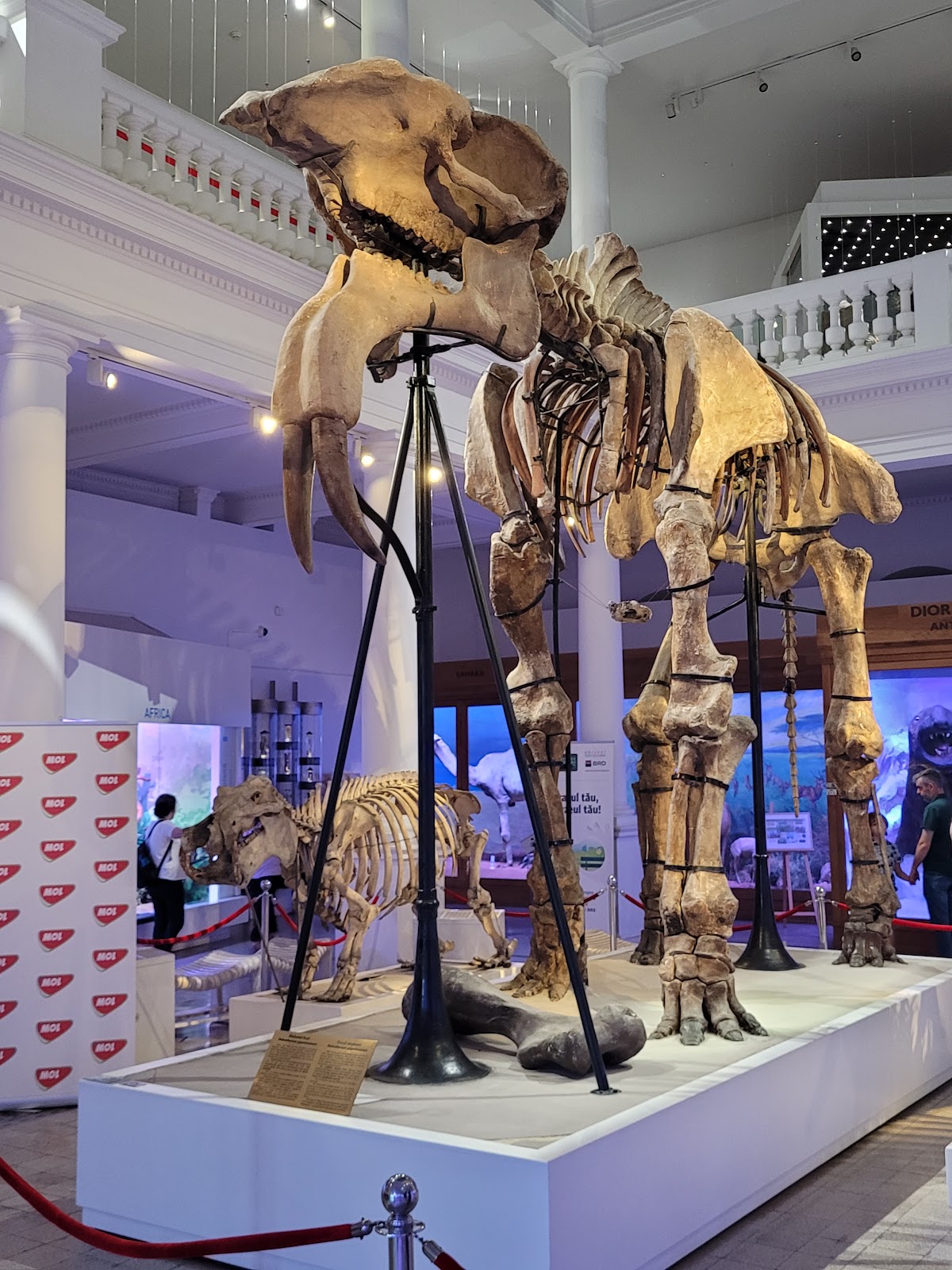
The "Grigore Antipa" National Museum of Natural History, at 1 Kiseleff Avenue in Bucharest, was founded in 1834 and holds over two million specimens across zoology, paleontology, and mineralogy. The institution houses the skeleton of Deinotherium gigantissimum, one of the best-preserved fossils of its kind in the world, discovered in Romania. It is conveniently reached via Piața Victoriei metro station.
The "Grigore Antipa" National Museum of Natural History is located at 1 Kiseleff Avenue in Bucharest, near Piața Victoriei. The institution was founded on 3 November 1834, by decree of ruler Alexandru Ghica, on the initiative of his brother, ban Mihalache Ghica, under the name "Museum of Natural History and Antiquities." It operated from several locations — including "Sfântul Sava" College — before settling into its current building, inaugurated on 24 May 1908, in the presence of King Carol I. Its current name was adopted in 1933, by decree of King Carol II, in honor of naturalist Grigore Antipa, who led the museum for 51 years (1893-1944) and turned its collections into one of the most representative in Southeastern Europe.
The permanent collections hold nearly two million specimens, organized into sections on zoology, geology, paleontology, and mineralogy — including Romania's largest insect collection, with about 1.1 million specimens. Notable exhibits include the Deinotherium gigantissimum skeleton, standing about 4 meters tall, discovered in Vaslui County in 1894 by geologist Grigoriu Ștefănescu and considered one of the most complete specimens in the world. In 1907, Grigore Antipa introduced, for the first time anywhere, three-dimensional biological dioramas — a museography innovation later adopted by dozens of museums across Europe and America. Fittingly, the urn holding his ashes now rests inside the museum he built.
The museum covers an exhibition area of about 7,000 square meters, spread across three levels — basement, ground floor, and first floor — fully renovated for its 2011 reopening, which introduced interactive screens, 3D projections, and a digitized cave exhibit. The 1977 earthquake damaged the building and its collections, closing the museum for eight months for repairs. It is reached by metro to Piața Victoriei station, or by public transport serving Kiseleff Avenue. Worth visiting for its paleontology and zoology collections of exceptional scientific value, including endemic specimens and rare fossils discovered on Romanian territory.
Soseaua Kiseleff 1 Bucuresti