
Attraction
The Mounds of Șona (The Pyramids of Șona)
The mounds of Șona, also known as the "Pyramids of Șona" or "guruieți" (as the locals call them), are eight pyramid-shaped earthen mounds, some nearly 30 metres tall, arranged in two parallel rows in order of size, on the outskirts of the village of Șona, near Făgăraș. Their perfectly ordered arrangement and the valley between the two rows, oriented precisely east–west, suggest human intervention — yet their origin remains unexplained to this day. They are considered one of the greatest archaeological enigmas in Romania.
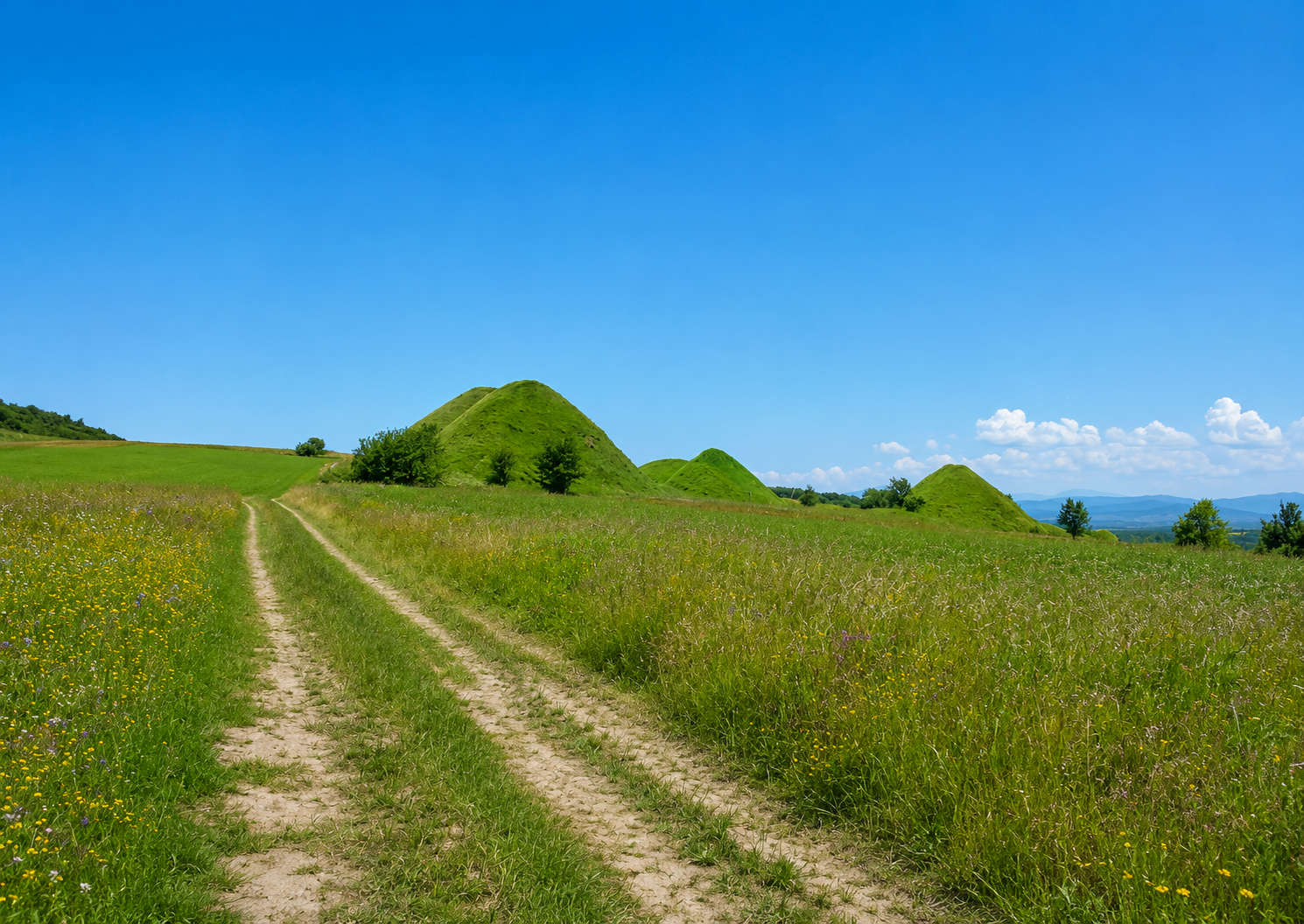
The mounds of Șona are a group of eight pyramid-shaped earthen mounds located on the outskirts of the village of Șona, Brașov County, approximately 5 km from Făgăraș. The locals call them "guruieți" — meaning earthen rises. Some reach nearly 30 metres in height and are arranged in two parallel rows, ordered by increasing size, with a valley between them oriented precisely east–west. This apparently intentional arrangement is the main argument put forward by those who maintain that the mounds are anthropogenic (man-made) rather than natural in origin. Their origin is disputed and remains unresolved, as no extensive official archaeological excavations have taken place. The most widespread theory attributes them to the Dacians: researchers such as Andrei Vartic consider them Dacian vestiges connected to Geto-Dacian religion and astronomy. One striking hypothesis holds that connecting the mounds on a map with Vârful Omu in the Bucegi mountains and the Dacian sanctuary at Racoș produces a right triangle with angles of 30 and 60 degrees, and that the line between Șona and Omu also passes through the rock-hewn temple at Șinca Veche — part of a supposed network of Dacian "sacred lines" crossing the Carpathians, with reference points at Sarmizegetusa, Piatra Roșie, and Racoș. Researchers have also compared the mounds to the funerary tumuli in which Celtic or Scythian chieftains were buried — peoples who passed through the territory of present-day Romania. Local legends speak of the graves of Dacian kings or of giants; one story holds that the mounds are the earth shaken from the sandals of a giant. Archaeologists have discovered pottery from the Late Bronze Age and the Hallstatt period (approximately 1200–500 BC) in the vicinity of the mounds, attesting to human presence in the area from ancient times. Geologists, on the other hand, argue for a natural origin: the mounds would have resulted from the stepped sliding of a hillside around 12,000 years ago, combined with the action of torrents that separated the individual rises. One detail that fuels the mystery: the earth inside the pyramids is yellow, while the surrounding soil is black. Over the years, the site has been dug up more by treasure hunters than by researchers. Access is straightforward — from Brașov or Sibiu to Făgăraș, then approximately 5 km to the village of Șona.
Satul Șona, județul Brașov