
Attraction
Carol I Mosque
The Carol I Mosque in Constanța, also known as the Great Mosque or "the King's Mosque," was built between 1910 and 1913 on the initiative of King Carol I and is Romania's principal Muslim place of worship. Designed by the architect Victor Ștefănescu and executed by the engineer Gogu Constantinescu, it was the first building in Romania to use reinforced concrete. Its Moorish-style minaret rises 47 metres and holds 140 steps. The prayer hall houses the Ada Kaleh carpet, a gift of Sultan Abdul Hamid II, one of the largest oriental carpets in Europe.
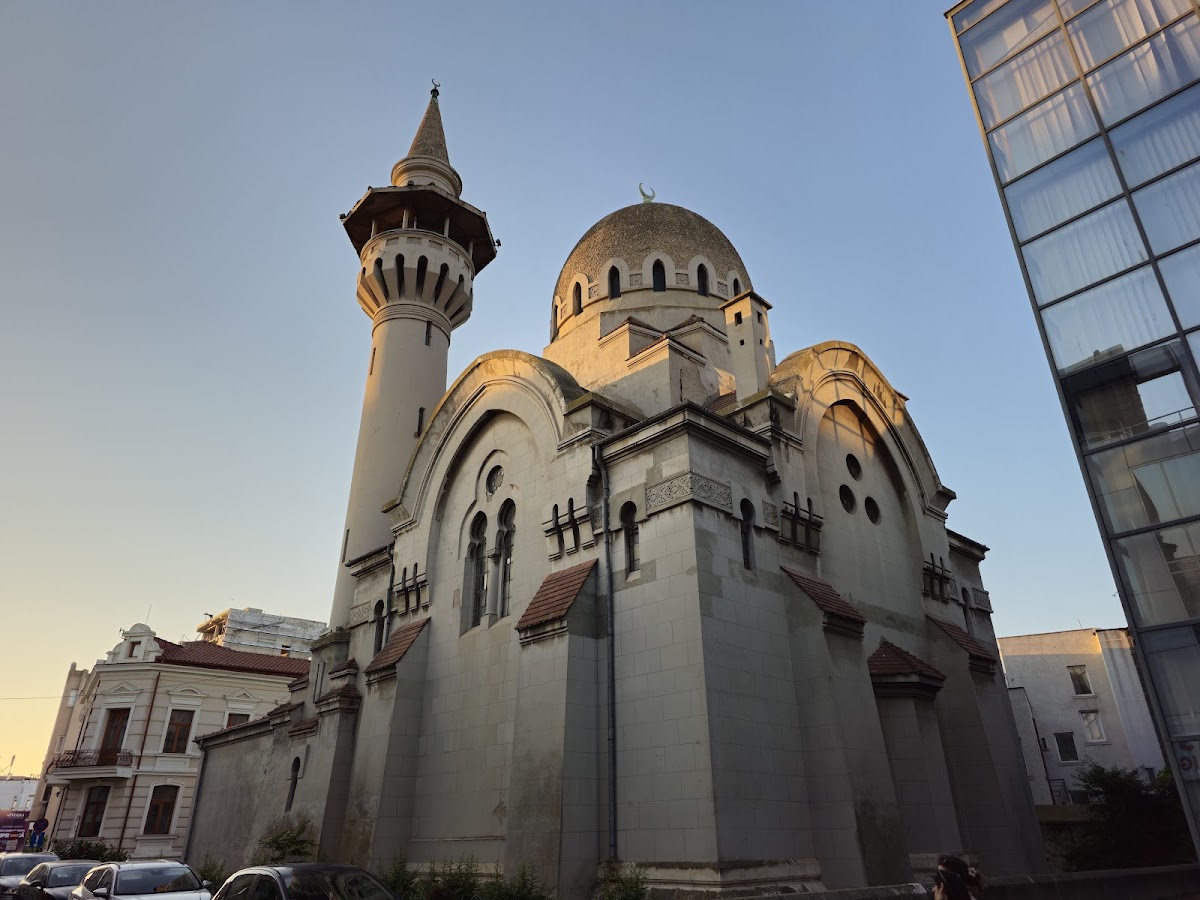
The Carol I Mosque stands in the historic centre of Constanța, on Ovidiu Square. It is also called the Great Mosque, and Muslim worshippers know it as "Kral camisi," the King's Mosque. It was later officially renamed the Mahmud II Mosque. It is Romania's principal Muslim place of worship.
The building rose on the site of the former Mahmudiye Mosque, founded in 1822-1823 by Hafuz Hussein Pasha. Only the mihrab, worked in Moorish style, survives from the older structure. The foundation stone of the new mosque was laid on 24 June 1910, on the initiative of King Carol I, as a tribute to the city's Muslim community. Work concluded in 1913, and the inauguration took place on 31 May 1913, in the presence of the royal family and representatives of the Muslim faith in Romania.
The design was by the architect Victor Ștefănescu, who first travelled to Constantinople to study the subject, while the execution fell to the engineer and inventor Gogu Constantinescu. The model was the Konya Mosque in Anatolia. The style is Egyptian-Byzantine, with some Romanian architectural motifs in the body of the building, a combination found in no other Dobrujan mosque. The main structure is of stone and brick, but the dome and minaret are of reinforced concrete: Gogu Constantinescu's decision makes the Great Mosque the first building in Romania to use this material.
The Moorish-style minaret rises 47 metres, and its interior spiral staircase counts 140 steps to the muezzin's station, from which the hour of prayer was once announced. From the circular balcony one sees the Saints Peter and Paul Cathedral, the Casino, the rooftops of the old town, the port, and the sea. According to the mosque's imam, out of respect no other mosque in Romania may have a taller minaret.
The central hall is a square room 14 metres to a side. The plinth is faced in Dobrujan stone, the interior columns are of Câmpulung marble, the main portal is of Dobrujan stone, and the doors are of black marble inlaid with bronze, modelled on those found in the sultans' palaces. The walls are covered with painted faience and golden calligraphic inscriptions: the 99 attributes of Allah, arranged around the mihrab, and verses from the Quran. There are no figurative representations.
The mosque's chief treasure is the oriental carpet spread beneath the chandelier. Over two centuries old, it covers 144 square metres and weighs more than 490 kilograms, making it one of the largest hand-woven oriental carpets in Europe. It was woven at Hereke in Turkey and donated in 1904 by Sultan Abdul Hamid II to the faithful of Ada Kaleh island, on the Danube. When the island was submerged following the construction of the Iron Gates dam, the carpet was rescued and brought to Constanța. Its dimensions exceed the available space, so it is displayed only partly unrolled.
Defects in the minaret and dome were noted as early as 1915, but reinforcement work was carried out only between 1957 and 1959, to designs by Professor Aurel Beleș. The mosque is a listed architectural monument and can be visited for a token fee, outside prayer hours.
The Carol I Mosque is worth visiting for three things that converge in a single building: a Romanian technical first, reinforced concrete, used here before anywhere else in the country; a heritage object rescued from an island that no longer exists; and a view from 47 metres over a city where an Orthodox cathedral, a Catholic church, and a mosque are visible at once.
Strada Arhiepiscopiei 5 Constanta judetul Constanta