
Attraction
Stavropoleos Church
Stavropoleos Church, founded in 1724 by Greek archimandrite Ioanichie Stratonikeas, is one of the most representative examples of Brâncovenesc-style architecture in Bucharest's historic center. The small church, about 22 by 9 meters, features carved arcades, slender columns, and floral friezes typical of the style. Its courtyard holds a collection of gravestones and medieval architectural fragments rescued from 19th- and 20th-century urban demolitions.
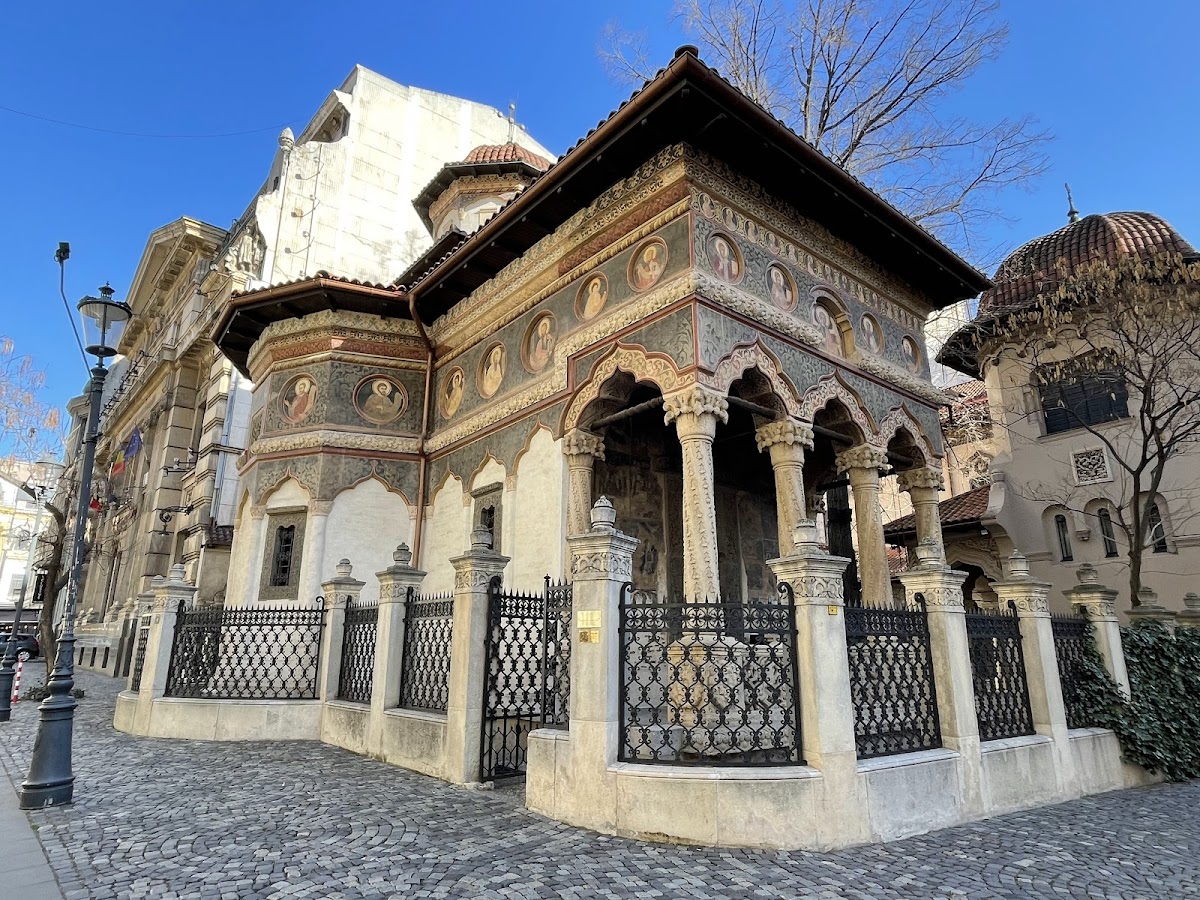
Stavropoleos Church is an Orthodox monastic complex in Bucharest's historic center, at 4 Stavropoleos Street, about 200 meters from the Old Princely Court. It was built in just five months, in 1724, by the Greek monk Ioanichie Stratonikeas, originally from Epirus, during the second reign of Nicolae Mavrocordat, who actively supported the church's construction. Ioanichie had first bought the land and built an inn, and used its income to fund the church and monastery. In 1726, just two years later, Ioanichie was elected Metropolitan of Stavropolis, the name from which the church takes its current title.
The building is one of the most valuable examples of post-Brâncovenesc architecture in the capital — a refined continuation of the style championed by Constantin Brâncoveanu (executed in 1714, a decade earlier), blending Byzantine, Oriental, and Baroque elements. The facades are decorated with carved stone arcades, slender columns, and floral friezes, and the inscription above the entrance is marked by the coat of arms of Wallachia and the Cantacuzino double-headed eagle.
The inn, monastic cells, and other annexes were demolished at the end of the 19th century, leaving only the church standing. It was seriously damaged by the 1838 earthquake, which weakened the tower to the point of near-collapse — the tower was torn down in 1841. Between 1897 and 1904, architect Ion Mincu led a major restoration, adding the arcaded portico and the Neo-Romanian bell tower and laying out the current courtyard. A second major restoration, spanning two decades (1995-2012), with contributions from restorer Dan Mohanu and architect Aurelian Trișcu, received the European Commission's Award for architectural heritage conservation in 1995 — the most prestigious prize of its kind in Europe.
The monastery's courtyard holds a collection of gravestones and medieval architectural fragments rescued from churches demolished during the communist era. The monastic community was reestablished in 2008, with a community of nuns, and the church was reconsecrated in 2012. It is also known for its Byzantine choir. It is reached on foot from Calea Victoriei or Union Square, about 5 minutes away. Worth visiting as one of the few surviving examples of authentic Brâncovenesc-style architecture in Bucharest, offering concrete insight into 18th-century construction and decorative techniques.
Strada Stavropoleos 4 Bucuresti