
Attraction
Secu Monastery
Secu Monastery is an Orthodox monastery of monks in Vânători-Neamț commune, Neamț County, built as a fortified enclosure in the valley of the Secu stream. Its church of the Beheading of St John the Baptist was built in 1602 by the high steward Nestor Ureche, father of the chronicler Grigore Ureche, and his wife Mitrofana, near the skete founded in 1530 by the hieroschemamonk Zosima.
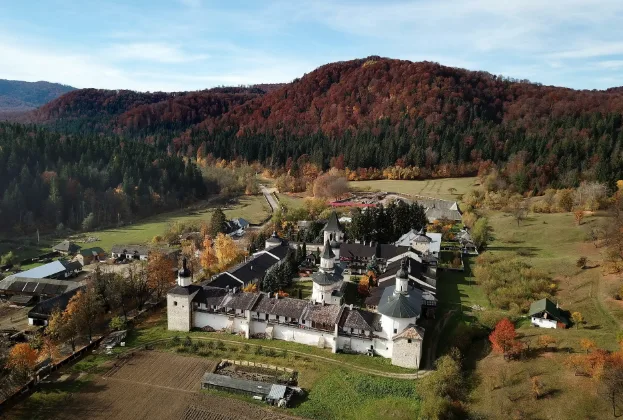
Secu Monastery lies in the valley of the Secu stream, in Vânători-Neamț commune, on the former estate of Neamț Citadel. Around 1500 a group of hermits settled here and, led by the hieroschemamonk Zosima, a monk of Neamț Monastery, founded Zosima's Skete in 1530. Prince Petru Rareș built the skete church on the site of the present cemetery church, and in 1550 his wife, Lady Elena, and their sons enclosed the skete with a stone wall, a small part of which still survives at the cemetery entrance.
The stone monastery, shaped like a rectangular fortress, was founded by Nestor Ureche, high steward of Lower Moldavia, and his wife Mitrofana, the parents of the chronicler Grigore Ureche. The Slavonic inscription on the south wall states that the church of the Beheading of St John the Baptist was begun on 7 June 1602 and completed on 5 October of the same year, during the reign of Ieremia Movilă. In 1640 Abbot Ghedeon built the chapel of the Dormition in the south-east tower. Paisius Velichkovsky was abbot here from 1775 to 1779, and from 1779 until 1910 Secu was subordinate to Neamț Monastery. In 1821 the last battle between the Greek Eterists and the Turks took place here, and the monastery was burned. The cells and the St Nicholas chapel were then rebuilt, and in 1832 the masonry church of the Nativity of St John the Baptist was built in the cemetery, on the site of Zosima's church.
The main church shows Wallachian influence in its vaulting and in its towers on octagonal bases: the domes rest directly on the arches of the nave and narthex. Of the 1602 painting, a few registers survive above the door between the narthex and nave, at the founders' tombs and on the south facade above the inscription. The present oil painting was done in 1849-1850 by Costache Lifsicar and his pupils and the painter Tudorache Ionescu, and was restored in 2000-2002. The enclosure wall is in places more than 3 m thick and 9 m high, has corner towers and encloses a courtyard of about 95 x 75 m. The entrance runs beneath the bell tower on the west side, and the north-west tower, known as Mitrofana's Tower, served as living quarters for the founder's family.
The complex is a class A historic monument (LMI code NT-II-a-A-10735) and was restored in 1977-1984. The church holds the tombs of the founders Nestor Ureche and Mitrofana. The monastery museum keeps the Homiliary of Metropolitan Varlaam of 1643, an epitaphios of 1608 and manuscripts from the Secu copyists' school. The community numbers about 45 monks, and the patronal feast is on 29 August. Access is from the DN15B road between Târgu Neamț and Pipirig, along the DJ157F for about 4 km.
Sat Vânători-Neamț, comuna Vânători-Neamț, județul Neamț