
Attraction
Râmeț Monastery
Râmeț Monastery, in Râmeț commune at the entrance to the Râmeț Gorge, is one of the oldest monastic settlements in Transylvania. Its old church preserves murals painted in 1377 by Mihu of Crișul Alb.
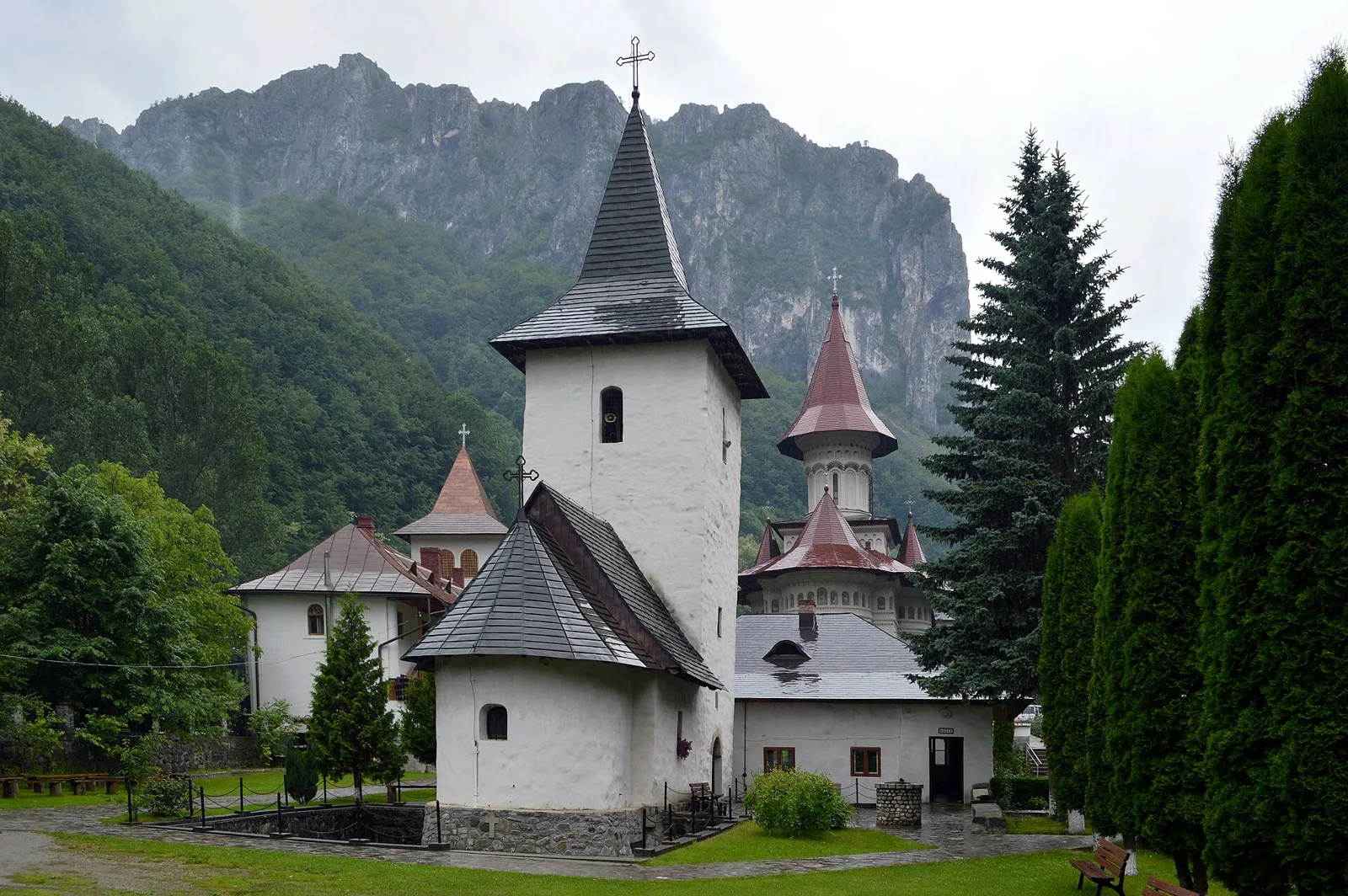
Foto: DimiTalen, CC0, via Wikimedia Commons
Râmeț Monastery is in the village of Valea Mănăstirii, Râmeț commune, Alba County, in the Geoagiu valley at the entrance to the Râmeț Gorge in the Trascău Mountains. It is 34 km from Alba Iulia and 18 km from Teiuș.
It is one of the oldest monastic settlements in Transylvania. The old church, dedicated to the Nativity of the Virgin and the Life-Giving Spring, has several layers of murals; one of them was painted in 1377 by Mihu of Crișul Alb, and the church itself may date from the 13th century. The monastery was destroyed in 1762, during the religious conflicts of the time, and again after the uprising of Horea, Cloșca and Crișan; the church was rebuilt in 1792. Monastic life resumed in 1940, and since 1955 it has been a convent for nuns. Closed by the communist authorities in 1959, it reopened in 1962.
Inside the precinct you can see the old church, which was raised in its entirety to save it, the new church of the Holy Apostles Peter and Paul, also called the Cathedral of the Apuseni Mountains, built under Bishop Emilian Birdaș, and the former school, now a museum. In July 2019 a fire destroyed part of the roof of the new church. The monastery is an active place of worship and can be visited.
The Râmeț Monastery ensemble is a listed historical monument (LMI code AB-II-a-A-00386): the old church (AB-II-m-A-00386.01) and the former school, now a museum (AB-II-m-A-00386.02).
Did you know that the old church, painted walls and all, was raised by 2.08 m under Bishop Emilian Birdaș to save it from destruction?
Valea Mănăstirii, comuna Râmeț, județul Alba