
Attraction
Neamț Monastery
Neamț Monastery is an Orthodox monastery of monks in the village of Mănăstirea Neamț, Vânători-Neamț commune, in the Nemțișor valley, whose earliest surviving document dates from 7 January 1407. Its church of the Ascension, built by Stephen the Great and completed on 14 November 1497, holds in its burial chamber the tombs of Ștefan, son of Alexandru cel Bun, and of Abbot Paisius Velichkovsky.
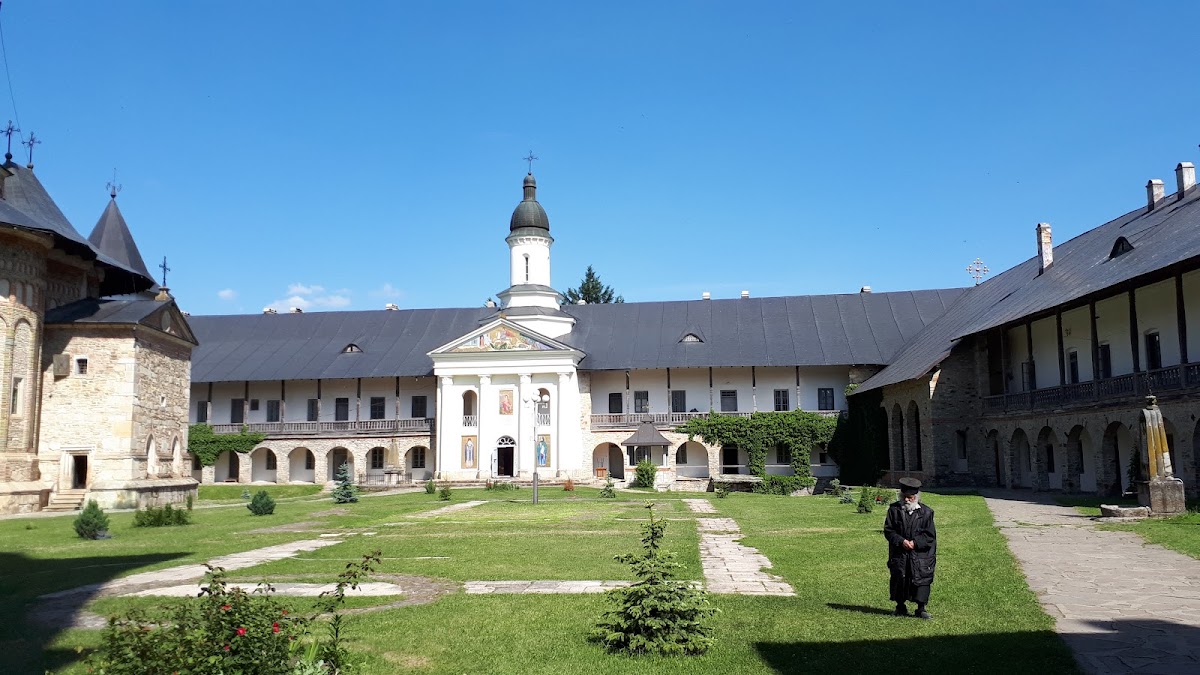
Neamț Monastery lies in a wide clearing in the Nemțișor valley, west of Târgu Neamț, among wooded ridges. No sources fix its exact founding date, but the inscription on a bell recast in the nineteenth century from the metal of a bell of 1393, together with local tradition, shows that it existed by the end of the fourteenth century. The earliest surviving document, dated 7 January 1407 under Alexandru cel Bun, shows that the monastery owned two villages given by Petru Mușat, as well as mills, vineyards, books and vestments. According to tradition, Petru Mușat also built the first stone church, on the site of a wooden church known as the "White Church". The remains of the earliest churches, from the late fourteenth and early fifteenth centuries, are marked out in the courtyard today.
The church of the Ascension was built by Stephen the Great in the last decade of the fifteenth century. The Slavonic inscription on the south wall of the narthex states that it was completed on 14 November 1497, and a note from 1512 records its consecration on the same day, after the victory at Codrii Cosminului. The triconch plan is extended with a porch to the west and a burial chamber between the narthex and the nave. The facades have a dressed stone plinth, walls of river stone and brick, two rows of blind niches and a frieze of glazed discs and bricks. The painting in the sanctuary, nave and burial chamber dates from the last years of Stephen the Great or the reign of Bogdan III, while that in the narthex and porch dates from the reign of Petru Rareș; it was retouched in 1830 and blackened by the fire of 1862. The church was restored between 1953 and 1961.
The burial chamber holds the tombs of Prince Ștefan, son of Alexandru cel Bun (died 1447), and of Abbot Paisius Velichkovsky (died 1794), who led a large community here and an extensive translation effort. The porch holds the tombstone of Metropolitan Teoctist II, who consecrated the church in 1497, that of Micota, governor of Neamț (died 1495), and the tomb of Metropolitan Calinic Miclescu, and the narthex holds the tomb of Bishop Pavel of Roman (died 1632). From the end of the fourteenth century the monastery had a school of calligraphers and illuminators, where the monk Gavriil Uric worked in the first half of the fifteenth century. Metropolitan Veniamin Costachi founded a printing press at the monastery in 1807.
The complex is a class A historic monument (LMI code NT-II-a-A-10629). Besides Stephen the Great's church, it includes the church of St George, rebuilt in 1958-1961 on the east side, the gate bell tower with the Annunciation chapel, the chapels of the Dormition and of St Panteleimon, the Pârgu Tower, the circular holy water pavilion of 1836, the infirmary church of St John the New of 1848 and the monastic houses. The museum holds the icon of the Mother of God which, according to tradition, Alexandru cel Bun received from the Byzantine emperor John VIII Palaiologos, the iconostasis of the former chapel of Neamț Citadel, icons painted by Nicolae Grigorescu and old printing presses. Next to the monastery is the Veniamin Costachi Theological Seminary, founded in 1855. The community numbers about 50 monks, and access is from the DN15B road between Târgu Neamț and Pipirig, along the DJ155C.
Sat Mănăstirea Neamț, comuna Vânători-Neamț, județul Neamț