
Attraction
Golia Monastery
Golia Monastery is a fortified monastic complex in the centre of Iași, at Strada Cuza Vodă no. 51, dedicated to the Ascension of the Lord. The present church was begun by Vasile Lupu in 1650 and completed by his son Ștefăniță Lupu in 1660, and the 29.5-metre bell tower can be climbed by 120 steps for a view over the city.
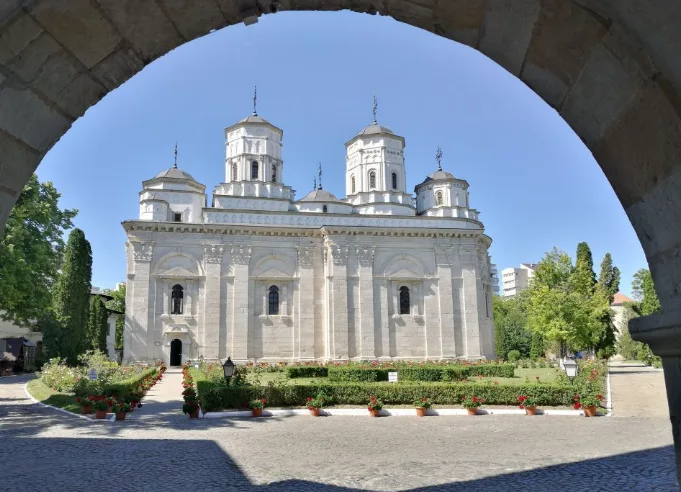
Golia Monastery stands in the centre of Iași, at Strada Cuza Vodă no. 51, and takes its name from the grand logothete Ioan Golăi (Golia). The earliest evidence of a church on the site is a tombstone with a Greek inscription dated 1515. Around 1550 the grand logothete most probably began building a stone church, and the first certain record dates from 1564, when his parents-in-law, Maxim Burnar and Antimia, gave the church an ebony cross mounted in gilded silver. In 1606 the monastery was dedicated to Vatopedi Monastery on Mount Athos.
In 1650 Prince Vasile Lupu began rebuilding the church on a much larger scale, and his son Ștefăniță Lupu completed it in 1660 and placed the founding inscription above the entrance to the narthex. The church of the Ascension has a rectangular plan, 13 metres wide and about 30 metres high, and combines the Byzantine tradition with Western elements, among them the Corinthian pilasters, over 12 metres high, on its facades. The roof carries seven towers, each different from the others, added in stages. Inside are the narthex, nave and sanctuary, with two side apses that give the nave a cross shape, and in the sanctuary the altar table stands under a canopy. The painting was redone from 1838 and restored between 2013 and 2015.
The bell tower, 29.5 metres high, with a square base of 5 metres a side and walls 2 metres thick, has a ground floor, two vaulted storeys, a bell chamber, an upper gallery and terraces; visitors climb 120 steps to the terrace overlooking the city. Over time the tower served as a lookout, an occasional prison (around 1705), a refuge during the plague of 1819, a store for the monastery's treasury and a post for the Iași firemen, and today it is a bell tower and museum. The enclosure walls, originally more than 9 metres high, and the four corner towers were built by Prince Gheorghe Duca in 1667-1668. The precinct also holds the Water House, whose present building was put up by Prince Alexandru Moruzi in the early nineteenth century, where the town's first free public fountain operated, and the late seventeenth-century house where Ion Creangă lived from 1866 to 1871 while serving as a deacon at Golia, with a memorial museum opened in 2011.
Golia was set on fire in 1686 by the troops of the Polish king Jan Sobieski, and in 1738 the church's domes collapsed in an earthquake. After the secularisation of monastic estates it served from 1863 as a parish church, was closed for restoration between 1900 and 1947 and became a monastery again in 1992. After restoration work in 2008-2010, the church was reconsecrated on 17 October 2010 by Patriarch Daniel, and in 2012 the restoration of the complex received the European Union Prize for Cultural Heritage / Europa Nostra Award. The complex is a class A historic monument, LMI code IS-II-a-A-03852, comprising the church, the abbot's residence, the Water House, the Ion Creangă House, the fountain, the corner towers, the bell tower and the enclosure wall.
Strada Cuza Vodă nr. 51, Iași, județul Iași