
Attraction
Dragomirna Monastery
Dragomirna Monastery is a fortified Orthodox convent of nuns in Mitocu Dragomirnei commune, about 12 km north of Suceava, founded by Metropolitan Anastasie Crimca. Its church of the Descent of the Holy Spirit, completed in 1609, is about 35 m long, 9.5 m wide and 42 m high, and the enclosure wall with towers was built in 1627 by Prince Miron Barnovschi-Movilă.
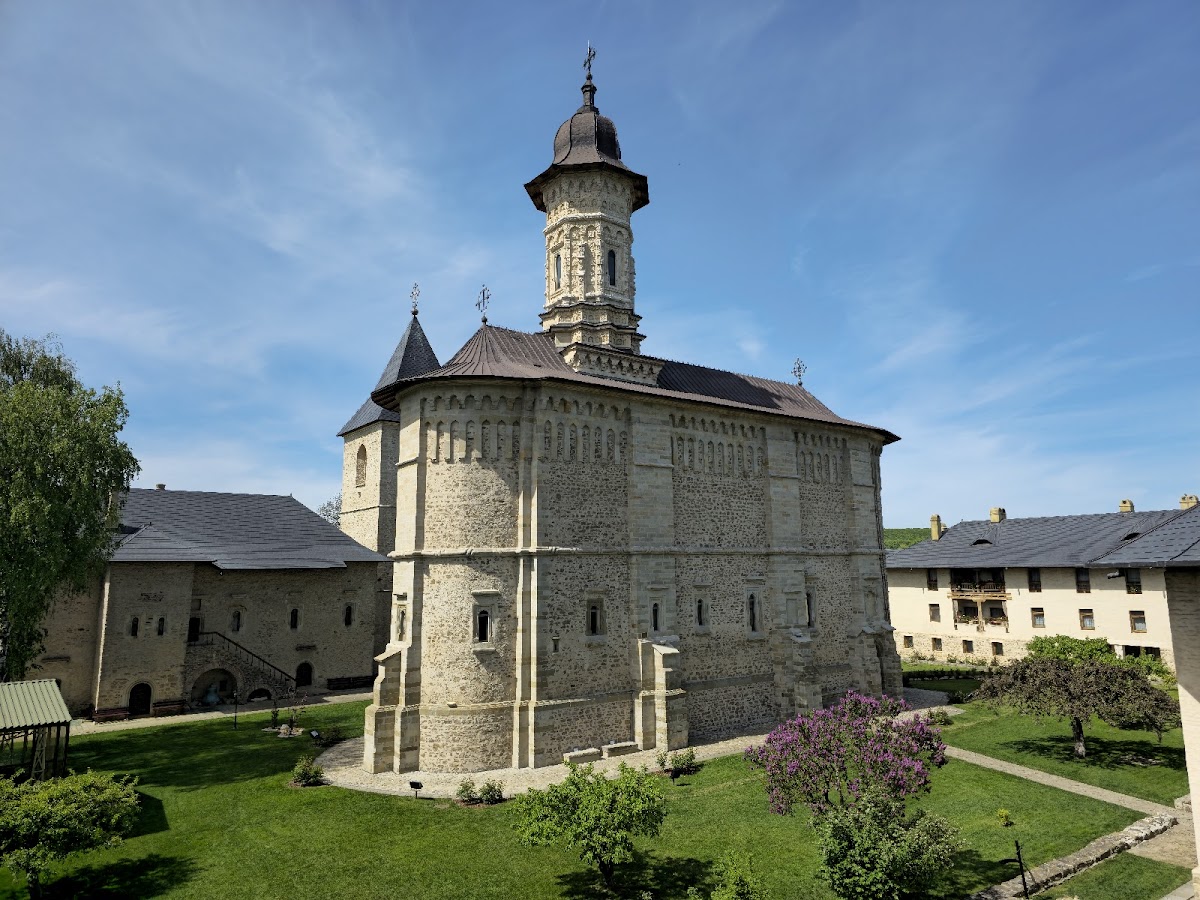
Dragomirna Monastery lies beside the Dragomirna forest in Mitocu Dragomirnei commune, about 12 km north of the city of Suceava. The land belonged to the scribe Ilie Crimcovici, the future Metropolitan Anastasie Crimca, who had received the deserted site of Ungurașii from Prince Petru Șchiopul in 1587, where a wooden skete already stood. In 1602 Anastasie Crimca, former bishop of Rădăuți, together with the grand chancellor Lupu Stroici and his brother, the grand treasurer Simion Stroici, built the small church of Saints Enoch, Elijah and John the Theologian, now the cemetery church (Dragomirna Mică). Having become Metropolitan of Moldavia, Crimca built the large church of the Descent of the Holy Spirit, completed in 1609. The church has no dedicatory inscription; the date comes from a note in a Gospel book of 1609.
The large church is narrow and very tall: about 35 m long, 9.5 m wide and 42 m high. Its stone facades are divided horizontally by a cable moulding of three twisted strands, and the tower, octagonal on the outside, carries rich carved decoration with geometric and plant motifs. The door and window frames are Gothic in style. The seventeenth-century painting, preserved only in the nave, sanctuary and tower, is signed by the painters Father Crăciun Mătieș, Father Ignat and Gligorie and was restored after 2010. The gilded wooden iconostasis of 1613 was brought around 1793 from the former Solca Monastery.
In 1627 Prince Miron Barnovschi-Movilă surrounded the monastery with high walls, with four defensive towers at the corners and a bell tower on the south side bearing the inscription. Anastasie Crimca died in 1629 and was buried in the narthex under an uninscribed slab. The monastery was plundered by the Cossacks of Tymofiy Khmelnytsky in 1653 and by the Tatars in 1658. From 1763 to 1775 its abbot was Paisius Velichkovsky, who then moved with his community to Secu and Neamț. Dragomirna was one of the three Orthodox monasteries the Austrians kept in Bukovina after 1783, and it has been a convent of nuns since 1960.
The Gothic Hall houses a collection of manuscripts, embroidery, liturgical silver and icons, including the Gospel book written and illuminated by Anastasie Crimca in 1609, two embroidered epitaphioi given by the founder (1612 and 1626), a yew-wood cross mounted in silver (1624) and the crystal chandelier given in 1767 by Empress Catherine II. The complex is a class A historic monument (LMI code SV-II-a-A-05577) and comprises the large church, the chapel of St Nicholas, the abbot's house, the refectory and the enclosure wall; the Dragomirna Mică church has a separate code (SV-II-m-A-05576).
Sat Dragomirna, comuna Mitocu Dragomirnei, județul Suceava