
Attraction
Cârța Cistercian Monastery
Cârța Monastery is a former Cistercian abbey in the village of Cârța, in the Făgăraș Land, on the left bank of the Olt, founded between 1202 and 1206 by monks from Igriș Abbey. It was the easternmost Cistercian abbey and played an important part in spreading Gothic art in Transylvania. The nave of the church is in ruins, while the choir and transept are used as a church by the Lutheran community.
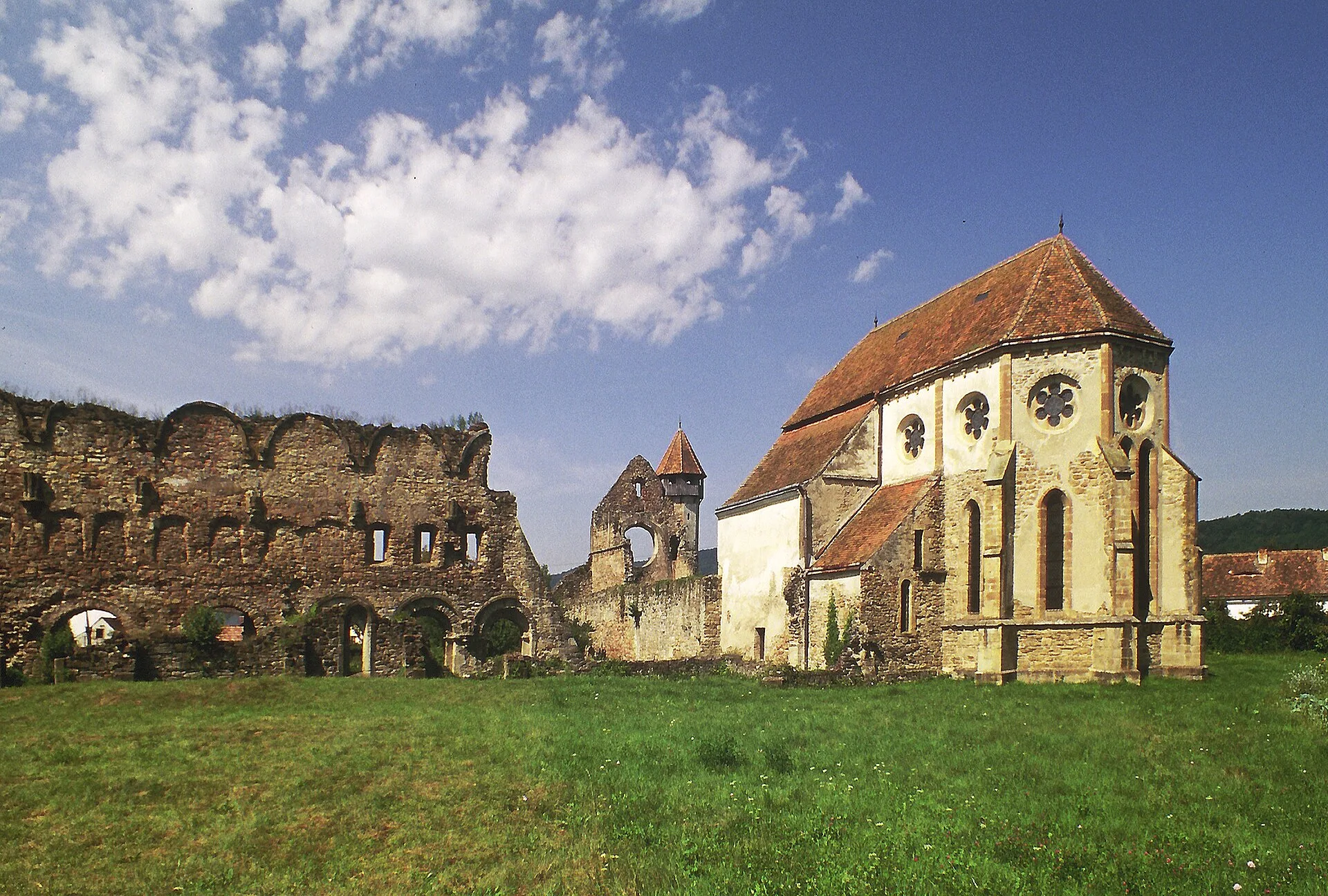
Foto: Otto Schemmel, CC BY-SA 2.0 DE, via Wikimedia Commons
Cârța Monastery (Latin: monasterium beatae Mariae virginis in Candelis de Kerch) stands in the village of Cârța, seat of the commune of the same name in Sibiu County, in the Făgăraș Land on the left bank of the Olt, about 3 km from the Sibiu-Brașov national road. The abbey was founded by Cistercian monks from Igriș Abbey in the Banat plain, itself a daughter house of Pontigny Abbey in France. The foundation falls between 1202 and 1206: a royal charter of 1223 describes the abbey's territory, between the Olt, the Arpaș, the Cârțișoara and the Făgăraș Mountains, and in 1206 the first abbot of Cârța is recorded at the General Chapter of the order at Cîteaux.
The first buildings were of wood, and around 1210-1215 a small stone chapel was built, whose foundations were uncovered in 1927 by the archaeologist Victor Roth. Stone construction of the monastery began in the 1220s or 1230s and proceeded in two phases separated by the Mongol invasion of 1241: the first in late Romanesque style, the second resumed in 1260 under an architect trained in mature Gothic. By about 1300 the church and the east wing were finished. The Cârța workshop helped spread Gothic art in Transylvania, and its influence can be seen in churches at Sebeș, Prejmer, Hărman and Cristian.
The abbey owned several villages and founded settlements populated by Saxons, among them Cârța and Apoș. King Matthias Corvinus dissolved the monastery on 27 February 1474, and its property passed to the Provostship of Sibiu.
Of the church, a basilica with a nave, two aisles and a transept, the west façade and the walls of the nave survive in ruins, while the choir and transept are used as a church by the Lutheran community. Of the monastic buildings, the east wall survives, with round-arched windows and a twin window. The complex is a class A historic monument (LMI code SB-II-a-A-12348), comprising the Lutheran church, the west façade of the former abbey church and the cloister, partly preserved in the substructure of the Lutheran parish house. In the churchyard there is a plot for German soldiers of the First World War, laid out in 1926.
Satul Cârța, comuna Cârța, județul Sibiu