
Attraction
Ciolanu Monastery
Ciolanu Monastery, in Tisău commune, about 33-35 km from the city of Buzău, is documented since the 16th century and is one of the oldest monastic complexes in Buzău County. The complex includes two churches — the Old Church, dedicated to Saint George (1590), and the Great Church, dedicated to Saints Peter and Paul (1828) — monastic cells, and a museum holding religious objects, manuscripts, and church embroidery. Its value lies in over four centuries of historical continuity and its preserved artistic heritage.
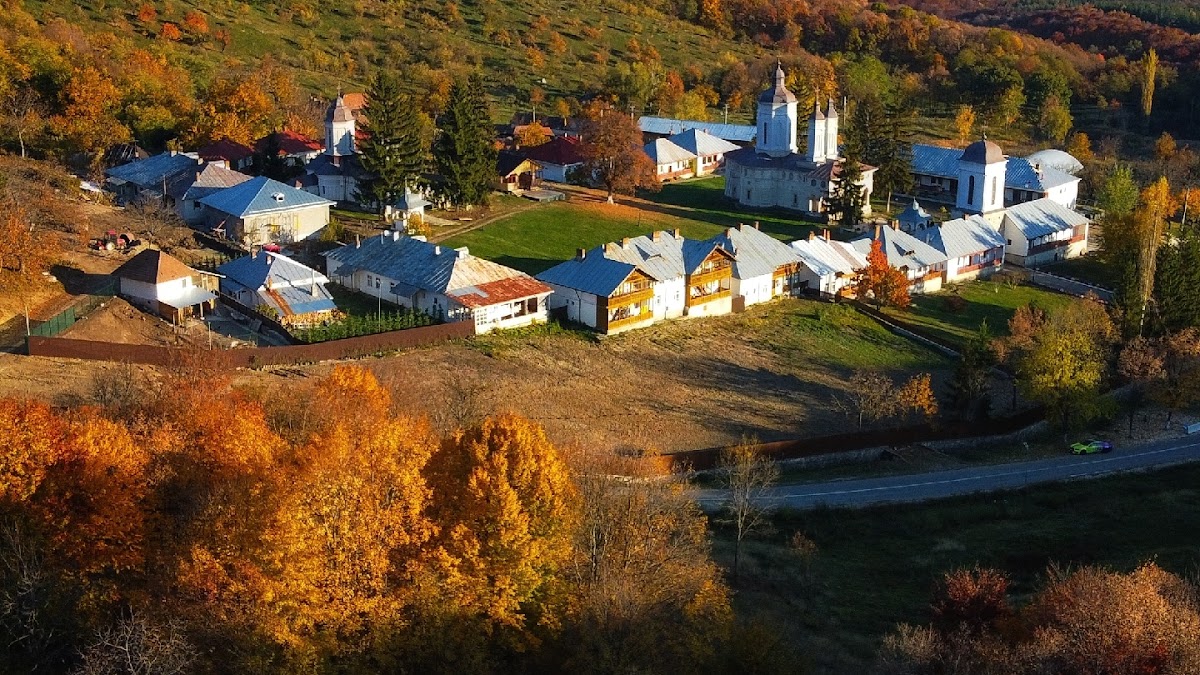
Ciolanu Monastery is an Orthodox monastic complex located in Tisău commune, Buzău County, at the foot of the Buzău Mountains, at an altitude of about 400 m. The monastery's earliest reliable documentary record dates from 15 January 1600 (some sources cite 1615), mentioning monks and abbot Vasilie. Tradition credits its founding to Princess Neaga, wife of ruler Mihnea II the Turned, said to have built a church here between 1586 and 1589, while other documents point to boyars Dumitru Ciolanu of Transylvania and Radu and Dragomir Sorescu of Vernești as the first founders, in 1568 — possibly the origin of the "Ciolanu" name.
The monastery has two churches, about a hundred meters apart. The Old Church, dedicated to Saint George, was founded by Princess Neaga and consecrated, according to an 1857 inscription, in 1590. The Great Church, dedicated to Saints Peter and Paul, was built between 1823 and 1828, through the efforts of Bishop Chesarie of Buzău, considered a second founder of the establishment. Both churches were painted by Nicolae Teodorescu Pitarul, head of Buzău's school of church painting, and the monastery also holds several icons signed by his nephew, Gheorghe Tattarescu, a pioneer of Neoclassicism in Romanian painting — the painter is buried, along with his family, in the monastery's cemetery.
The monastery went through a period of abandonment, being re-established in 1763 (or 1766) by Elder Vasile of Poiana Mărului, who brought 12 monks from Moldavia and Wallachia; since then, monastic life at Ciolanu has never ceased. The complex was damaged by a major fire in 1855, which destroyed the refectory, bell tower, and bishop's residences, and was rebuilt in 1862 with support from Bishop Filotei of Buzău. Around 1830, relics of several saints — George, Mercurius, Panteleimon, Haralambos, Tryphon, Euthymius, Ignatius, Acacius, Neophytos, and Paraskeva — were brought from Greece to Ciolanu and are kept in a reliquary in the Great Church.
The monastery's museum holds religious objects, church vestments, 18th-19th century icons (including about 100 wooden icons from the 19th century), and around 40 manuscripts from the 16th-17th centuries, including the first printed works of the Diocese of Buzău. Local legend tells that in 1867, King Carol I visited the area looking for a suitable site to build a royal castle; his horse broke its leg right at the monastery gate, taken as a bad omen, which led him to choose Sinaia instead, where Peleș Castle was later built.
The monastery now operates as a monastery of monks, under the jurisdiction of the Archdiocese of Buzău and Vrancea. The famous Măgura Sculpture Camp, with 256 stone works created between 1970 and 1985, stands right on the monastery's grounds. It is reached from the city of Buzău via county road DJ100H toward Tisău, then DJ203G, for a total distance of about 33-35 km. Ciolanu Monastery is worth visiting for its historical value, documented over more than four centuries, its artistic heritage preserved in the museum, and its architecture representative of the Wallachian monastic style.
Tisau judetul Buzau