
Attraction
Brebu Monastery
Brebu Monastery, in the village of Brebu Mânăstirei, Brebu commune, is one of the main foundations of Prince Matei Basarab and a class A historic monument. The seventeenth-century complex comprises the church of the Holy Archangels Michael and Gabriel, the Princely House (now a museum), the bell tower and the enclosure wall, and since 2012 it has again been a convent of nuns.
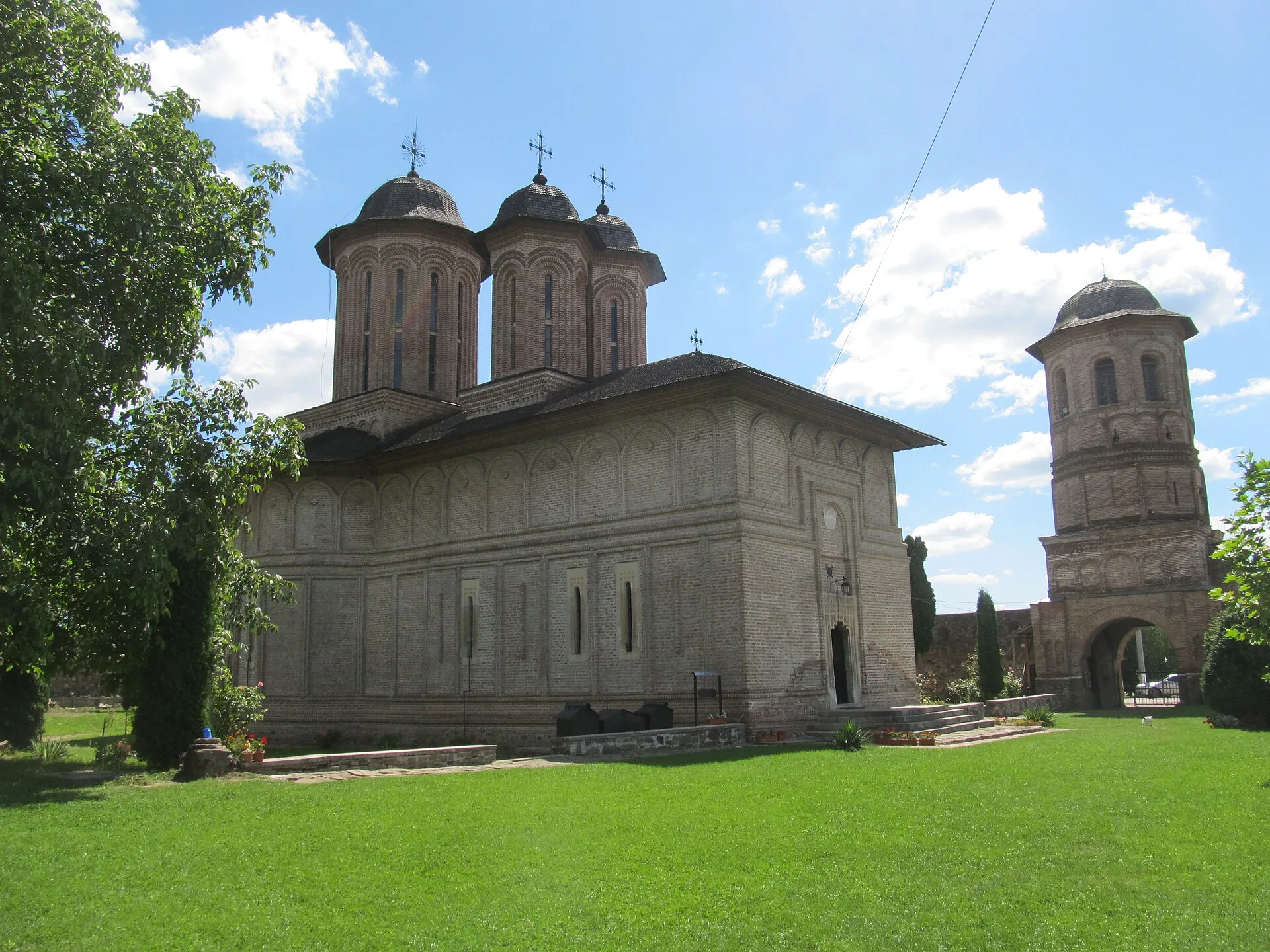
Foto: Nenea hartia, CC BY-SA 4.0, via Wikimedia Commons
Brebu Monastery lies in the village of Brebu Mânăstirei, Brebu commune, Prahova County, on a plateau on the left bank of the Doftana, north-east of Câmpina, in a sub-Carpathian basin at the foot of the Baiu and Grohotiș mountains. Designed as both a monastery and a princely court, the complex comprises the church, the Princely House, the entrance bell tower, an irregular octagonal enclosure wall with loopholes, and the traces of the vanished monks' cells, marked during the restoration completed in 1963. It is a class A historic monument (LMI code PH-II-a-A-16375).
A charter of Matei Basarab dated 27 November 1640 and one of the Patriarchate of Constantinople from April 1641 already refer to the monastery as raised „from its foundations” by the prince. The inscription in the narthex, however, states that building began on 27 June 1650, a discrepancy some researchers explain by assuming that the work was finished, not begun, in 1650. At Matei Basarab's death the finishing work and the painting were incomplete; Constantin Brâncoveanu confirmed the monastery's privileges by charters of 1689 and 1690 and exempted 52 villagers from taxes so that the work and the painting, now preserved only in fragments, could be completed. In 1752 Grigore II Ghica placed the monastery's administration under the trustees of St Pantelimon Hospital in Bucharest.
The earthquakes of 1802 and 1838 brought down the towers and damaged the walls and the bell tower, and the fire of 1 December 1855 destroyed the cells and the library of Archimandrite Ghenadie Pârvulescu. After the secularisation of monastic estates in 1863 the monastery was dissolved and the church became a parish church. Restorations followed in 1843 under Gheorghe Bibescu, in 1930, and in 1939, when the wooden towers and the nineteenth-century porch were removed, then the campaign of 1955-1960, when the stone towers were rebuilt. After a fire on 23 April 1961, the restoration completed in 1963 returned the complex to its seventeenth-century appearance.
The church, 30 by 10 metres, has a triconch plan with a tower over the nave and two smaller ones over the narthex, thick walls of brick and stone, and exterior decoration of two rows of niches and a cornice band; the stone door and window frames, carved by the craftsman Lupu, follow late Moldavian Gothic models. The painting of the iconostasis and the altar was redone by Sava Henția in 1901-1902. Since 2012 the complex has again been a convent of nuns. The Princely House holds the „Casa Domnească” Museum, a branch of the Prahova County Museum of History and Archaeology, with a display of seventeenth- and eighteenth-century history and art: icons, vestments, boyar costumes and old books such as „Pravila de la Govora” (1640), „Îndreptarea Legii” (1652) and the Bucharest Bible (1688).
Aleea Casa Domnească, sat Brebu Mânăstirei, comuna Brebu, județul Prahova