
Attraction
Bradu Monastery
Bradu Monastery, also known as "Lady Neaga's Fortress," is a fortified monastery in Haleș village, Tisău commune, Buzău County, on the left bank of the Nișcov stream. Archaeological research confirms monastic life on the site as early as the mid-14th century, while the enclosure walls with their defensive towers were raised in 1640 by Radu Cândescu. Constantin Brâncoveanu took refuge here three times and ordered the building of the Princely House. Closed by the 1863 secularization law, the monastery reopened in October 2023, after 160 years.
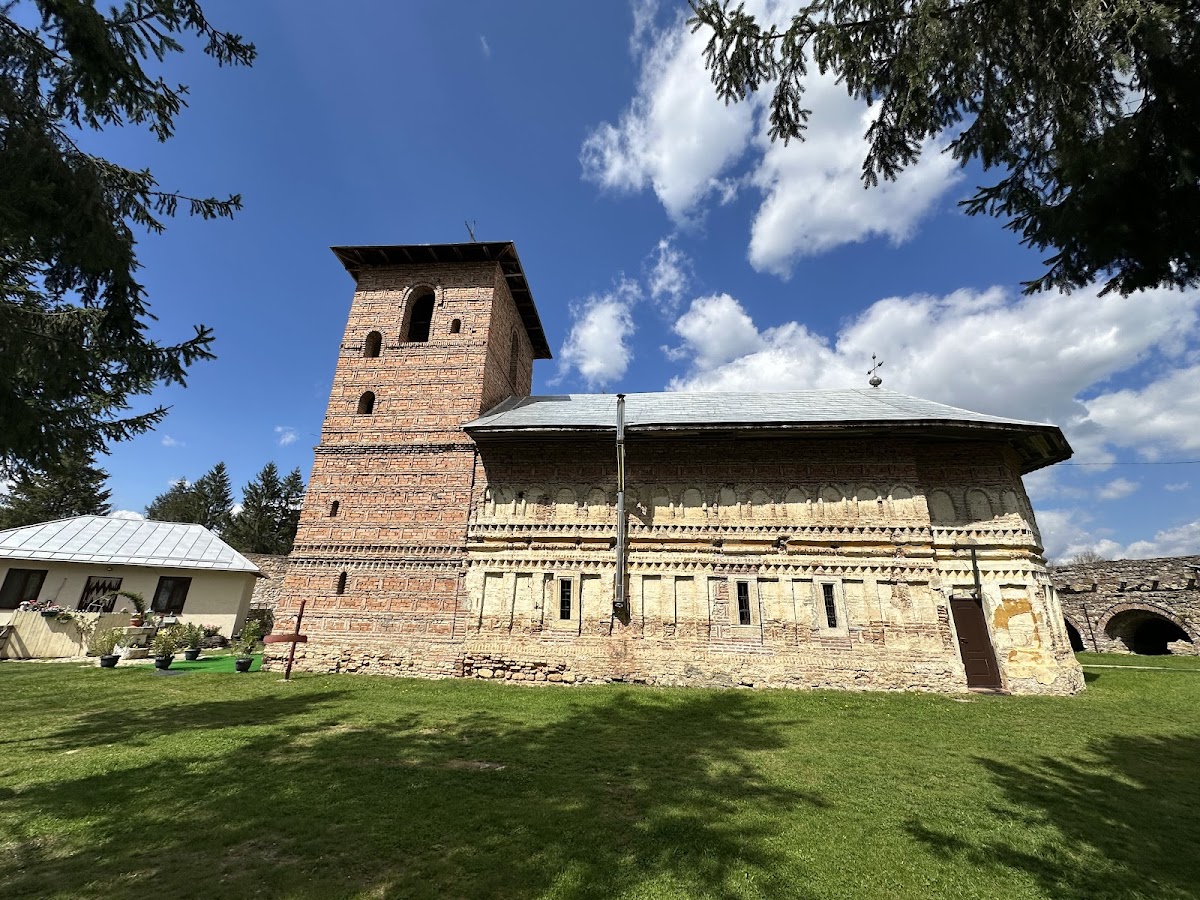
Bradu Monastery lies in the village of Haleș, Tisău commune, Buzău County, on the left bank of the Nișcov stream, in the county's Subcarpathian zone. It is also known as Bradu Fortress-Monastery, Lady Neaga's Fortress, or Lady Neaga's Monastery, and is listed as a historic monument under code BZ-II-a-A-02407. It belongs to the Archdiocese of Buzău and Vrancea, and its patronal feast is Saint Demetrius the Myrrh-Streamer, celebrated on 26 October.
The first documentary mention dates from 15 January 1600, but archaeological research has established monastic life on the site as early as the mid-14th century. The present church was built during the 16th century, founded by the Cândești boyar family, to which Buzău County Council sources add the Pătârlăgeni family. Lady Neaga, wife of ruler Mihnea Turcitul, rebuilt the complex, hence the site's second name.
What sets Bradu apart from other Buzău monasteries is its character as a stronghold. In 1640, Radu Cândescu built the enclosure walls to protect the complex from Ottoman raids, and in 1641-1642 the bell tower and a range of monastic cells were added. The walls form a quadrilateral with sides of differing lengths, built of river boulders and brick, reinforced at intervals with buttresses. Each of the four corners once held a large tower with narrow windows, allowing a distant view and a line of fire; two of them survive today.
Constantin Brâncoveanu hid here three times, in 1703, 1708, and 1711, during periods when he was hunted by the Ottomans, and ordered the construction of the Princely House on the western side of the fortified enclosure. During the 1821 Revolution, the fortress sheltered local boyars and was attacked repeatedly by Greek insurgents. Its massive oak gates, clad in thick iron bands, still hold lead bullets fired during those assaults in their metal plating; the gates are now kept at the Buzău County Museum.
The complex comprises the enclosure walls, the corner defensive towers, the ruins of the old cells and living quarters, the Princely House, and the church. In the northern part of the courtyard stands a well made of carved stone rings, recorded in the 1842 parish register. In front of the entrance lay the fortress's second courtyard, once walled but now entirely gone, used as a garden and later as the site of the Pentecost fair and the patronal feast.
Following the 1863 secularization of monastic estates, the monastery ceased to function as a religious foundation. Its cells housed the village school between 1872 and 1910, and the town hall until 1905. On 26 October 2023, the feast of Saint Demetrius, Archbishop Ciprian of Buzău and Vrancea reopened the monastery after 160 years, installing Protosyncellus Eftimie Burghiu as abbot. The complex is currently undergoing consolidation and restoration.
Bradu Monastery is worth visiting for the rarity of its type in Wallachia: a fortress-monastery whose military enclosure survives in part, where defensive and religious architecture visibly coexist. It is also one of the few places where one can trace concretely how boyar refuges worked in times of crisis, from Brâncoveanu's hiding place to the Greek insurgent assaults of 1821.
Tisău, judetul Buzau