
Attraction
Agapia Monastery
Agapia Monastery is an Orthodox convent in Agapia commune, Neamț County, in the valley of the Agapia stream, about 9 km from Târgu Neamț. Its church of the Holy Archangels Michael and Gabriel was built in 1641-1643 by Hetman Gavriil Coci, brother of Prince Vasile Lupu, and its interior was painted by Nicolae Grigorescu in 1858-1861.
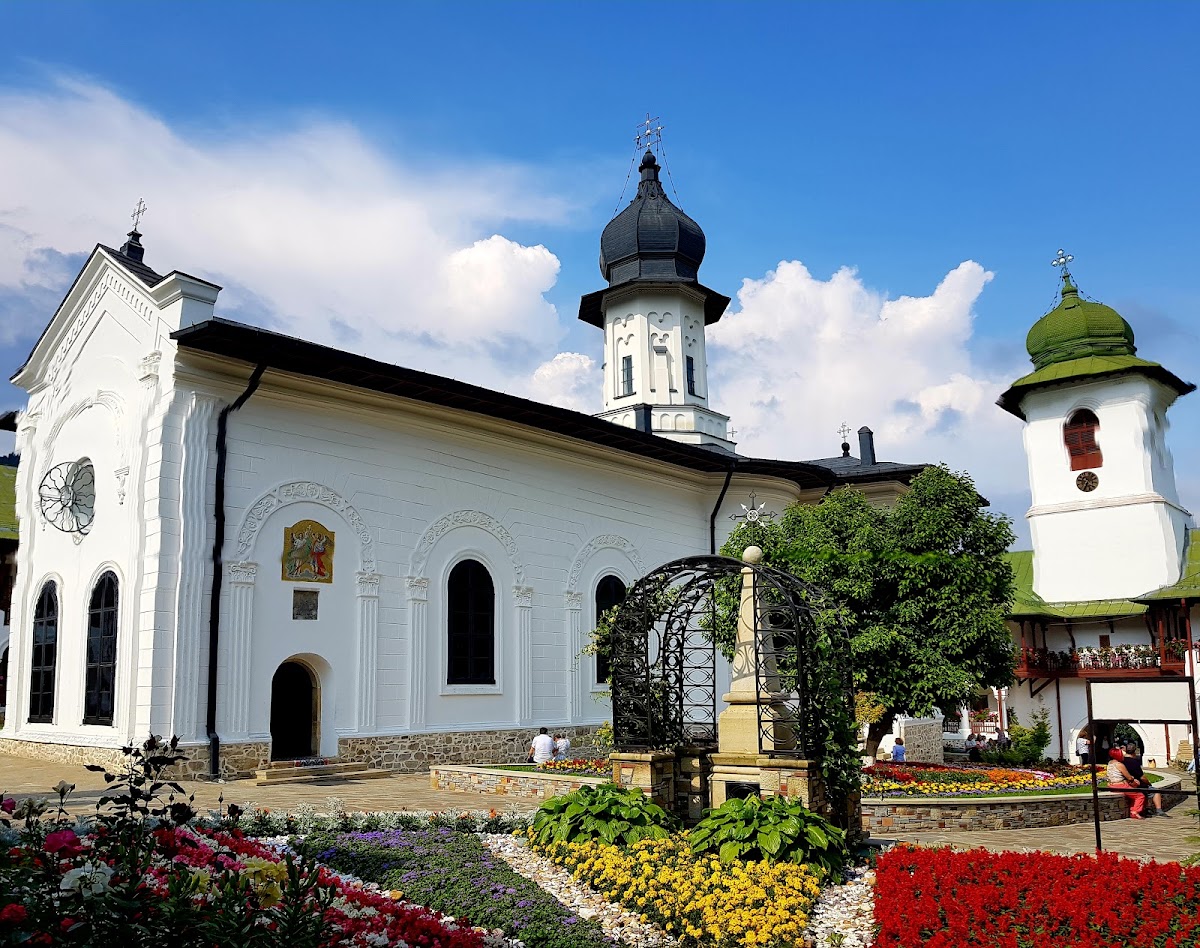
Agapia Monastery lies in the valley of the Agapia stream, about 9 km from Târgu Neamț, surrounded by the hills of Muncelu, Ciungi, Bogoslov and Dealul Crucii. The name comes from the hermit Agapie, who lived in the clearing where Agapia Veche Skete now stands, higher up the hill. Because that site was hard to reach, at the beginning of the seventeenth century some monks moved down into the valley and built a wooden church. The founder of the present monastery is Hetman Gavriil Coci, brother of Vasile Lupu, together with his wife Liliana. According to the Slavonic inscription on the south side, construction of the church of the Holy Archangels Michael and Gabriel began on 16 October 1641 and was completed on 3 September 1643, to plans by the architect Enache Ctisi of Constantinople, and the church was consecrated on 12 September 1646 by Metropolitan Varlaam in the presence of the prince.
The monastery was damaged and plundered by Turks and Tatars in 1671-1672 and 1674-1675 and by Polish troops in 1680 and 1689-1693. Until 1803 it was a monastery of monks. That year Metropolitan Veniamin Costachi moved the roughly 50 nuns of Socola Monastery in Iași here, and by a charter of Prince Alexandru Moruzi Agapia became a convent, with a school for nuns; the first abbess was Elisabeta Costachi, the metropolitan's sister. On 16 September 1821 the complex was set on fire by the Turks, and it was repaired in 1823. Another fire, in July 1903, destroyed the cells around the courtyard, the bell tower and the church roof.
Between 1858 and 1862, under Abbess Tavefta Ursache, the church was enlarged and given its present neoclassical facade. The abbess brought in Nicolae Grigorescu, then 20 years old, who painted the interior and the iconostasis icons between 1858 and 1861 under a contract signed on 2 April 1858. The church was reconsecrated on 25 January 1862 by Bishop Calinic Miclescu. The painting, blackened by smoke from the 1903 fire, was cleaned in 1928 and in 1970, and between 1995 and 2009 the complex underwent a full restoration. A niche in the former porch, now part of the narthex, holds the tomb of the founders Gavriil Coci and Liliana and their daughter Safta, where the remains of Abbess Elisabeta Costachi were later also placed.
The Agapia Monastery complex is a class A historic monument (LMI code NT-II-a-A-10627). It includes the church of the Holy Archangels, the chapel of the Nativity of the Mother of God on the south side of the courtyard, the 1823 bell tower, the wooden church of St John the Theologian in the cemetery (1821), the wooden infirmary church of the Dormition (1780) and the monastic houses around the enclosure. Also here are the Alexandru Vlahuță Memorial House (1885, LMI code NT-II-m-B-10628) and the St Paraskeva Monastic Theological Seminary. The monastery museum holds embroidery, carpets, manuscripts, old books and liturgical objects. The community numbers several hundred nuns, and the patronal feast is celebrated on 8 November.
Comuna Agapia, județul Neamț