
Attraction
Lake Techirghiol
Lake Techirghiol is Romania's largest saltwater lake, a fluvio-marine liman of roughly 10.68 km², lying on the edge of the Eforie Nord resort. Cut off from the sea by a sand bar some 200 metres wide, its waters turned hypersaline through evaporation, exceeding 90 g/l, nearly five times the Black Sea. Only a few adapted species live here, chief among them the brine shrimp Artemia salina and the alga Cladophora cristalina, from whose decomposition the therapeutic sapropelic mud forms. Because of its high mineral content, the water can drop below 0°C without freezing.
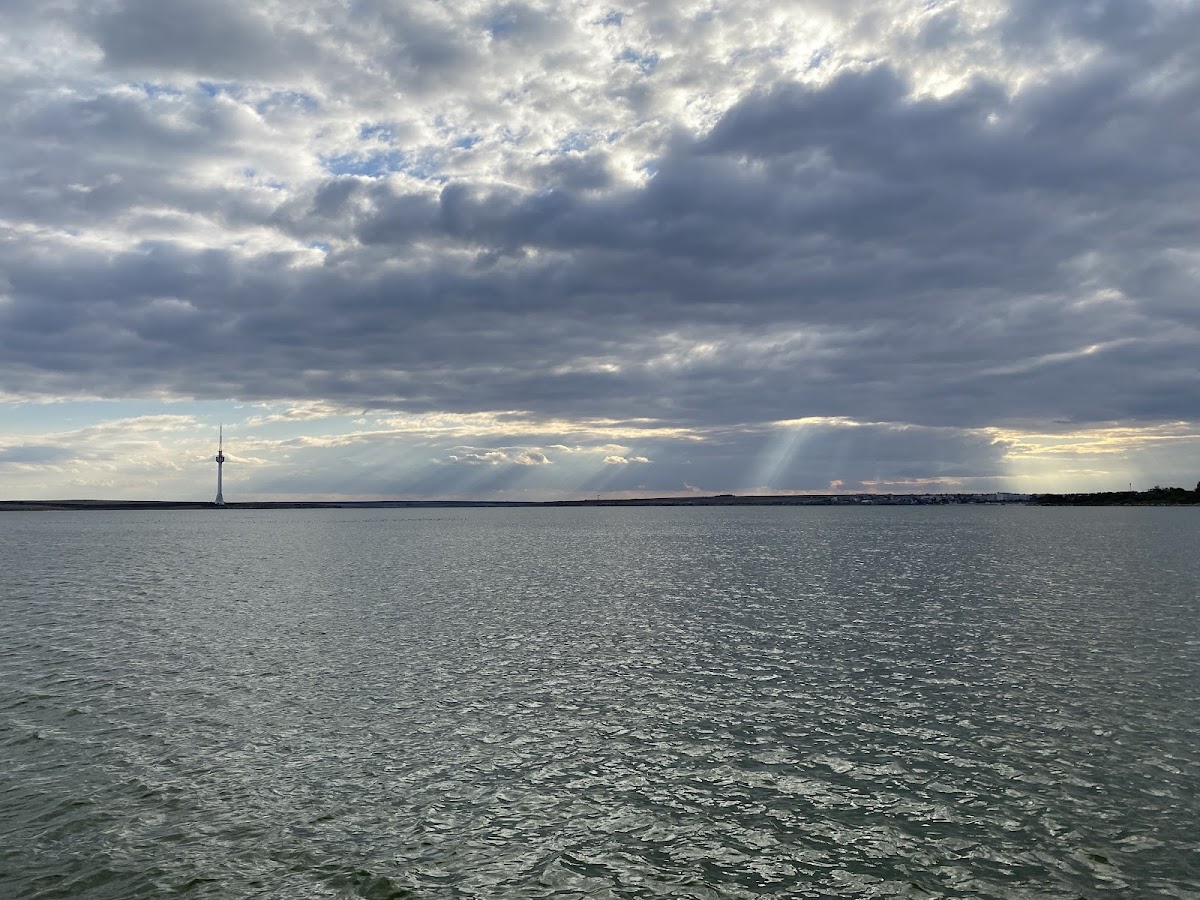
Lake Techirghiol lies on the Black Sea shore in Constanța County, on the edge of the Eforie Nord resort, between the towns of Techirghiol, Eforie Nord, and Eforie Sud, about 12 kilometres from the port of Constanța. Its name comes from the Turkish Tekirgöl, rendered either as "Tekir's lake" or "the lake of the red mullet," after the fish Mullus barbatus. It is Romania's largest saltwater lake.
It covers roughly 10.68 km², runs 7,500 metres long, and reaches a maximum depth of nine metres. Geologically it is a fluvio-marine liman: the basin passed through phases of connection with the sea, functioning as a marine gulf, until the formation of a coastal sand bar some two hundred metres wide cut it off. Once isolated, in Dobruja's subarid climate, strong evaporation lowered the water level and concentrated the salts beyond marine values. The low inflow of fresh water sustained the process.
Salinity today exceeds 90 g/l, holding a practically uniform value of 85.5 parts per thousand across the central section, both horizontally and vertically down to three metres. That is nearly five times the Black Sea. The figures have swung considerably over time: 71.4 g/l measured in 1893, 106.9 g/l in 1924, 81.5 g/l in 1969. After 1975, irrigation through the Carasu canal increased water inflow and lowered the concentration. The water is chloride-sodic, magnesian, sulphated, iodinated, and brominated, with a mean density of 1.065 to 1.070 g/l. Because of its high mineral content, its temperature can fall below zero without the lake freezing.
These extreme conditions make Techirghiol a rarity in southeastern Europe. Only a small number of species have managed to adapt to the hypersalinity and high osmotic pressure. The invertebrate fauna is dominated by the brine shrimp Artemia salina, a branchiopod of five to ten millimetres, the lake's most important filter feeder, which produces three generations a year here: April-May, June, and August-September. Alongside it lives the filamentous alga Cladophora cristalina. From the bacterial decomposition of dead Artemia together with the alga, sapropelic mud forms, a process unfolding over hundreds of years. The mud's black colour comes from iron sulphide, formed from the iron in the lake's banks.
The mud and salt water have been used therapeutically since the 19th century, in treating rheumatic, dermatological, neurological, and gynaecological conditions. The lake drew leading researchers early on, among them the engineer Anghel Saligny, who took measurements in 1893, M. Georgescu in 1900, P. Petrescu in 1924, and P. Bujor in 1928.
The lake is not uniform. The area known as "the lake's tail," where the most abundant freshwater springs rise, was cut off by a dyke from the rest of the basin, precisely to prevent dilution of the salt water. Techirghiol therefore now holds a freshwater sector too, with a wholly different ecosystem. The wetland shelters birds, among them the white-headed duck (Oxyura leucocephala), a rare and endangered species.
On the western shore lies the Techirghiol resort, specialized in mud and salt-water treatment, and on the opposite shore, Eforie Nord.
Lake Techirghiol is worth visiting for something simple and rare: it is a natural laboratory in which, from just two species able to survive in hypersaline water, a therapeutic sediment forms over hundreds of years, one that modern medicine still uses. Few places in Europe offer so direct a link between biology, geology, and medicine, visible to the naked eye on the shore of a lake that never freezes.
Techirghiol judetul Constanta