
Attraction
Emerald Lake and Racoș Extinct Volcano
The Emerald Lake in Racoș, Brașov County, is a lake formed in a former basalt quarry (the Brazi quarry), its intense green colour coming from the basaltic rock and the algae on its bed. It is part of the Racoș Geological Complex, alongside the Racoș Extinct Volcano — the most recently active volcano on Romanian territory — and spectacular basalt columns. Swimming in the lake is forbidden, as the area is protected.
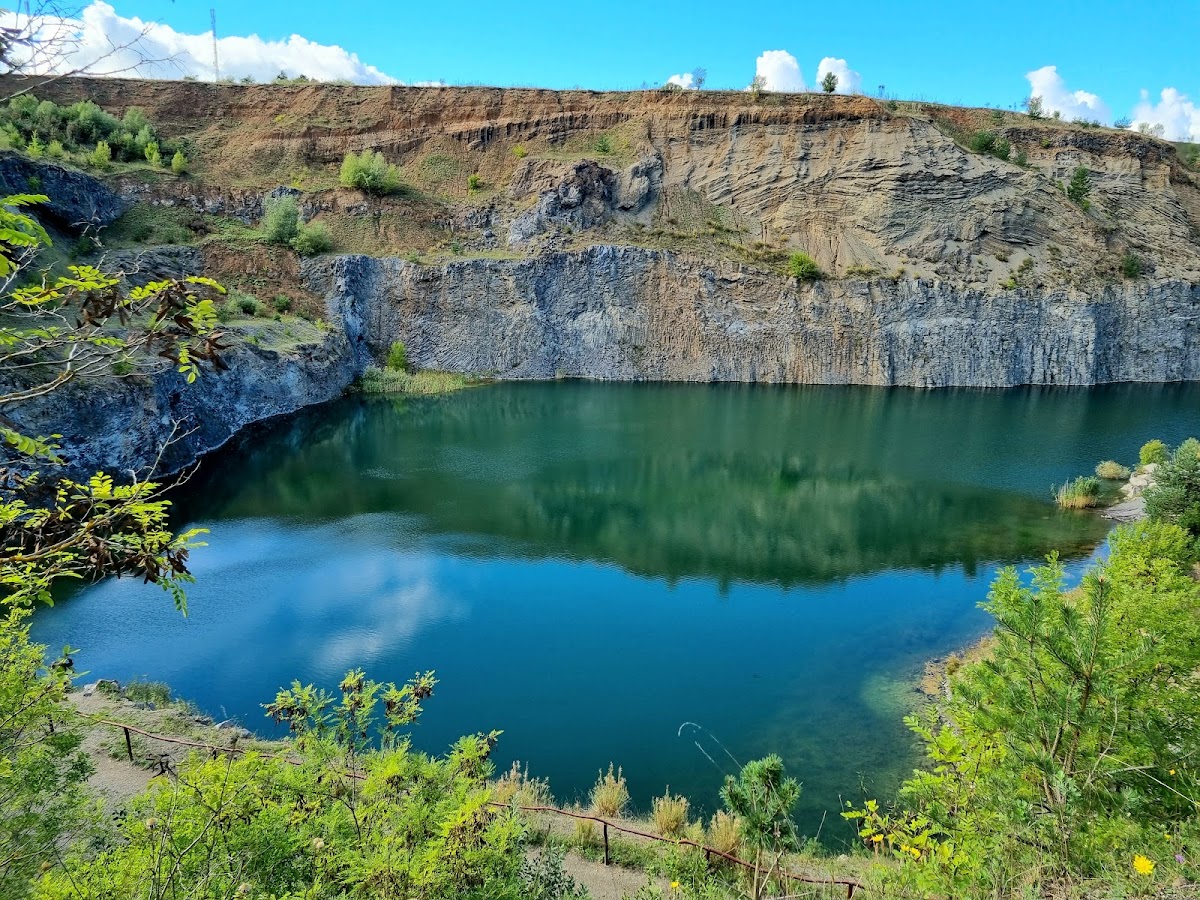
The Emerald Lake (Brazi Lake) is an artificial lake formed inside a former basalt quarry, near the village of Racoș, Brașov County, part of the Racoș Geological Complex — a nature reserve of about 95 hectares, in the Perșani Mountains. The quarry, once worked for basalt, gradually filled with water from rainfall, snowmelt and bottom springs, creating a lake about 20 m deep, whose emerald-green colour shifts with the light and the season.
A short distance away lies the Racoș Extinct Volcano, an effusive-type volcanic cone with a crater up to about 100 m high and nearly 400 m in diameter. It is considered the most recently active volcano in Romania, its first eruptions dating back about 1.3–1.4 million years. Its walls — in shades of red, yellow, grey and black, made of scoria, ash and solidified lava — create a lunar, almost Martian landscape. From the resulting porous rock — pumice — local people built their houses, and even the village castle.
The complex also features basalt columns, formed by the slow cooling of lava, 12–15 m high with regular hexagonal sections — a phenomenon comparable to the Detunata formations in the Apuseni Mountains or to those in Iceland, Scotland and Ireland. The area thus brings together, within a small perimeter, a lake in a basalt quarry, an extinct volcano and basalt columns — a concentration of geological phenomena rare in Romania. Nearby, in the centre of the village, stands the Sükösd-Bethlen Castle, a 17th-century fortified manor.
Satul Racoș județul Brașov