
Attraction
Coșul Boului Grotto
Coșul Boului Grotto is a karst formation within the Șesul Craiului–Scărița-Belioara geo-botanical reserve, in the Muntele Mare massif, Alba County. Its entrance portal rises roughly 60 metres, and the collapsed ceiling opens the grotto to the sky, making it striking even from a distance. It lies along the Scărița-Belioara hiking circuit, though the spur leading directly to it is unmarked and steep.
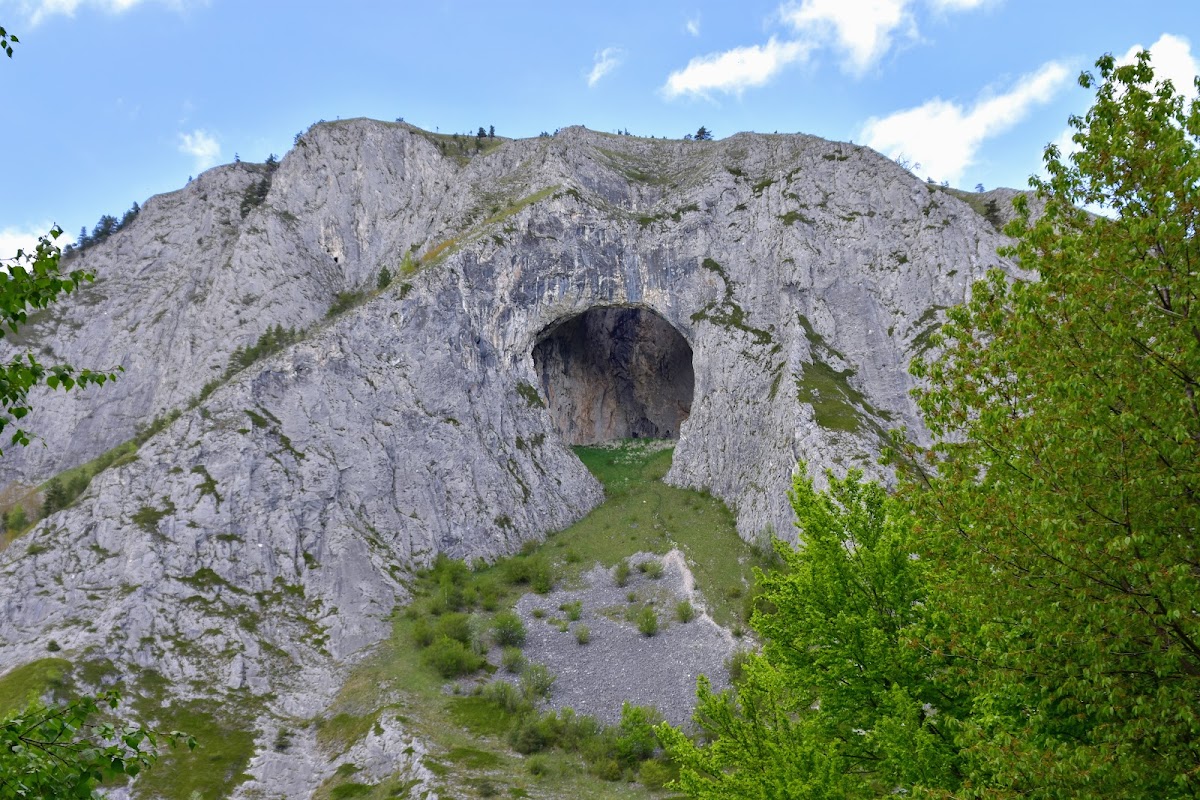
Coșul Boului Grotto is the most striking karst feature of the Șesul Craiului–Scărița-Belioara geo-botanical reserve, set in the Muntele Mare massif of the Apuseni Mountains, on the territory of Poșaga and Ocoliș communes in Alba County. The grotto opens in the limestone escarpment that guards the headwaters of the Belioara Valley, a tributary of the Poșaga Valley.
What sets Coșul Boului apart from the reserve's other caves is its portal: an opening roughly 60 metres high, with a collapsed ceiling that lets light and vegetation reach into the cavity. Grass grows right up to the mouth, and from the entrance the view opens toward the peaks of the Trascău Mountains. Experienced climbers with proper equipment can abseil down through the collapsed ceiling.
The reserve covers 47.7 hectares and includes the Șesul Craiului limestone plateau at over 1,350 m altitude, the forest of Mount Scărița, and dramatic escarpments with vertical walls, pinnacles, ledges, and sharp ridges. The relief features spire-shaped summits such as Colțul Bleantului, Piatra Belii, and Vârful Negrilii, along with a cave system that includes, besides Coșul Boului, the Bottomless Cave, the Red Cave, the Long Cave, the Monk's Cave, Filip's Cave, and the Round Rock Cave.
The reserve's value is primarily botanical. It shelters rare species, some unique in Europe: Nigritella rubra, Dryas octopetala, Adonis, columbine, gentian, and the chequered lily. Distinctive to the massif are the endemic species known locally as barba mugurului and mălăoaie, alongside bearberry (Arctostaphylos uva-ursi), a glacial relict that reached here from the Balkan Peninsula. The initiative to protect the area came from botanist Alexandru Borza, as early as the 1920s.
The grotto lies along the Scărița-Belioara circuit, marked with a red dot: roughly 10 km with about 700-900 m of elevation gain, taking five to eight hours. On the plateau, the circuit crosses the "Nature in Colours" interpretive trail, six information panels spread over 1.2 km explaining the area's flora, fauna, and geology. Note that the spur leading to Coșul Boului is unmarked: the path climbs steeply and directly across scree, and many hikers choose to admire the grotto from a distance, from the meadows along the main trail, where it is clearly visible.
The reserve has been damaged by fire, once in 2007 and again in April 2020, when more than 10 hectares of forest burned; the traces are still visible along the route. Coșul Boului is worth visiting for the unusual scale of its portal, rare in Romanian karst, for the contrast between the open Șesul Craiului plateau and the cliffs below it, and for the botanical context of a reserve protected for a century.
Sat Poșaga de Sus, comuna Poșaga, județul Alba